

152
S. Nautiyal et al.
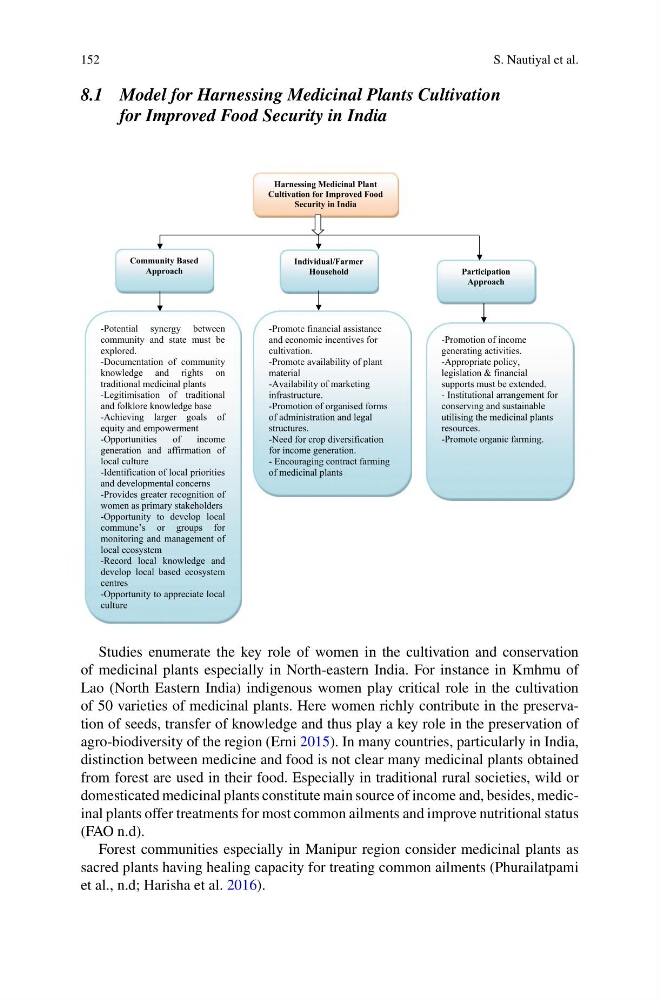
8.1 Model for Harnessing Medicinal Plants Cultivation
for Improved Food Security in India
Harnessing Medicinal Plant
Cultivation for Improved Food
Security in India
Community Based
Approach
Individual/Farmer
Household
Participation
Approach
-Promote financial assistance
and economic incentives for
cultivation.
-Promote availability of plant
material
-Availability of marketing
infrastructure.
-Promotion of organised forms
of administration and legal
structures.
-Need for crop diversification
for income generation.
- Encouraging contract farming
of medicinal plants
-Potential synergy between
community and state must be
explored.
-Documentation of community
knowledge and rights on
traditional medicinal plants
-Legitimisation of traditional
and folklore knowledge base
-Achieving larger goals of
equity and empowerment
-Opportunities
of
income
generation and affirmation of
local culture
-Identification of local priorities
and developmental concerns
-Provides greater recognition of
women as primary stakeholders
-Opportunity to develop local
commune’s or groups for
monitoring and management of
local ecosystem
-Record local knowledge and
develop local based ecosystem
centres
-Opportunity to appreciate local
culture
-Promotion of income
generating activities.
-Appropriate policy,
legislation & financial
supports must be extended.
- Institutional arrangement for
conserving and sustainable
utilising the medicinal plants
resources.
-Promote organic farming.
Studies enumerate the key role of women in the cultivation and conservation
of medicinal plants especially in North-eastern India. For instance in Kmhmu of
Lao (North Eastern India) indigenous women play critical role in the cultivation
of 50 varieties of medicinal plants. Here women richly contribute in the preservation of seeds, transfer of knowledge and thus play a key role in the preservation of
agro-biodiversity of the region (Erni 2015). In many countries, particularly in India,
distinction between medicine and food is not clear many medicinal plants obtained
from forest are used in their food. Especially in traditional rural societies, wild or
domesticated medicinal plants constitute main source of income and, besides, medicinal plants offer treatments for most common ailments and improve nutritional status
(FAO n.d).
Forest communities especially in Manipur region consider medicinal plants as
sacred plants having healing capacity for treating common ailments (Phurailatpami
et al., n.d; Harisha et al. 2016).
S. Nautiyal et al.
8.1 Model for Harnessing Medicinal Plants Cultivation
for Improved Food Security in India
Harnessing Medicinal Plant
Cultivation for Improved Food
Security in India
Community Based
Approach
Individual/Farmer
Household
Participation
Approach
-Promote financial assistance
and economic incentives for
cultivation.
-Promote availability of plant
material
-Availability of marketing
infrastructure.
-Promotion of organised forms
of administration and legal
structures.
-Need for crop diversification
for income generation.
- Encouraging contract farming
of medicinal plants
-Potential synergy between
community and state must be
explored.
-Documentation of community
knowledge and rights on
traditional medicinal plants
-Legitimisation of traditional
and folklore knowledge base
-Achieving larger goals of
equity and empowerment
-Opportunities
of
income
generation and affirmation of
local culture
-Identification of local priorities
and developmental concerns
-Provides greater recognition of
women as primary stakeholders
-Opportunity to develop local
commune’s or groups for
monitoring and management of
local ecosystem
-Record local knowledge and
develop local based ecosystem
centres
-Opportunity to appreciate local
culture
-Promotion of income
generating activities.
-Appropriate policy,
legislation & financial
supports must be extended.
- Institutional arrangement for
conserving and sustainable
utilising the medicinal plants
resources.
-Promote organic farming.
Studies enumerate the key role of women in the cultivation and conservation
of medicinal plants especially in North-eastern India. For instance in Kmhmu of
Lao (North Eastern India) indigenous women play critical role in the cultivation
of 50 varieties of medicinal plants. Here women richly contribute in the preservation of seeds, transfer of knowledge and thus play a key role in the preservation of
agro-biodiversity of the region (Erni 2015). In many countries, particularly in India,
distinction between medicine and food is not clear many medicinal plants obtained
from forest are used in their food. Especially in traditional rural societies, wild or
domesticated medicinal plants constitute main source of income and, besides, medicinal plants offer treatments for most common ailments and improve nutritional status
(FAO n.d).
Forest communities especially in Manipur region consider medicinal plants as
sacred plants having healing capacity for treating common ailments (Phurailatpami
et al., n.d; Harisha et al. 2016).