

140
S. Nautiyal et al.
Table 1 Medicinal plants in demand
AONLA
CHANDAN
KALMEGH
SATAVARI
ASWAHAGANDHA
CHIRATA
KATKI
SHANKAPUSHPI
ASHOKA
GILOE
KOKUM
SAFED MUSLI
ATIS
GUGGAL
KERTH
SENNA
BAIBERANG
INDIAN BARBERY
LIQORICE
BAEL
ISABGOL
LONG PEPPER
BRAHMI
JATAMANSI
MADHUNASHINI
Source http://www.indiahomeclub.com/botanical_garden/medicinal_plants_in_demand.html
Medicinal Plant Board Tripura has identified 266 species out which 12 varieties are
suitable for cultivation and income generation (Bhattacharjee 2015).
The study by Mishra and Kotwal (2011) clearly documents factors responsible
for success and failure in growing, processing marketing medicinal plants in Malwa
region of Central India. The study observes that though medicinal crop has increased
manifold yet there is scarcity of planting material, marketing and proper management
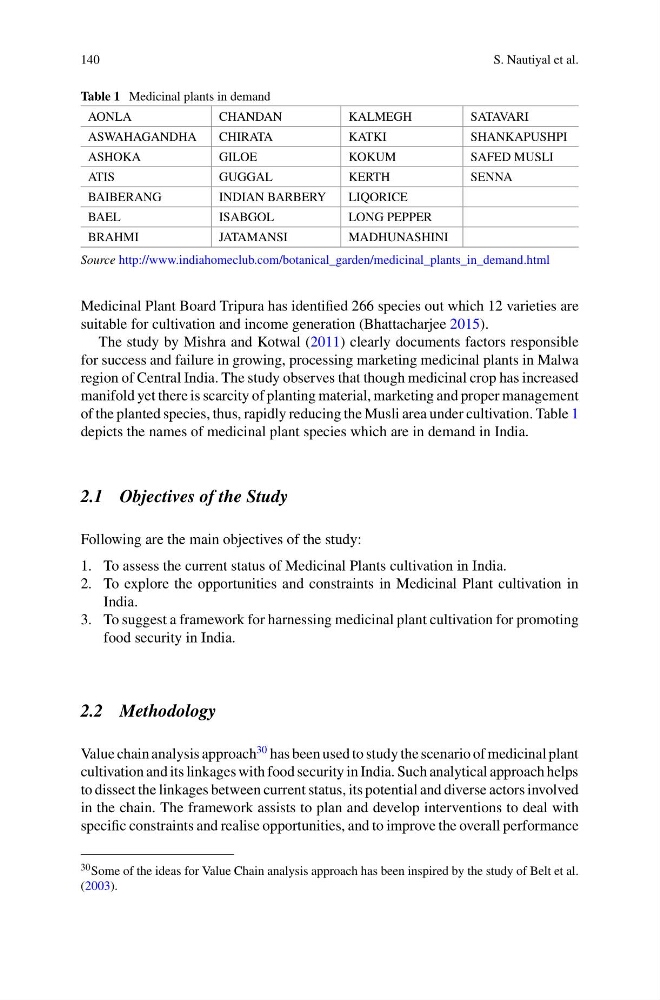
of the planted species, thus, rapidly reducing the Musli area under cultivation. Table 1
depicts the names of medicinal plant species which are in demand in India.
2.1 Objectives of the Study
Following are the main objectives of the study:
1. To assess the current status of Medicinal Plants cultivation in India.
2. To explore the opportunities and constraints in Medicinal Plant cultivation in
India.
3. To suggest a framework for harnessing medicinal plant cultivation for promoting
food security in India.
2.2 Methodology
Value chain analysis approach
30 has been used to study the scenario of medicinal plant
cultivation and its linkages with food security in India. Such analytical approach helps
to dissect the linkages between current status, its potential and diverse actors involved
in the chain. The framework assists to plan and develop interventions to deal with
specific constraints and realise opportunities, and to improve the overall performance
30 Some of the ideas for Value Chain analysis approach has been inspired by the study of Belt et al.
(2003).
S. Nautiyal et al.
Table 1 Medicinal plants in demand
AONLA
CHANDAN
KALMEGH
SATAVARI
ASWAHAGANDHA
CHIRATA
KATKI
SHANKAPUSHPI
ASHOKA
GILOE
KOKUM
SAFED MUSLI
ATIS
GUGGAL
KERTH
SENNA
BAIBERANG
INDIAN BARBERY
LIQORICE
BAEL
ISABGOL
LONG PEPPER
BRAHMI
JATAMANSI
MADHUNASHINI
Source http://www.indiahomeclub.com/botanical_garden/medicinal_plants_in_demand.html
Medicinal Plant Board Tripura has identified 266 species out which 12 varieties are
suitable for cultivation and income generation (Bhattacharjee 2015).
The study by Mishra and Kotwal (2011) clearly documents factors responsible
for success and failure in growing, processing marketing medicinal plants in Malwa
region of Central India. The study observes that though medicinal crop has increased
manifold yet there is scarcity of planting material, marketing and proper management
of the planted species, thus, rapidly reducing the Musli area under cultivation. Table 1
depicts the names of medicinal plant species which are in demand in India.
2.1 Objectives of the Study
Following are the main objectives of the study:
1. To assess the current status of Medicinal Plants cultivation in India.
2. To explore the opportunities and constraints in Medicinal Plant cultivation in
India.
3. To suggest a framework for harnessing medicinal plant cultivation for promoting
food security in India.
2.2 Methodology
Value chain analysis approach
30 has been used to study the scenario of medicinal plant
cultivation and its linkages with food security in India. Such analytical approach helps
to dissect the linkages between current status, its potential and diverse actors involved
in the chain. The framework assists to plan and develop interventions to deal with
specific constraints and realise opportunities, and to improve the overall performance
30 Some of the ideas for Value Chain analysis approach has been inspired by the study of Belt et al.
(2003).