

130
T. Das and A. K. Das
women and also used for construction of houses and for fencing. The study revealed
the diversity of plant species being managed in Ingkhol, the traditional homegardens
of Meiteis in Rajubari village.
6.3 Barak Valley of Assam, NorthEast India
In a study of 181 homegardens from 38 villages in Cachar, Hailakandi and Karimganj
districts of Barak Valley, northeast India by Das and Das (2015) a total of 161 tree
species from 47 families were identified. Native species comprised of 155 or 86%
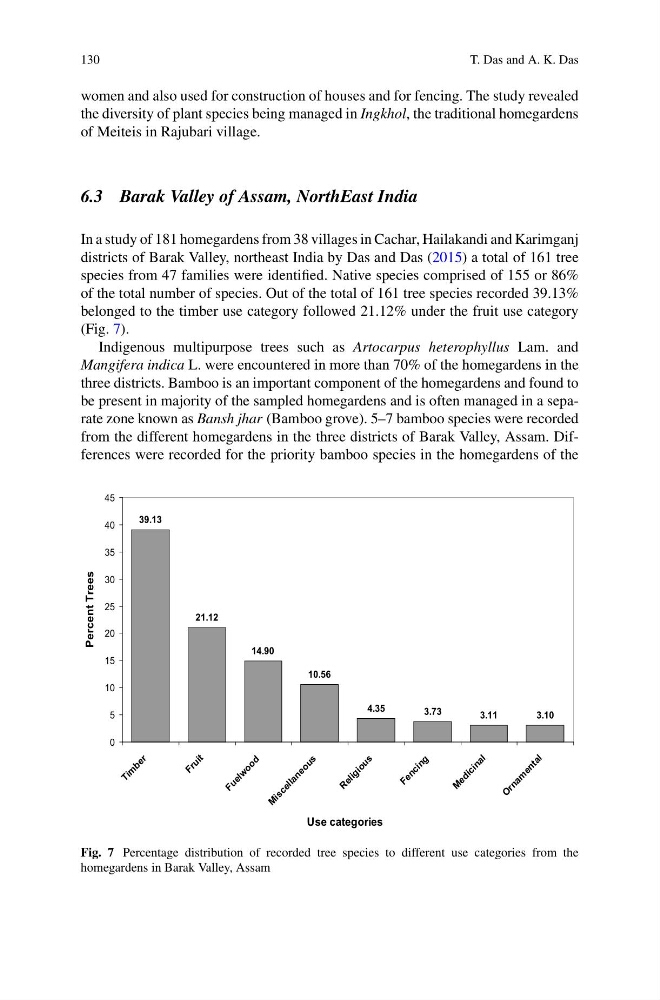
of the total number of species. Out of the total of 161 tree species recorded 39.13%
belonged to the timber use category followed 21.12% under the fruit use category
(Fig. 7).
Indigenous multipurpose trees such as Artocarpus heterophyllus Lam. and
Mangifera indica L. were encountered in more than 70% of the homegardens in the
three districts. Bamboo is an important component of the homegardens and found to
be present in majority of the sampled homegardens and is often managed in a separate zone known as Bansh jhar (Bamboo grove). 5–7 bamboo species were recorded
from the different homegardens in the three districts of Barak Valley, Assam. Differences were recorded for the priority bamboo species in the homegardens of the
39.13
21.12
14.90
10.56
4.35
3.73
3.11
3.10
0
5
10
15
20
25
30
35
40
45
T i m
b e r
F r u i t
F u e l w
o o d
M
i s c e l l a n e o u s
R
e l i g i o u s
F e n c i n g
M
e d i c i n a l
O
r n a m
e n t a l
Use categories
Percent Trees
Fig. 7 Percentage distribution of recorded tree species to different use categories from the
homegardens in Barak Valley, Assam
T. Das and A. K. Das
women and also used for construction of houses and for fencing. The study revealed
the diversity of plant species being managed in Ingkhol, the traditional homegardens
of Meiteis in Rajubari village.
6.3 Barak Valley of Assam, NorthEast India
In a study of 181 homegardens from 38 villages in Cachar, Hailakandi and Karimganj
districts of Barak Valley, northeast India by Das and Das (2015) a total of 161 tree
species from 47 families were identified. Native species comprised of 155 or 86%
of the total number of species. Out of the total of 161 tree species recorded 39.13%
belonged to the timber use category followed 21.12% under the fruit use category
(Fig. 7).
Indigenous multipurpose trees such as Artocarpus heterophyllus Lam. and
Mangifera indica L. were encountered in more than 70% of the homegardens in the
three districts. Bamboo is an important component of the homegardens and found to
be present in majority of the sampled homegardens and is often managed in a separate zone known as Bansh jhar (Bamboo grove). 5–7 bamboo species were recorded
from the different homegardens in the three districts of Barak Valley, Assam. Differences were recorded for the priority bamboo species in the homegardens of the
39.13
21.12
14.90
10.56
4.35
3.73
3.11
3.10
0
5
10
15
20
25
30
35
40
45
T i m
b e r
F r u i t
F u e l w
o o d
M
i s c e l l a n e o u s
R
e l i g i o u s
F e n c i n g
M
e d i c i n a l
O
r n a m
e n t a l
Use categories
Percent Trees
Fig. 7 Percentage distribution of recorded tree species to different use categories from the
homegardens in Barak Valley, Assam