

126
T. Das and A. K. Das
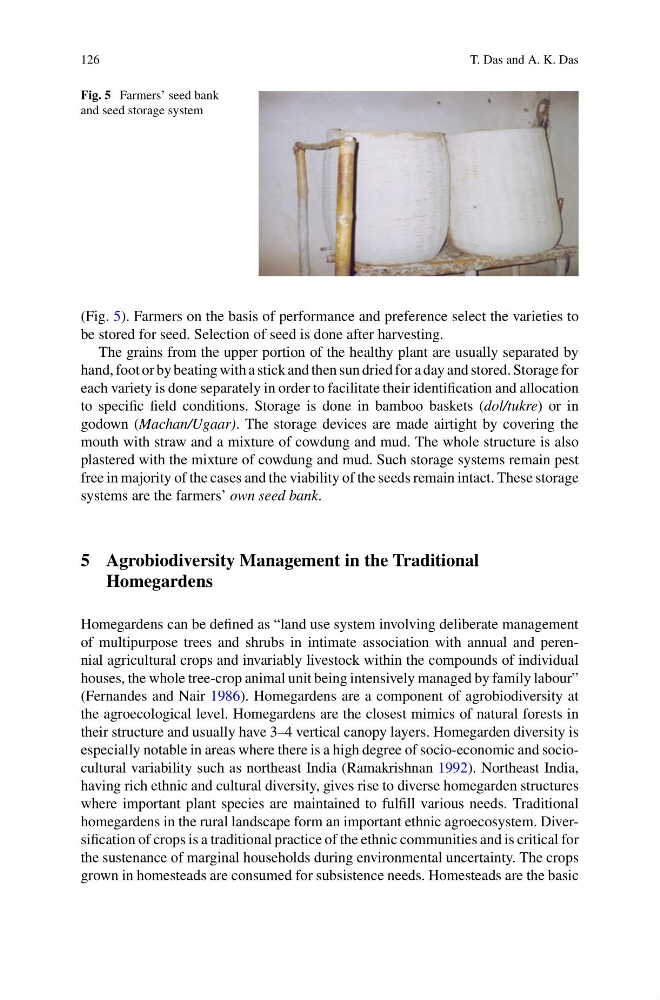
Fig. 5 Farmers’ seed bank
and seed storage system
(Fig. 5). Farmers on the basis of performance and preference select the varieties to
be stored for seed. Selection of seed is done after harvesting.
The grains from the upper portion of the healthy plant are usually separated by
hand, foot or by beating with a stick and then sun dried for a day and stored. Storage for
each variety is done separately in order to facilitate their identification and allocation
to specific field conditions. Storage is done in bamboo baskets (dol/tukre) or in
godown (Machan/Ugaar). The storage devices are made airtight by covering the
mouth with straw and a mixture of cowdung and mud. The whole structure is also
plastered with the mixture of cowdung and mud. Such storage systems remain pest
free in majority of the cases and the viability of the seeds remain intact. These storage
systems are the farmers’ own seed bank.
5 Agrobiodiversity Management in the Traditional
Homegardens
Homegardens can be defined as “land use system involving deliberate management
of multipurpose trees and shrubs in intimate association with annual and perennial agricultural crops and invariably livestock within the compounds of individual
houses, the whole tree-crop animal unit being intensively managed by family labour”
(Fernandes and Nair 1986). Homegardens are a component of agrobiodiversity at
the agroecological level. Homegardens are the closest mimics of natural forests in
their structure and usually have 3–4 vertical canopy layers. Homegarden diversity is
especially notable in areas where there is a high degree of socio-economic and sociocultural variability such as northeast India (Ramakrishnan 1992). Northeast India,
having rich ethnic and cultural diversity, gives rise to diverse homegarden structures
where important plant species are maintained to fulfill various needs. Traditional
homegardens in the rural landscape form an important ethnic agroecosystem. Diversification of crops is a traditional practice of the ethnic communities and is critical for
the sustenance of marginal households during environmental uncertainty. The crops
grown in homesteads are consumed for subsistence needs. Homesteads are the basic
T. Das and A. K. Das
Fig. 5 Farmers’ seed bank
and seed storage system
(Fig. 5). Farmers on the basis of performance and preference select the varieties to
be stored for seed. Selection of seed is done after harvesting.
The grains from the upper portion of the healthy plant are usually separated by
hand, foot or by beating with a stick and then sun dried for a day and stored. Storage for
each variety is done separately in order to facilitate their identification and allocation
to specific field conditions. Storage is done in bamboo baskets (dol/tukre) or in
godown (Machan/Ugaar). The storage devices are made airtight by covering the
mouth with straw and a mixture of cowdung and mud. The whole structure is also
plastered with the mixture of cowdung and mud. Such storage systems remain pest
free in majority of the cases and the viability of the seeds remain intact. These storage
systems are the farmers’ own seed bank.
5 Agrobiodiversity Management in the Traditional
Homegardens
Homegardens can be defined as “land use system involving deliberate management
of multipurpose trees and shrubs in intimate association with annual and perennial agricultural crops and invariably livestock within the compounds of individual
houses, the whole tree-crop animal unit being intensively managed by family labour”
(Fernandes and Nair 1986). Homegardens are a component of agrobiodiversity at
the agroecological level. Homegardens are the closest mimics of natural forests in
their structure and usually have 3–4 vertical canopy layers. Homegarden diversity is
especially notable in areas where there is a high degree of socio-economic and sociocultural variability such as northeast India (Ramakrishnan 1992). Northeast India,
having rich ethnic and cultural diversity, gives rise to diverse homegarden structures
where important plant species are maintained to fulfill various needs. Traditional
homegardens in the rural landscape form an important ethnic agroecosystem. Diversification of crops is a traditional practice of the ethnic communities and is critical for
the sustenance of marginal households during environmental uncertainty. The crops
grown in homesteads are consumed for subsistence needs. Homesteads are the basic