

70
consumed for towing the net underwater. The recent introduction of Ultra High
Molecular Weight Polyethylene (UHMWPE) twines for the fishing industry in India
is a right step towards this direction. Reduction of drag by 15% in UHMWPE trawlnet compared to the traditional nets is reported.
(c) Tapping of alternate sources of energy for powering fishing operations
Steps to minimize fossil fuel usage can reduce the emissions during activities
related to fishing. Use of solar and wind energy using appropriate technologies are
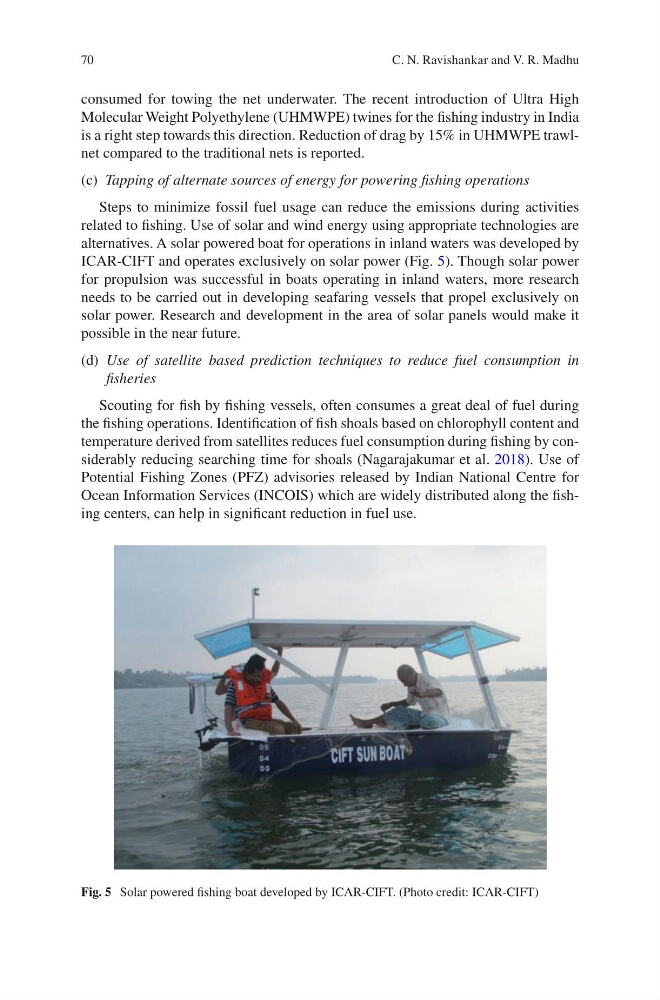
alternatives. A solar powered boat for operations in inland waters was developed by
ICAR-CIFT and operates exclusively on solar power (Fig. 5). Though solar power
for propulsion was successful in boats operating in inland waters, more research
needs to be carried out in developing seafaring vessels that propel exclusively on
solar power. Research and development in the area of solar panels would make it
possible in the near future.
(d) Use of satellite based prediction techniques to reduce fuel consumption in
fisheries
Scouting for fish by fishing vessels, often consumes a great deal of fuel during
the fishing operations. Identification of fish shoals based on chlorophyll content and
temperature derived from satellites reduces fuel consumption during fishing by considerably reducing searching time for shoals (Nagarajakumar et al. 2018). Use of
Potential Fishing Zones (PFZ) advisories released by Indian National Centre for
Ocean Information Services (INCOIS) which are widely distributed along the fishing centers, can help in significant reduction in fuel use.
Fig. 5 Solar powered fishing boat developed by ICAR-CIFT. (Photo credit: ICAR-CIFT)
C. N. Ravishankar and V. R. Madhu
consumed for towing the net underwater. The recent introduction of Ultra High
Molecular Weight Polyethylene (UHMWPE) twines for the fishing industry in India
is a right step towards this direction. Reduction of drag by 15% in UHMWPE trawlnet compared to the traditional nets is reported.
(c) Tapping of alternate sources of energy for powering fishing operations
Steps to minimize fossil fuel usage can reduce the emissions during activities
related to fishing. Use of solar and wind energy using appropriate technologies are
alternatives. A solar powered boat for operations in inland waters was developed by
ICAR-CIFT and operates exclusively on solar power (Fig. 5). Though solar power
for propulsion was successful in boats operating in inland waters, more research
needs to be carried out in developing seafaring vessels that propel exclusively on
solar power. Research and development in the area of solar panels would make it
possible in the near future.
(d) Use of satellite based prediction techniques to reduce fuel consumption in
fisheries
Scouting for fish by fishing vessels, often consumes a great deal of fuel during
the fishing operations. Identification of fish shoals based on chlorophyll content and
temperature derived from satellites reduces fuel consumption during fishing by considerably reducing searching time for shoals (Nagarajakumar et al. 2018). Use of
Potential Fishing Zones (PFZ) advisories released by Indian National Centre for
Ocean Information Services (INCOIS) which are widely distributed along the fishing centers, can help in significant reduction in fuel use.
Fig. 5 Solar powered fishing boat developed by ICAR-CIFT. (Photo credit: ICAR-CIFT)
C. N. Ravishankar and V. R. Madhu