

32
1 Introduction
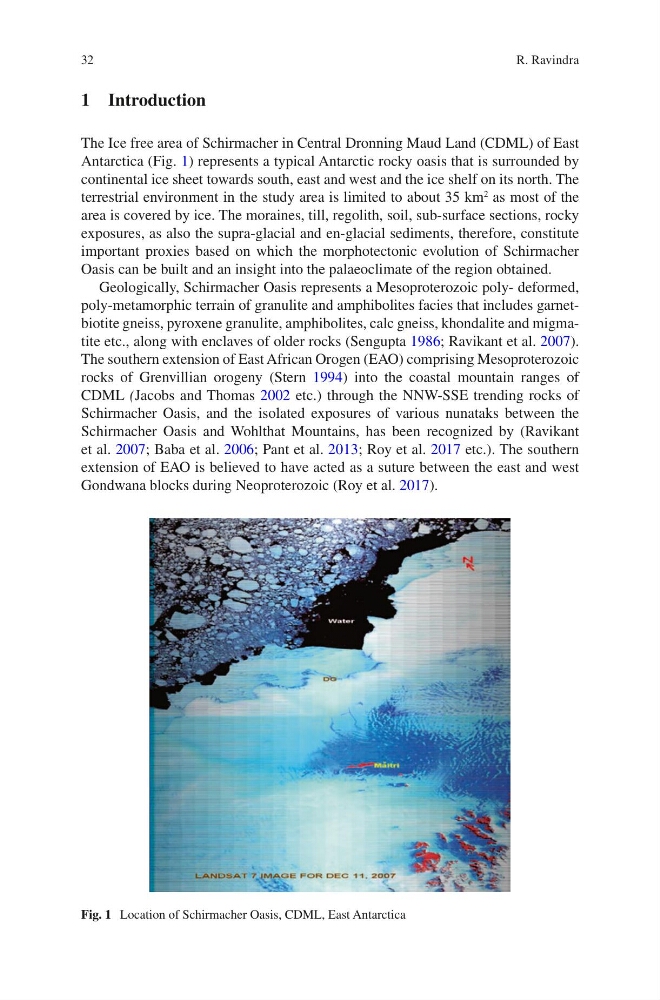
The Ice free area of Schirmacher in Central Dronning Maud Land (CDML) of East
Antarctica (Fig. 1) represents a typical Antarctic rocky oasis that is surrounded by
continental ice sheet towards south, east and west and the ice shelf on its north. The
terrestrial environment in the study area is limited to about 35 km
2
as most of the
area is covered by ice. The moraines, till, regolith, soil, sub-surface sections, rocky
exposures, as also the supra-glacial and en-glacial sediments, therefore, constitute
important proxies based on which the morphotectonic evolution of Schirmacher
Oasis can be built and an insight into the palaeoclimate of the region obtained.
Geologically, Schirmacher Oasis represents a Mesoproterozoic poly- deformed,
poly-metamorphic terrain of granulite and amphibolites facies that includes garnetbiotite gneiss, pyroxene granulite, amphibolites, calc gneiss, khondalite and migmatite etc., along with enclaves of older rocks (Sengupta 1986; Ravikant et al. 2007).
The southern extension of East African Orogen (EAO) comprising Mesoproterozoic
rocks of Grenvillian orogeny (Stern 1994) into the coastal mountain ranges of
CDML (Jacobs and Thomas 2002 etc.) through the NNW-SSE trending rocks of
Schirmacher Oasis, and the isolated exposures of various nunataks between the
Schirmacher Oasis and Wohlthat Mountains, has been recognized by (Ravikant
et al. 2007; Baba et al. 2006; Pant et al. 2013; Roy et al. 2017 etc.). The southern
extension of EAO is believed to have acted as a suture between the east and west
Gondwana blocks during Neoproterozoic (Roy et al. 2017).
Fig. 1 Location of Schirmacher Oasis, CDML, East Antarctica
R. Ravindra
1 Introduction
The Ice free area of Schirmacher in Central Dronning Maud Land (CDML) of East
Antarctica (Fig. 1) represents a typical Antarctic rocky oasis that is surrounded by
continental ice sheet towards south, east and west and the ice shelf on its north. The
terrestrial environment in the study area is limited to about 35 km
2
as most of the
area is covered by ice. The moraines, till, regolith, soil, sub-surface sections, rocky
exposures, as also the supra-glacial and en-glacial sediments, therefore, constitute
important proxies based on which the morphotectonic evolution of Schirmacher
Oasis can be built and an insight into the palaeoclimate of the region obtained.
Geologically, Schirmacher Oasis represents a Mesoproterozoic poly- deformed,
poly-metamorphic terrain of granulite and amphibolites facies that includes garnetbiotite gneiss, pyroxene granulite, amphibolites, calc gneiss, khondalite and migmatite etc., along with enclaves of older rocks (Sengupta 1986; Ravikant et al. 2007).
The southern extension of East African Orogen (EAO) comprising Mesoproterozoic
rocks of Grenvillian orogeny (Stern 1994) into the coastal mountain ranges of
CDML (Jacobs and Thomas 2002 etc.) through the NNW-SSE trending rocks of
Schirmacher Oasis, and the isolated exposures of various nunataks between the
Schirmacher Oasis and Wohlthat Mountains, has been recognized by (Ravikant
et al. 2007; Baba et al. 2006; Pant et al. 2013; Roy et al. 2017 etc.). The southern
extension of EAO is believed to have acted as a suture between the east and west
Gondwana blocks during Neoproterozoic (Roy et al. 2017).
Fig. 1 Location of Schirmacher Oasis, CDML, East Antarctica
R. Ravindra