

25
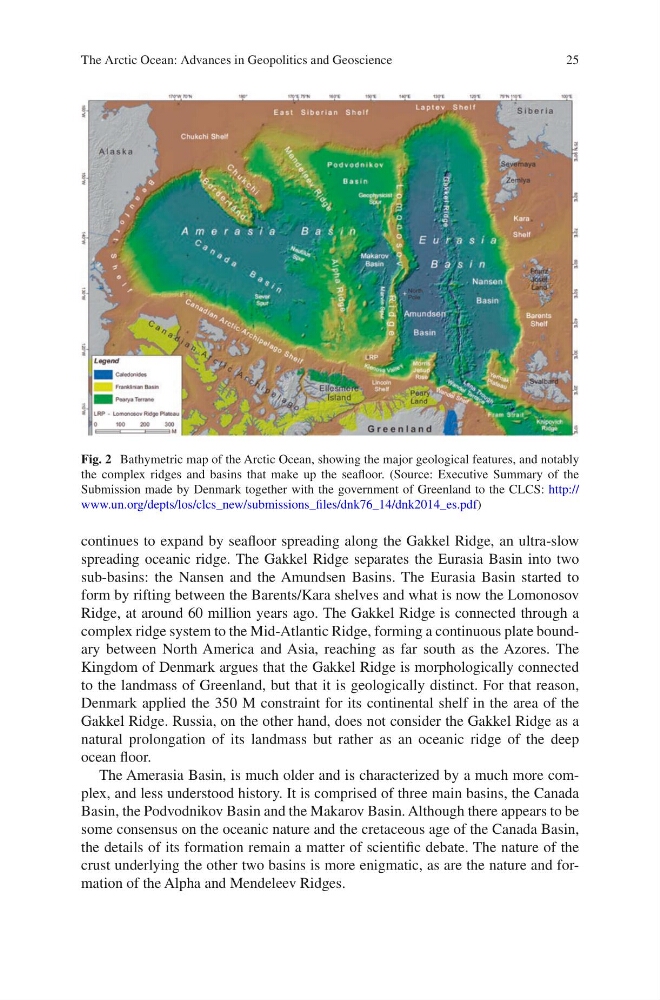
continues to expand by seafloor spreading along the Gakkel Ridge, an ultra-slow
spreading oceanic ridge. The Gakkel Ridge separates the Eurasia Basin into two
sub-basins: the Nansen and the Amundsen Basins. The Eurasia Basin started to
form by rifting between the Barents/Kara shelves and what is now the Lomonosov
Ridge, at around 60 million years ago. The Gakkel Ridge is connected through a
complex ridge system to the Mid-Atlantic Ridge, forming a continuous plate boundary between North America and Asia, reaching as far south as the Azores. The
Kingdom of Denmark argues that the Gakkel Ridge is morphologically connected
to the landmass of Greenland, but that it is geologically distinct. For that reason,
Denmark applied the 350 M constraint for its continental shelf in the area of the
Gakkel Ridge. Russia, on the other hand, does not consider the Gakkel Ridge as a
natural prolongation of its landmass but rather as an oceanic ridge of the deep
ocean floor.
The Amerasia Basin, is much older and is characterized by a much more complex, and less understood history. It is comprised of three main basins, the Canada
Basin, the Podvodnikov Basin and the Makarov Basin. Although there appears to be
some consensus on the oceanic nature and the cretaceous age of the Canada Basin,
the details of its formation remain a matter of scientific debate. The nature of the
crust underlying the other two basins is more enigmatic, as are the nature and formation of the Alpha and Mendeleev Ridges.
Fig. 2 Bathymetric map of the Arctic Ocean, showing the major geological features, and notably
the complex ridges and basins that make up the seafloor. (Source: Executive Summary of the
Submission made by Denmark together with the government of Greenland to the CLCS: http://
www.un.org/depts/los/clcs_new/submissions_files/dnk76_14/dnk2014_es.pdf)
The Arctic Ocean: Advances in Geopolitics and Geoscience
continues to expand by seafloor spreading along the Gakkel Ridge, an ultra-slow
spreading oceanic ridge. The Gakkel Ridge separates the Eurasia Basin into two
sub-basins: the Nansen and the Amundsen Basins. The Eurasia Basin started to
form by rifting between the Barents/Kara shelves and what is now the Lomonosov
Ridge, at around 60 million years ago. The Gakkel Ridge is connected through a
complex ridge system to the Mid-Atlantic Ridge, forming a continuous plate boundary between North America and Asia, reaching as far south as the Azores. The
Kingdom of Denmark argues that the Gakkel Ridge is morphologically connected
to the landmass of Greenland, but that it is geologically distinct. For that reason,
Denmark applied the 350 M constraint for its continental shelf in the area of the
Gakkel Ridge. Russia, on the other hand, does not consider the Gakkel Ridge as a
natural prolongation of its landmass but rather as an oceanic ridge of the deep
ocean floor.
The Amerasia Basin, is much older and is characterized by a much more complex, and less understood history. It is comprised of three main basins, the Canada
Basin, the Podvodnikov Basin and the Makarov Basin. Although there appears to be
some consensus on the oceanic nature and the cretaceous age of the Canada Basin,
the details of its formation remain a matter of scientific debate. The nature of the
crust underlying the other two basins is more enigmatic, as are the nature and formation of the Alpha and Mendeleev Ridges.
Fig. 2 Bathymetric map of the Arctic Ocean, showing the major geological features, and notably
the complex ridges and basins that make up the seafloor. (Source: Executive Summary of the
Submission made by Denmark together with the government of Greenland to the CLCS: http://
www.un.org/depts/los/clcs_new/submissions_files/dnk76_14/dnk2014_es.pdf)
The Arctic Ocean: Advances in Geopolitics and Geoscience