

215
intensity of monsoon (Prell and Kutzbach 1992; Clemens et al. 2003). The combined and interrelated response of these exogenic and endogenic forces might have
responded in sediment aggradation during MIS-5. However, the transitional
responses of sub-stage climatic variations i.e. cold to warm and vice versa have not
accorded as shift to incisional phase in the valley. This can be due to shorter response
time being available to the system to acclaim such transitions. Equivalent phase of
sediment aggradation has also been argued in Ganga plains at the Kalpi section
(Gibling et al. 2005) with aggradational sequences from c. 120 to 65 ka (Marine
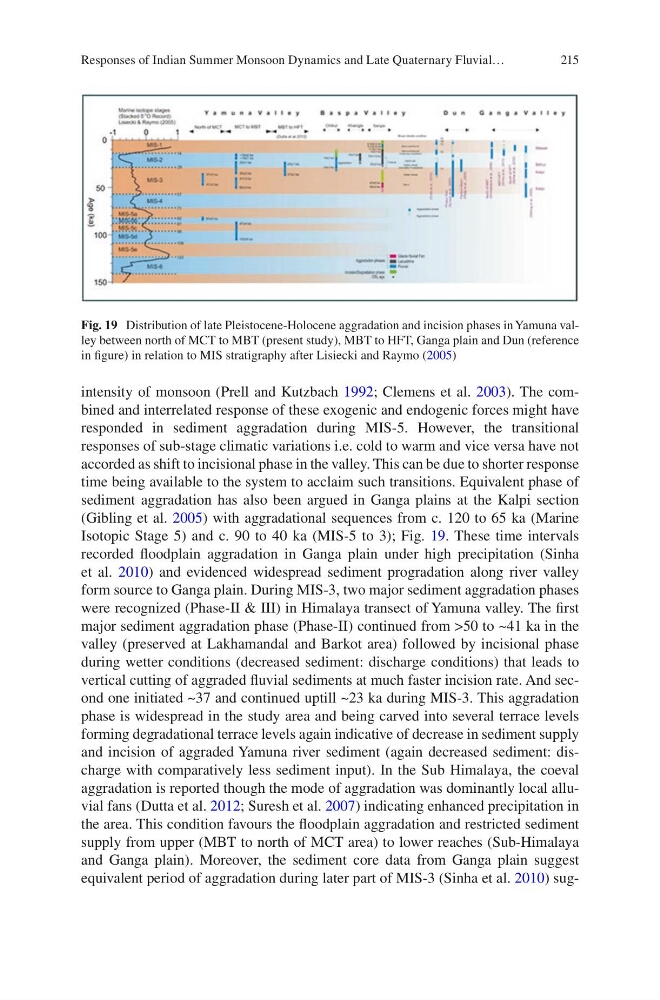
Isotopic Stage 5) and c. 90 to 40 ka (MIS-5 to 3); Fig. 19. These time intervals
recorded floodplain aggradation in Ganga plain under high precipitation (Sinha
et al. 2010) and evidenced widespread sediment progradation along river valley
form source to Ganga plain. During MIS-3, two major sediment aggradation phases
were recognized (Phase-II & III) in Himalaya transect of Yamuna valley. The first
major sediment aggradation phase (Phase-II) continued from >50 to ~41 ka in the
valley (preserved at Lakhamandal and Barkot area) followed by incisional phase
during wetter conditions (decreased sediment: discharge conditions) that leads to
vertical cutting of aggraded fluvial sediments at much faster incision rate. And second one initiated ~37 and continued uptill ~23 ka during MIS-3. This aggradation
phase is widespread in the study area and being carved into several terrace levels
forming degradational terrace levels again indicative of decrease in sediment supply
and incision of aggraded Yamuna river sediment (again decreased sediment: discharge with comparatively less sediment input). In the Sub Himalaya, the coeval
aggradation is reported though the mode of aggradation was dominantly local alluvial fans (Dutta et al. 2012; Suresh et al. 2007) indicating enhanced precipitation in
the area. This condition favours the floodplain aggradation and restricted sediment
supply from upper (MBT to north of MCT area) to lower reaches (Sub-Himalaya
and Ganga plain). Moreover, the sediment core data from Ganga plain suggest
equivalent period of aggradation during later part of MIS-3 (Sinha et al. 2010) sugFig. 19 Distribution of late Pleistocene-Holocene aggradation and incision phases in Yamuna valley between north of MCT to MBT (present study), MBT to HFT, Ganga plain and Dun (reference
in figure) in relation to MIS stratigraphy after Lisiecki and Raymo (2005)
Responses of Indian Summer Monsoon Dynamics and Late Quaternary Fluvial…
intensity of monsoon (Prell and Kutzbach 1992; Clemens et al. 2003). The combined and interrelated response of these exogenic and endogenic forces might have
responded in sediment aggradation during MIS-5. However, the transitional
responses of sub-stage climatic variations i.e. cold to warm and vice versa have not
accorded as shift to incisional phase in the valley. This can be due to shorter response
time being available to the system to acclaim such transitions. Equivalent phase of
sediment aggradation has also been argued in Ganga plains at the Kalpi section
(Gibling et al. 2005) with aggradational sequences from c. 120 to 65 ka (Marine
Isotopic Stage 5) and c. 90 to 40 ka (MIS-5 to 3); Fig. 19. These time intervals
recorded floodplain aggradation in Ganga plain under high precipitation (Sinha
et al. 2010) and evidenced widespread sediment progradation along river valley
form source to Ganga plain. During MIS-3, two major sediment aggradation phases
were recognized (Phase-II & III) in Himalaya transect of Yamuna valley. The first
major sediment aggradation phase (Phase-II) continued from >50 to ~41 ka in the
valley (preserved at Lakhamandal and Barkot area) followed by incisional phase
during wetter conditions (decreased sediment: discharge conditions) that leads to
vertical cutting of aggraded fluvial sediments at much faster incision rate. And second one initiated ~37 and continued uptill ~23 ka during MIS-3. This aggradation
phase is widespread in the study area and being carved into several terrace levels
forming degradational terrace levels again indicative of decrease in sediment supply
and incision of aggraded Yamuna river sediment (again decreased sediment: discharge with comparatively less sediment input). In the Sub Himalaya, the coeval
aggradation is reported though the mode of aggradation was dominantly local alluvial fans (Dutta et al. 2012; Suresh et al. 2007) indicating enhanced precipitation in
the area. This condition favours the floodplain aggradation and restricted sediment
supply from upper (MBT to north of MCT area) to lower reaches (Sub-Himalaya
and Ganga plain). Moreover, the sediment core data from Ganga plain suggest
equivalent period of aggradation during later part of MIS-3 (Sinha et al. 2010) sugFig. 19 Distribution of late Pleistocene-Holocene aggradation and incision phases in Yamuna valley between north of MCT to MBT (present study), MBT to HFT, Ganga plain and Dun (reference
in figure) in relation to MIS stratigraphy after Lisiecki and Raymo (2005)
Responses of Indian Summer Monsoon Dynamics and Late Quaternary Fluvial…