

152
evidence of a 50-year cycle in Arctic temperatures in their study, and concluded that
the warming since 1980 was not due to natural internal climate-system variability
but response to anthropogenic forcing. Substantial variations in temperature and
precipitation have been observed in Svalbard since twentieth century. During last
decades, the annual temperature has increased by 1.2 °C per decade. A significant
change in winter warming has been observed with an increase of 2–3 °C per decade
in the region by Førland et al. (2011). The North Atlantic Current transports warmer
Atlantic water to the Svalbard and influences the climate by keeping the sea free
from ice even during the winter. Apart from the natural forcing like frequent transport of milder air from lower latitudes (Førland et al. 2011) and recent change in
atmospheric circulation (Førland et al. 2011), anthropogenic forcing is one of the
dominant reason for the dramatic increment in temperature. However, there is still
more in depth study required before it can be firmly concluded that the increase in
Arctic temperatures during last one and half decades is due to anthropogenic forcing. The amount of precipitation is not much high in lower region of Svalbard
(400 mm per year). The glacier region, however, records higher precipitation
(2–4 m) due to orographic effect but it seldom exceeds 2–4 m of snow. East central
part of Svalbard has experienced more precipitation due to frequent easterly winds,
caused by low pressure systems passing through the Barents Sea (Hisdal 1985).
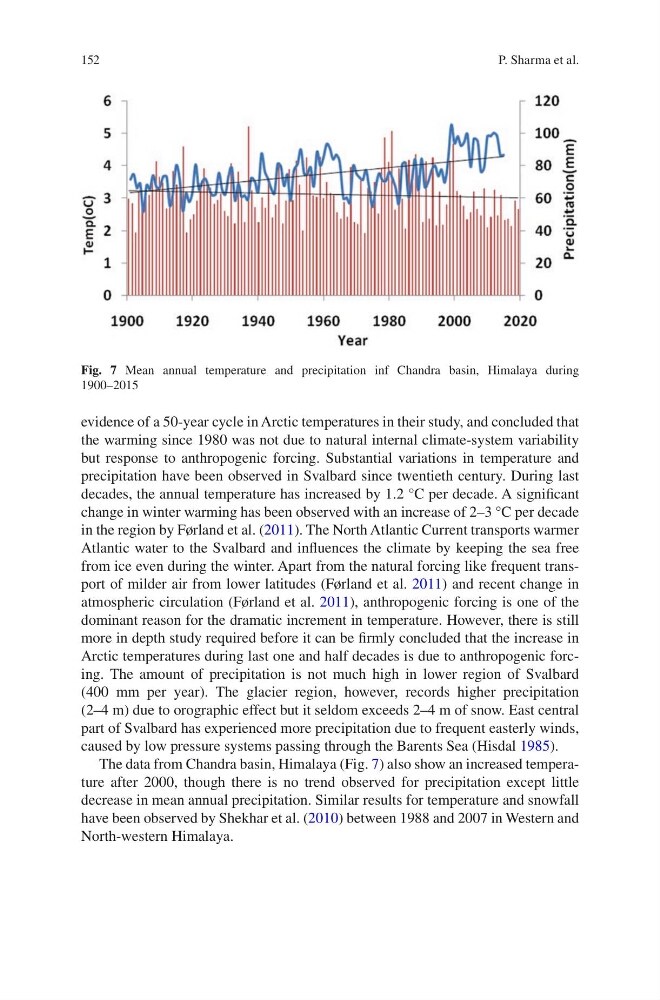
The data from Chandra basin, Himalaya (Fig. 7) also show an increased temperature after 2000, though there is no trend observed for precipitation except little
decrease in mean annual precipitation. Similar results for temperature and snowfall
have been observed by Shekhar et al. (2010) between 1988 and 2007 in Western and
North-western Himalaya.
Fig. 7 Mean annual temperature and precipitation inf Chandra basin, Himalaya during
1900–2015
P. Sharma et al.
evidence of a 50-year cycle in Arctic temperatures in their study, and concluded that
the warming since 1980 was not due to natural internal climate-system variability
but response to anthropogenic forcing. Substantial variations in temperature and
precipitation have been observed in Svalbard since twentieth century. During last
decades, the annual temperature has increased by 1.2 °C per decade. A significant
change in winter warming has been observed with an increase of 2–3 °C per decade
in the region by Førland et al. (2011). The North Atlantic Current transports warmer
Atlantic water to the Svalbard and influences the climate by keeping the sea free
from ice even during the winter. Apart from the natural forcing like frequent transport of milder air from lower latitudes (Førland et al. 2011) and recent change in
atmospheric circulation (Førland et al. 2011), anthropogenic forcing is one of the
dominant reason for the dramatic increment in temperature. However, there is still
more in depth study required before it can be firmly concluded that the increase in
Arctic temperatures during last one and half decades is due to anthropogenic forcing. The amount of precipitation is not much high in lower region of Svalbard
(400 mm per year). The glacier region, however, records higher precipitation
(2–4 m) due to orographic effect but it seldom exceeds 2–4 m of snow. East central
part of Svalbard has experienced more precipitation due to frequent easterly winds,
caused by low pressure systems passing through the Barents Sea (Hisdal 1985).
The data from Chandra basin, Himalaya (Fig. 7) also show an increased temperature after 2000, though there is no trend observed for precipitation except little
decrease in mean annual precipitation. Similar results for temperature and snowfall
have been observed by Shekhar et al. (2010) between 1988 and 2007 in Western and
North-western Himalaya.
Fig. 7 Mean annual temperature and precipitation inf Chandra basin, Himalaya during
1900–2015
P. Sharma et al.