

145
3.2 Mass Balance After 2000
Most of the glaciers in Svalbard are of the surge type and change in the frontal position of a glacier cannot be used as a climatic indicator. In these slow-moving glaciers, the front will shrink and retreat between surges. The frontal position, therefore,
gives little information on whether the total ice mass is growing or shrinking. Mass
balance measurements are therefore necessary to calculate the total volume change
accurately. Apart from various countries, India has also initiated monitoring of glaciers with mass balance investigation for Vestre Broggerbreen glacier in year 2011
under Indian Arctic Programme and later extended the study area by monitoring one
more glacier namely the Feiringbreen (across the fjord at Ny-Alesund) by 2015.
The detailed data of surface mass balance after 2000 are given in Table 2.
Studies show that there were massive changes observed in net annual mass balance of monitored glaciers. Data of three glaciers Auste Broggerbreen, Midre
Loverbreen and Kongsvegen (Table 2) of Spitsbergan, Svalbard show significant
increment in mass loss after year 2000.
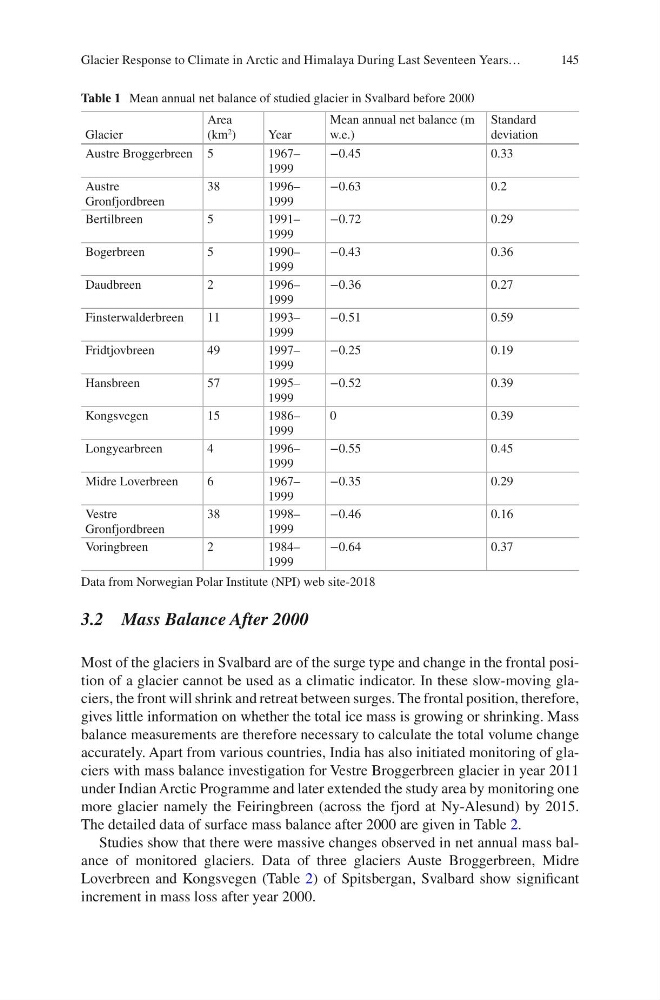
Table 1 Mean annual net balance of studied glacier in Svalbard before 2000
Glacier
Area
(km
2 )
Year
Mean annual net balance (m
w.e.)
Standard
deviation
Austre Broggerbreen 5
1967–
1999
−0.45
0.33
Austre
Gronfjordbreen
38
1996–
1999
−0.63
0.2
Bertilbreen
5
1991–
1999
−0.72
0.29
Bogerbreen
5
1990–
1999
−0.43
0.36
Daudbreen
2
1996–
1999
−0.36
0.27
Finsterwalderbreen
11
1993–
1999
−0.51
0.59
Fridtjovbreen
49
1997–
1999
−0.25
0.19
Hansbreen
57
1995–
1999
−0.52
0.39
Kongsvegen
15
1986–
1999
0
0.39
Longyearbreen
4
1996–
1999
−0.55
0.45
Midre Loverbreen
6
1967–
1999
−0.35
0.29
Vestre
Gronfjordbreen
38
1998–
1999
−0.46
0.16
Voringbreen
2
1984–
1999
−0.64
0.37
Data from Norwegian Polar Institute (NPI) web site-2018
Glacier Response to Climate in Arctic and Himalaya During Last Seventeen Years…
3.2 Mass Balance After 2000
Most of the glaciers in Svalbard are of the surge type and change in the frontal position of a glacier cannot be used as a climatic indicator. In these slow-moving glaciers, the front will shrink and retreat between surges. The frontal position, therefore,
gives little information on whether the total ice mass is growing or shrinking. Mass
balance measurements are therefore necessary to calculate the total volume change
accurately. Apart from various countries, India has also initiated monitoring of glaciers with mass balance investigation for Vestre Broggerbreen glacier in year 2011
under Indian Arctic Programme and later extended the study area by monitoring one
more glacier namely the Feiringbreen (across the fjord at Ny-Alesund) by 2015.
The detailed data of surface mass balance after 2000 are given in Table 2.
Studies show that there were massive changes observed in net annual mass balance of monitored glaciers. Data of three glaciers Auste Broggerbreen, Midre
Loverbreen and Kongsvegen (Table 2) of Spitsbergan, Svalbard show significant
increment in mass loss after year 2000.
Table 1 Mean annual net balance of studied glacier in Svalbard before 2000
Glacier
Area
(km
2 )
Year
Mean annual net balance (m
w.e.)
Standard
deviation
Austre Broggerbreen 5
1967–
1999
−0.45
0.33
Austre
Gronfjordbreen
38
1996–
1999
−0.63
0.2
Bertilbreen
5
1991–
1999
−0.72
0.29
Bogerbreen
5
1990–
1999
−0.43
0.36
Daudbreen
2
1996–
1999
−0.36
0.27
Finsterwalderbreen
11
1993–
1999
−0.51
0.59
Fridtjovbreen
49
1997–
1999
−0.25
0.19
Hansbreen
57
1995–
1999
−0.52
0.39
Kongsvegen
15
1986–
1999
0
0.39
Longyearbreen
4
1996–
1999
−0.55
0.45
Midre Loverbreen
6
1967–
1999
−0.35
0.29
Vestre
Gronfjordbreen
38
1998–
1999
−0.46
0.16
Voringbreen
2
1984–
1999
−0.64
0.37
Data from Norwegian Polar Institute (NPI) web site-2018
Glacier Response to Climate in Arctic and Himalaya During Last Seventeen Years…