

124
3.2 Glacier Ice Thickness by GPR
Polar ice sheet is vast in size and so is its thickness. The Polar ice sheet to the south
of Schirmacher Oasis remains cold and solid during polar wintering period between
March and October every year. However, during 4 month austral summer period
between November and February of the next year, the Polar ice sheet remains
slushy, which is observed to be more vulnerable during end of January, the peak
period of austral summer. The thickness of the Polar ice sheet to the south of the
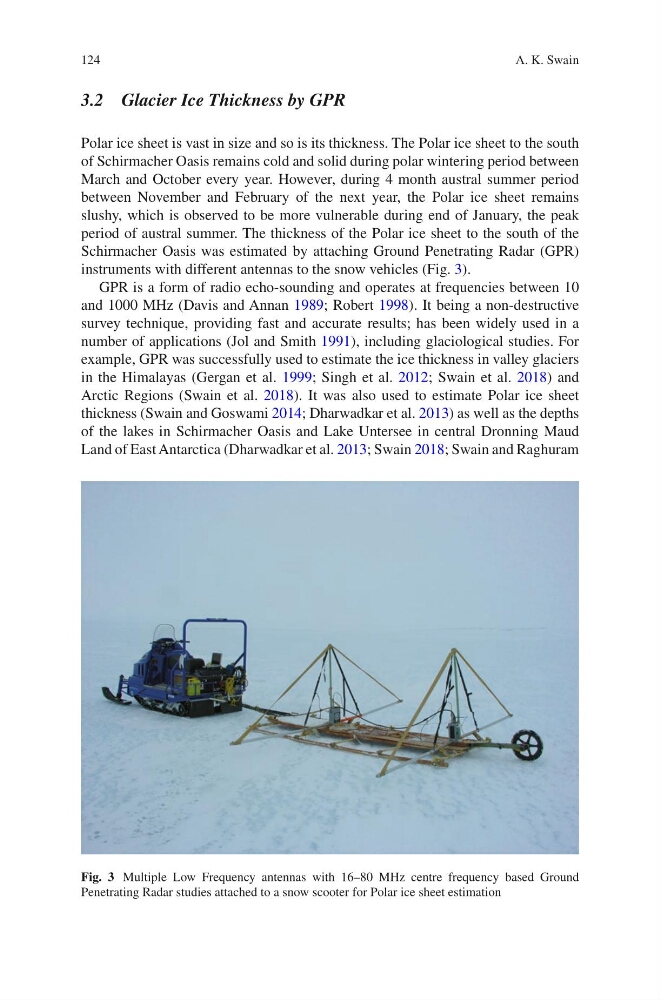
Schirmacher Oasis was estimated by attaching Ground Penetrating Radar (GPR)
instruments with different antennas to the snow vehicles (Fig. 3).
GPR is a form of radio echo-sounding and operates at frequencies between 10
and 1000 MHz (Davis and Annan 1989; Robert 1998). It being a non-destructive
survey technique, providing fast and accurate results; has been widely used in a
number of applications (Jol and Smith 1991), including glaciological studies. For
example, GPR was successfully used to estimate the ice thickness in valley glaciers
in the Himalayas (Gergan et al. 1999; Singh et al. 2012; Swain et al. 2018) and
Arctic Regions (Swain et al. 2018). It was also used to estimate Polar ice sheet
thickness (Swain and Goswami 2014; Dharwadkar et al. 2013) as well as the depths
of the lakes in Schirmacher Oasis and Lake Untersee in central Dronning Maud
Land of East Antarctica (Dharwadkar et al. 2013; Swain 2018; Swain and Raghuram
Fig. 3 Multiple Low Frequency antennas with 16–80 MHz centre frequency based Ground
Penetrating Radar studies attached to a snow scooter for Polar ice sheet estimation
A. K. Swain
3.2 Glacier Ice Thickness by GPR
Polar ice sheet is vast in size and so is its thickness. The Polar ice sheet to the south
of Schirmacher Oasis remains cold and solid during polar wintering period between
March and October every year. However, during 4 month austral summer period
between November and February of the next year, the Polar ice sheet remains
slushy, which is observed to be more vulnerable during end of January, the peak
period of austral summer. The thickness of the Polar ice sheet to the south of the
Schirmacher Oasis was estimated by attaching Ground Penetrating Radar (GPR)
instruments with different antennas to the snow vehicles (Fig. 3).
GPR is a form of radio echo-sounding and operates at frequencies between 10
and 1000 MHz (Davis and Annan 1989; Robert 1998). It being a non-destructive
survey technique, providing fast and accurate results; has been widely used in a
number of applications (Jol and Smith 1991), including glaciological studies. For
example, GPR was successfully used to estimate the ice thickness in valley glaciers
in the Himalayas (Gergan et al. 1999; Singh et al. 2012; Swain et al. 2018) and
Arctic Regions (Swain et al. 2018). It was also used to estimate Polar ice sheet
thickness (Swain and Goswami 2014; Dharwadkar et al. 2013) as well as the depths
of the lakes in Schirmacher Oasis and Lake Untersee in central Dronning Maud
Land of East Antarctica (Dharwadkar et al. 2013; Swain 2018; Swain and Raghuram
Fig. 3 Multiple Low Frequency antennas with 16–80 MHz centre frequency based Ground
Penetrating Radar studies attached to a snow scooter for Polar ice sheet estimation
A. K. Swain