

121
tribute immensely to the sea level change. Different aspects of the calving problem
were reviewed by Benn et al. (2007) and a framework with three-order calving process was suggested by them. The first-order control on calving is the strain rate
arising from spatial variations in velocity, which determines the location and depth
of surface crevasses. Second-order processes that can further erode the ice margin.
Calving of projecting, submerged ‘ice feet’ can be regarded as a third-order process.
Mottram and Benn (2009) tested models that predict crevasse depth from surface
strain rates in a field study at Breiðamerkurjökull, Iceland. Their results indicate that
both crevasse-depth models: a simple function proposed by Nye (1959) and a linear
elastic fracture mechanics (LEFM) model developed by Van der Veen (1998) are
tested to be within the correct order of magnitude. For surface crevasses on glaciers,
the net stress intensity factor can be calculated by superimposing the effects of a
tensile stress, the weight of the ice, and water pressure if the crevasse is filled with
water. The model proposed by Van der Veen (1998) indicates that a single crevasse
can only exist if the tensile stress is larger than 30–80 kPa, depending on the fracture
toughness of glacier ice. Multiple crevasses result in decrease in stress intensity factor for any crevasse, thus reducing their depth. As a result, in a field of crevasses, a
larger tensile stress is needed compared to an individual crevasse, to allow crevasse
formation.
As there is a limited documentation on this particular aspect of climate change
on the glaciers, an attempt has been taken in this paper to understand the role of
climate change on the glacier stress patterns in the form of crevasses, their population and orientation.
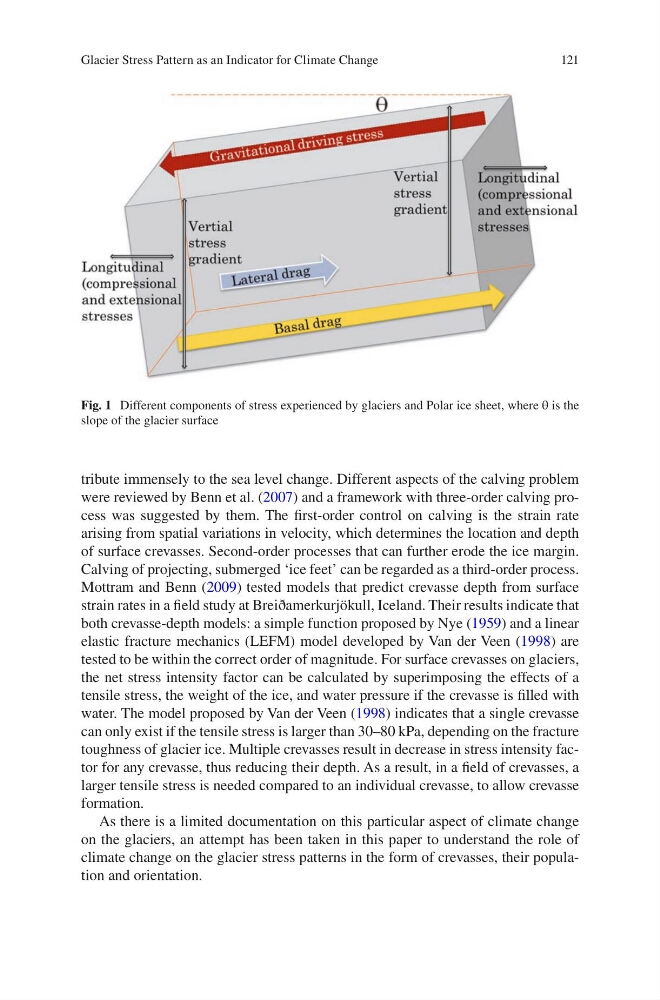
Fig. 1 Different components of stress experienced by glaciers and Polar ice sheet, where θ is the
slope of the glacier surface
Glacier Stress Pattern as an Indicator for Climate Change
tribute immensely to the sea level change. Different aspects of the calving problem
were reviewed by Benn et al. (2007) and a framework with three-order calving process was suggested by them. The first-order control on calving is the strain rate
arising from spatial variations in velocity, which determines the location and depth
of surface crevasses. Second-order processes that can further erode the ice margin.
Calving of projecting, submerged ‘ice feet’ can be regarded as a third-order process.
Mottram and Benn (2009) tested models that predict crevasse depth from surface
strain rates in a field study at Breiðamerkurjökull, Iceland. Their results indicate that
both crevasse-depth models: a simple function proposed by Nye (1959) and a linear
elastic fracture mechanics (LEFM) model developed by Van der Veen (1998) are
tested to be within the correct order of magnitude. For surface crevasses on glaciers,
the net stress intensity factor can be calculated by superimposing the effects of a
tensile stress, the weight of the ice, and water pressure if the crevasse is filled with
water. The model proposed by Van der Veen (1998) indicates that a single crevasse
can only exist if the tensile stress is larger than 30–80 kPa, depending on the fracture
toughness of glacier ice. Multiple crevasses result in decrease in stress intensity factor for any crevasse, thus reducing their depth. As a result, in a field of crevasses, a
larger tensile stress is needed compared to an individual crevasse, to allow crevasse
formation.
As there is a limited documentation on this particular aspect of climate change
on the glaciers, an attempt has been taken in this paper to understand the role of
climate change on the glacier stress patterns in the form of crevasses, their population and orientation.
Fig. 1 Different components of stress experienced by glaciers and Polar ice sheet, where θ is the
slope of the glacier surface
Glacier Stress Pattern as an Indicator for Climate Change