

89
strategy, NMSHE has identified six Task Forces, including the one on Forest
Resources and Plant biodiversity. This is due to the fact that the Himalaya is important on account of its representativeness, richness, uniqueness and life support values of its forests and floral diversity.
2 General Description of Himalayan Region (IHR)
The Himalaya, youngest but highest mountain system, that acts as (i) Store house of
snow and ice more than anywhere else in the world, outside the two poles, (ii)
Provider of large volumes of freshwater to the people in Indian subcontinent- popularly described as ‘“Water Tower for Asia”. Ten major rivers of the world, i.e. the
Amu Darya, Tarim, Indus, Ganga, Brahmaputra, Irrawaddy, Salween, Mekong,
Yangtze and the Yellow River, originate from this region, and drain large part of
Asia making it a crucial ecological entity in the region (Desai et al. 2011). The
Himalaya is known for its unique flora and fauna, and listed among the ‘Mega
Biodiversity Hot Spots’ areas. The region plays an important role in global atmospheric circulation and the regional hydrological cycle. It is home to rich, globallysignificant biodiversity: four global biodiversity hotspots are located in the
Himalayan region (Sharma 2017). The region is enriched by a diversity of culture,
ethnic groups and traditional knowledge system. The Hindu Kush Himalaya
(HKH) – a region whose water towers and ecosystem benefit billions of people living in south Asia (Sharma 2017), encompasses Afghanistan, Bangladesh, Bhutan,
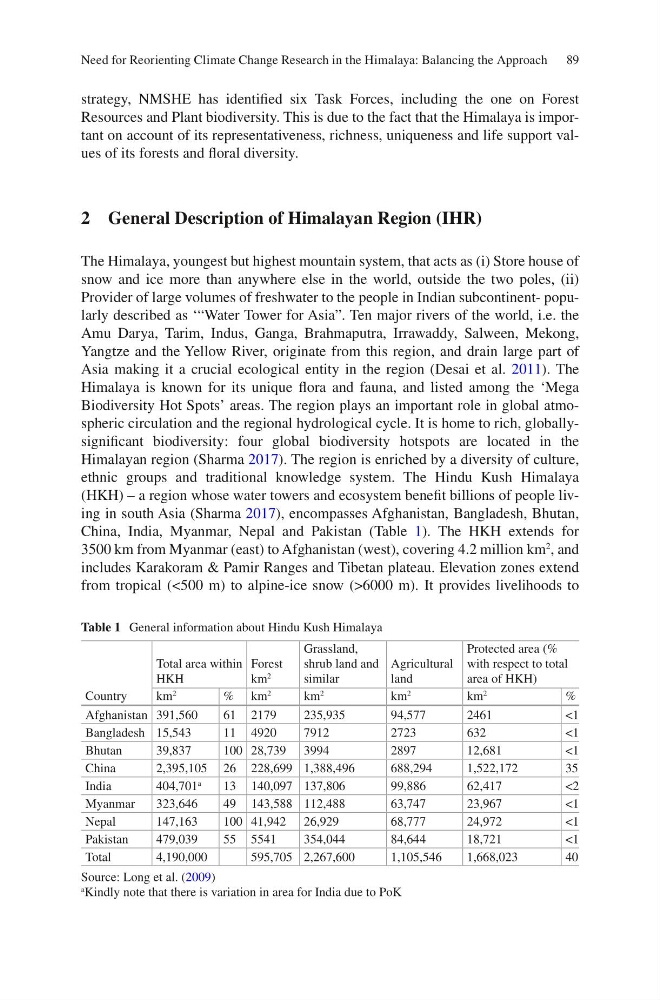
China, India, Myanmar, Nepal and Pakistan (Table 1). The HKH extends for
3500 km from Myanmar (east) to Afghanistan (west), covering 4.2 million km
2
, and
includes Karakoram & Pamir Ranges and Tibetan plateau. Elevation zones extend
from tropical (<500 m) to alpine-ice snow (>6000 m). It provides livelihoods to
Table 1 General information about Hindu Kush Himalaya
Country
Total area within
HKH
Forest
km
2
Grassland,
shrub land and
similar
Agricultural
land
Protected area (%
with respect to total
area of HKH)
km
2
% km
2
km
2
km
2
km
2
%
Afghanistan 391,560
61 2179
235,935
94,577
2461
<1
Bangladesh 15,543
11 4920
7912
2723
632
<1
Bhutan
39,837
100 28,739 3994
2897
12,681
<1
China
2,395,105 26 228,699 1,388,496
688,294
1,522,172
35
India
404,701
a
13 140,097 137,806
99,886
62,417
<2
Myanmar
323,646
49 143,588 112,488
63,747
23,967
<1
Nepal
147,163
100 41,942 26,929
68,777
24,972
<1
Pakistan
479,039
55 5541
354,044
84,644
18,721
<1
Total
4,190,000
595,705 2,267,600
1,105,546
1,668,023
40
Source: Long et al. (2009)
a
Kindly note that there is variation in area for India due to PoK
Need for Reorienting Climate Change Research in the Himalaya: Balancing the Approach
strategy, NMSHE has identified six Task Forces, including the one on Forest
Resources and Plant biodiversity. This is due to the fact that the Himalaya is important on account of its representativeness, richness, uniqueness and life support values of its forests and floral diversity.
2 General Description of Himalayan Region (IHR)
The Himalaya, youngest but highest mountain system, that acts as (i) Store house of
snow and ice more than anywhere else in the world, outside the two poles, (ii)
Provider of large volumes of freshwater to the people in Indian subcontinent- popularly described as ‘“Water Tower for Asia”. Ten major rivers of the world, i.e. the
Amu Darya, Tarim, Indus, Ganga, Brahmaputra, Irrawaddy, Salween, Mekong,
Yangtze and the Yellow River, originate from this region, and drain large part of
Asia making it a crucial ecological entity in the region (Desai et al. 2011). The
Himalaya is known for its unique flora and fauna, and listed among the ‘Mega
Biodiversity Hot Spots’ areas. The region plays an important role in global atmospheric circulation and the regional hydrological cycle. It is home to rich, globallysignificant biodiversity: four global biodiversity hotspots are located in the
Himalayan region (Sharma 2017). The region is enriched by a diversity of culture,
ethnic groups and traditional knowledge system. The Hindu Kush Himalaya
(HKH) – a region whose water towers and ecosystem benefit billions of people living in south Asia (Sharma 2017), encompasses Afghanistan, Bangladesh, Bhutan,
China, India, Myanmar, Nepal and Pakistan (Table 1). The HKH extends for
3500 km from Myanmar (east) to Afghanistan (west), covering 4.2 million km
2
, and
includes Karakoram & Pamir Ranges and Tibetan plateau. Elevation zones extend
from tropical (<500 m) to alpine-ice snow (>6000 m). It provides livelihoods to
Table 1 General information about Hindu Kush Himalaya
Country
Total area within
HKH
Forest
km
2
Grassland,
shrub land and
similar
Agricultural
land
Protected area (%
with respect to total
area of HKH)
km
2
% km
2
km
2
km
2
km
2
%
Afghanistan 391,560
61 2179
235,935
94,577
2461
<1
Bangladesh 15,543
11 4920
7912
2723
632
<1
Bhutan
39,837
100 28,739 3994
2897
12,681
<1
China
2,395,105 26 228,699 1,388,496
688,294
1,522,172
35
India
404,701
a
13 140,097 137,806
99,886
62,417
<2
Myanmar
323,646
49 143,588 112,488
63,747
23,967
<1
Nepal
147,163
100 41,942 26,929
68,777
24,972
<1
Pakistan
479,039
55 5541
354,044
84,644
18,721
<1
Total
4,190,000
595,705 2,267,600
1,105,546
1,668,023
40
Source: Long et al. (2009)
a
Kindly note that there is variation in area for India due to PoK
Need for Reorienting Climate Change Research in the Himalaya: Balancing the Approach