

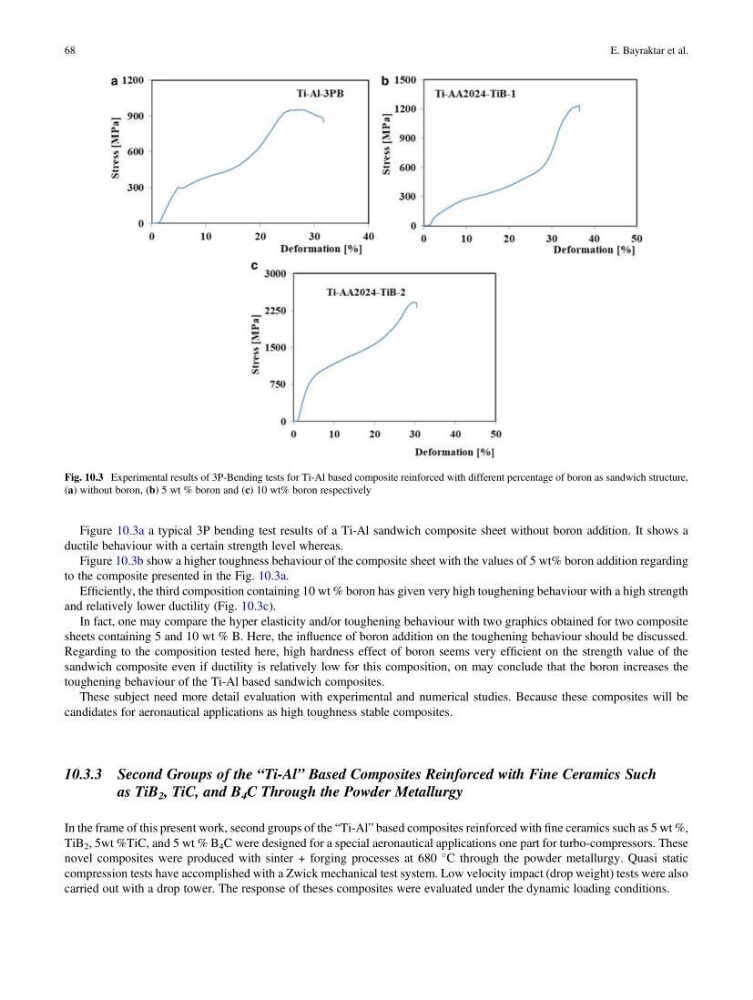
Figure 10.3a a typical 3P bending test results of a Ti-Al sandwich composite sheet without boron addition. It shows a
ductile behaviour with a certain strength level whereas.
Figure 10.3b show a higher toughness behaviour of the composite sheet with the values of 5 wt% boron addition regarding
to the composite presented in the Fig. 10.3a.
Efficiently, the third composition containing 10 wt % boron has given very high toughening behaviour with a high strength
and relatively lower ductility (Fig. 10.3c).
In fact, one may compare the hyper elasticity and/or toughening behaviour with two graphics obtained for two composite
sheets containing 5 and 10 wt % B. Here, the influence of boron addition on the toughening behaviour should be discussed.
Regarding to the composition tested here, high hardness effect of boron seems very efficient on the strength value of the
sandwich composite even if ductility is relatively low for this composition, on may conclude that the boron increases the
toughening behaviour of the Ti-Al based sandwich composites.
These subject need more detail evaluation with experimental and numerical studies. Because these composites will be
candidates for aeronautical applications as high toughness stable composites.
10.3.3 Second Groups of the “Ti-Al” Based Composites Reinforced with Fine Ceramics Such
as TiB 2 , TiC, and B 4 C Through the Powder Metallurgy
In the frame of this present work, second groups of the “Ti-Al” based composites reinforced with fine ceramics such as 5 wt %,
TiB 2 , 5wt %TiC, and 5 wt % B 4 C were designed for a special aeronautical applications one part for turbo-compressors. These
novel composites were produced with sinter + forging processes at 680
C through the powder metallurgy. Quasi static
compression tests have accomplished with a Zwick mechanical test system. Low velocity impact (drop weight) tests were also
carried out with a drop tower. The response of theses composites were evaluated under the dynamic loading conditions.
Fig. 10.3 Experimental results of 3P-Bending tests for Ti-Al based composite reinforced with different percentage of boron as sandwich structure,
(a) without boron, (b) 5 wt % boron and (c) 10 wt% boron respectively
68
E. Bayraktar et al.
ductile behaviour with a certain strength level whereas.
Figure 10.3b show a higher toughness behaviour of the composite sheet with the values of 5 wt% boron addition regarding
to the composite presented in the Fig. 10.3a.
Efficiently, the third composition containing 10 wt % boron has given very high toughening behaviour with a high strength
and relatively lower ductility (Fig. 10.3c).
In fact, one may compare the hyper elasticity and/or toughening behaviour with two graphics obtained for two composite
sheets containing 5 and 10 wt % B. Here, the influence of boron addition on the toughening behaviour should be discussed.
Regarding to the composition tested here, high hardness effect of boron seems very efficient on the strength value of the
sandwich composite even if ductility is relatively low for this composition, on may conclude that the boron increases the
toughening behaviour of the Ti-Al based sandwich composites.
These subject need more detail evaluation with experimental and numerical studies. Because these composites will be
candidates for aeronautical applications as high toughness stable composites.
10.3.3 Second Groups of the “Ti-Al” Based Composites Reinforced with Fine Ceramics Such
as TiB 2 , TiC, and B 4 C Through the Powder Metallurgy
In the frame of this present work, second groups of the “Ti-Al” based composites reinforced with fine ceramics such as 5 wt %,
TiB 2 , 5wt %TiC, and 5 wt % B 4 C were designed for a special aeronautical applications one part for turbo-compressors. These
novel composites were produced with sinter + forging processes at 680
C through the powder metallurgy. Quasi static
compression tests have accomplished with a Zwick mechanical test system. Low velocity impact (drop weight) tests were also
carried out with a drop tower. The response of theses composites were evaluated under the dynamic loading conditions.
Fig. 10.3 Experimental results of 3P-Bending tests for Ti-Al based composite reinforced with different percentage of boron as sandwich structure,
(a) without boron, (b) 5 wt % boron and (c) 10 wt% boron respectively
68
E. Bayraktar et al.