

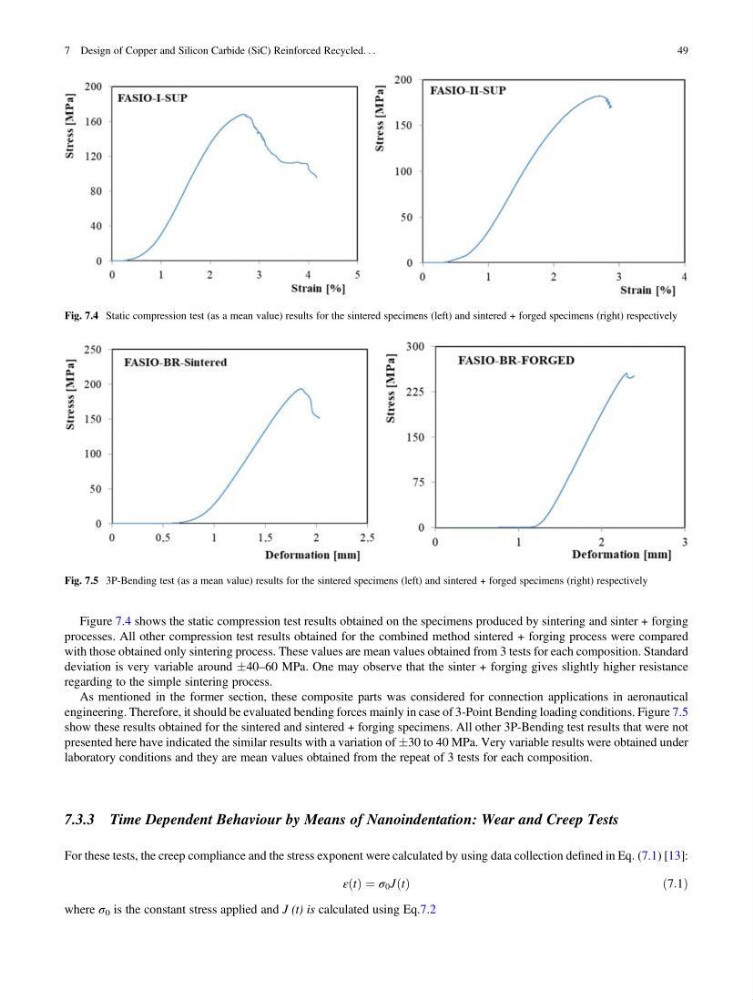
Figure 7.4 shows the static compression test results obtained on the specimens produced by sintering and sinter + forging
processes. All other compression test results obtained for the combined method sintered + forging process were compared
with those obtained only sintering process. These values are mean values obtained from 3 tests for each composition. Standard
deviation is very variable around Æ40–60 MPa. One may observe that the sinter + forging gives slightly higher resistance
regarding to the simple sintering process.
As mentioned in the former section, these composite parts was considered for connection applications in aeronautical
engineering. Therefore, it should be evaluated bending forces mainly in case of 3-Point Bending loading conditions. Figure 7.5
show these results obtained for the sintered and sintered + forging specimens. All other 3P-Bending test results that were not
presented here have indicated the similar results with a variation of Æ30 to 40 MPa. Very variable results were obtained under
laboratory conditions and they are mean values obtained from the repeat of 3 tests for each composition.
7.3.3 Time Dependent Behaviour by Means of Nanoindentation: Wear and Creep Tests
For these tests, the creep compliance and the stress exponent were calculated by using data collection defined in Eq. (7.1) [13]:
ε t
ð Þ ¼ σ 0 J t
ð Þ
ð7:1Þ
where σ 0 is the constant stress applied and J (t) is calculated using Eq.7.2
Fig. 7.4 Static compression test (as a mean value) results for the sintered specimens (left) and sintered + forged specimens (right) respectively
Fig. 7.5 3P-Bending test (as a mean value) results for the sintered specimens (left) and sintered + forged specimens (right) respectively
7 Design of Copper and Silicon Carbide (SiC) Reinforced Recycled. . .
49
processes. All other compression test results obtained for the combined method sintered + forging process were compared
with those obtained only sintering process. These values are mean values obtained from 3 tests for each composition. Standard
deviation is very variable around Æ40–60 MPa. One may observe that the sinter + forging gives slightly higher resistance
regarding to the simple sintering process.
As mentioned in the former section, these composite parts was considered for connection applications in aeronautical
engineering. Therefore, it should be evaluated bending forces mainly in case of 3-Point Bending loading conditions. Figure 7.5
show these results obtained for the sintered and sintered + forging specimens. All other 3P-Bending test results that were not
presented here have indicated the similar results with a variation of Æ30 to 40 MPa. Very variable results were obtained under
laboratory conditions and they are mean values obtained from the repeat of 3 tests for each composition.
7.3.3 Time Dependent Behaviour by Means of Nanoindentation: Wear and Creep Tests
For these tests, the creep compliance and the stress exponent were calculated by using data collection defined in Eq. (7.1) [13]:
ε t
ð Þ ¼ σ 0 J t
ð Þ
ð7:1Þ
where σ 0 is the constant stress applied and J (t) is calculated using Eq.7.2
Fig. 7.4 Static compression test (as a mean value) results for the sintered specimens (left) and sintered + forged specimens (right) respectively
Fig. 7.5 3P-Bending test (as a mean value) results for the sintered specimens (left) and sintered + forged specimens (right) respectively
7 Design of Copper and Silicon Carbide (SiC) Reinforced Recycled. . .
49