

68
3 Dynamic Tensile Mechanical Properties of UHPCC
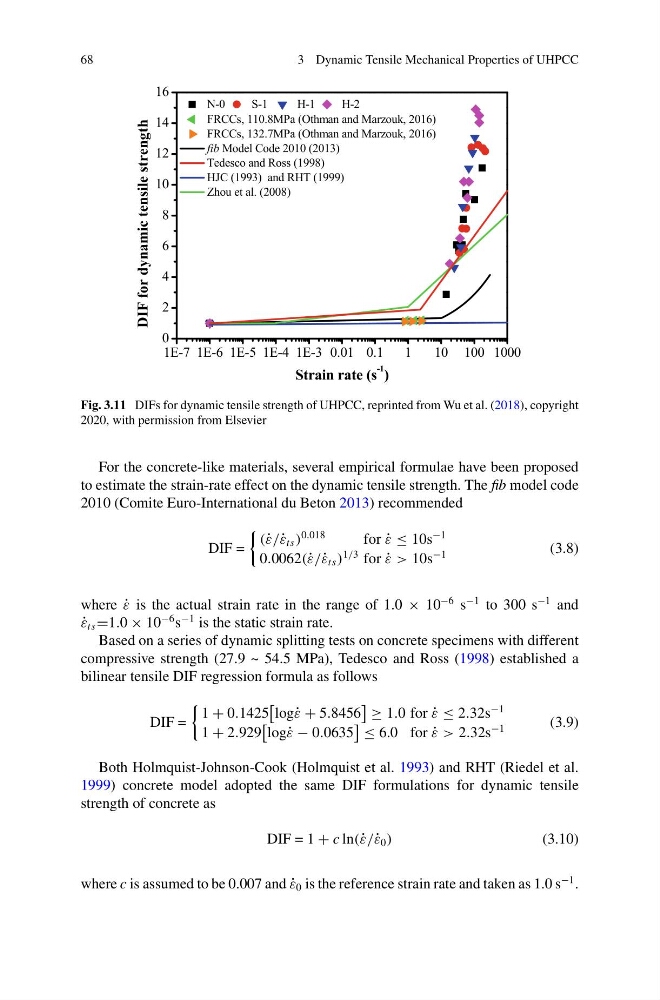
Fig. 3.11 DIFs for dynamic tensile strength of UHPCC, reprinted from Wu et al. (2018), copyright
2020, with permission from Elsevier
For the concrete-like materials, several empirical formulae have been proposed
to estimate the strain-rate effect on the dynamic tensile strength. The fib model code
2010 (Comite Euro-International du Beton 2013) recommended
DIF =
(˙ ε/˙ ε ts )
0.018
for ˙
ε ≤ 10s
−1
0.0062(˙ ε/˙ ε ts )
1/3 for ˙
ε > 10s
−1
(3.8)
where ˙
ε is the actual strain rate in the range of 1.0 × 10
−6 s
−1 to 300 s
−1 and
˙
ε ts =1.0 × 10
−6 s
−1 is the static strain rate.
Based on a series of dynamic splitting tests on concrete specimens with different
compressive strength (27.9 ~ 54.5 MPa), Tedesco and Ross (1998) established a
bilinear tensile DIF regression formula as follows
DIF =
1 + 0.1425
log˙ ε + 5.8456
≥ 1.0 for ˙
ε ≤ 2.32s
−1
1 + 2.929
log˙ ε − 0.0635
≤ 6.0 for ˙
ε > 2.32s
−1
(3.9)
Both Holmquist-Johnson-Cook (Holmquist et al. 1993) and RHT (Riedel et al.
1999) concrete model adopted the same DIF formulations for dynamic tensile
strength of concrete as
DIF = 1 + c ln(˙ ε/˙ ε 0 )
(3.10)
where c is assumed to be 0.007 and ˙
ε 0 is the reference strain rate and taken as 1.0 s
−1 .
3 Dynamic Tensile Mechanical Properties of UHPCC
Fig. 3.11 DIFs for dynamic tensile strength of UHPCC, reprinted from Wu et al. (2018), copyright
2020, with permission from Elsevier
For the concrete-like materials, several empirical formulae have been proposed
to estimate the strain-rate effect on the dynamic tensile strength. The fib model code
2010 (Comite Euro-International du Beton 2013) recommended
DIF =
(˙ ε/˙ ε ts )
0.018
for ˙
ε ≤ 10s
−1
0.0062(˙ ε/˙ ε ts )
1/3 for ˙
ε > 10s
−1
(3.8)
where ˙
ε is the actual strain rate in the range of 1.0 × 10
−6 s
−1 to 300 s
−1 and
˙
ε ts =1.0 × 10
−6 s
−1 is the static strain rate.
Based on a series of dynamic splitting tests on concrete specimens with different
compressive strength (27.9 ~ 54.5 MPa), Tedesco and Ross (1998) established a
bilinear tensile DIF regression formula as follows
DIF =
1 + 0.1425
log˙ ε + 5.8456
≥ 1.0 for ˙
ε ≤ 2.32s
−1
1 + 2.929
log˙ ε − 0.0635
≤ 6.0 for ˙
ε > 2.32s
−1
(3.9)
Both Holmquist-Johnson-Cook (Holmquist et al. 1993) and RHT (Riedel et al.
1999) concrete model adopted the same DIF formulations for dynamic tensile
strength of concrete as
DIF = 1 + c ln(˙ ε/˙ ε 0 )
(3.10)
where c is assumed to be 0.007 and ˙
ε 0 is the reference strain rate and taken as 1.0 s
−1 .