

66
3 Dynamic Tensile Mechanical Properties of UHPCC
3.4.3 Relations Between the Critical Time to Fracture
and Dynamic Spalling Strength
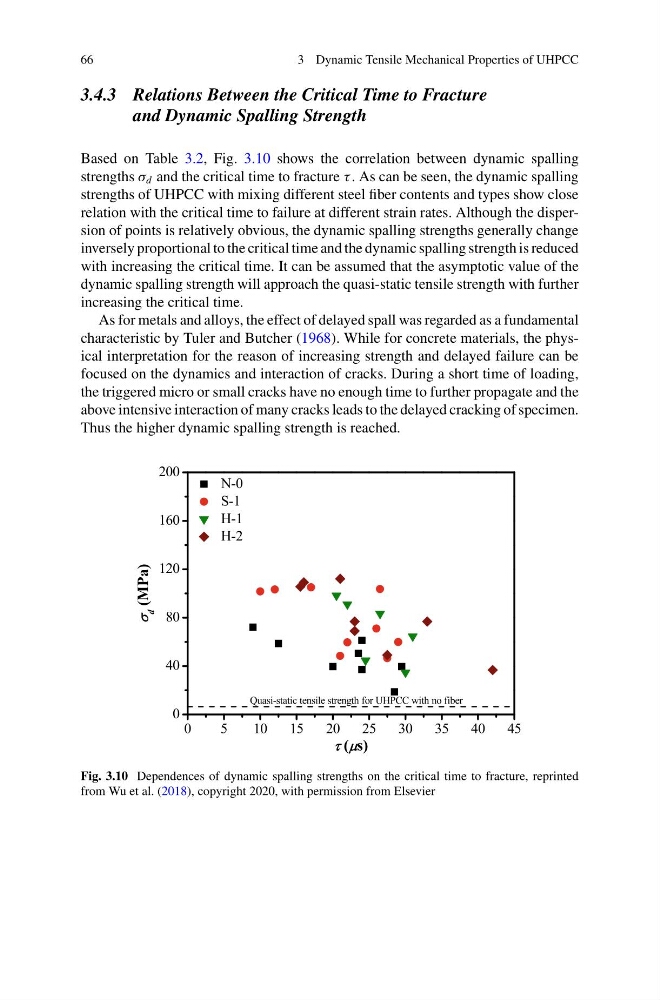
Based on Table 3.2, Fig. 3.10 shows the correlation between dynamic spalling
strengths σ d and the critical time to fracture τ . As can be seen, the dynamic spalling
strengths of UHPCC with mixing different steel fiber contents and types show close
relation with the critical time to failure at different strain rates. Although the dispersion of points is relatively obvious, the dynamic spalling strengths generally change
inversely proportional to the critical time and the dynamic spalling strength is reduced
with increasing the critical time. It can be assumed that the asymptotic value of the
dynamic spalling strength will approach the quasi-static tensile strength with further
increasing the critical time.
As for metals and alloys, the effect of delayed spall was regarded as a fundamental
characteristic by Tuler and Butcher (1968). While for concrete materials, the physical interpretation for the reason of increasing strength and delayed failure can be
focused on the dynamics and interaction of cracks. During a short time of loading,
the triggered micro or small cracks have no enough time to further propagate and the
above intensive interaction of many cracks leads to the delayed cracking of specimen.
Thus the higher dynamic spalling strength is reached.
Fig. 3.10 Dependences of dynamic spalling strengths on the critical time to fracture, reprinted
from Wu et al. (2018), copyright 2020, with permission from Elsevier
3 Dynamic Tensile Mechanical Properties of UHPCC
3.4.3 Relations Between the Critical Time to Fracture
and Dynamic Spalling Strength
Based on Table 3.2, Fig. 3.10 shows the correlation between dynamic spalling
strengths σ d and the critical time to fracture τ . As can be seen, the dynamic spalling
strengths of UHPCC with mixing different steel fiber contents and types show close
relation with the critical time to failure at different strain rates. Although the dispersion of points is relatively obvious, the dynamic spalling strengths generally change
inversely proportional to the critical time and the dynamic spalling strength is reduced
with increasing the critical time. It can be assumed that the asymptotic value of the
dynamic spalling strength will approach the quasi-static tensile strength with further
increasing the critical time.
As for metals and alloys, the effect of delayed spall was regarded as a fundamental
characteristic by Tuler and Butcher (1968). While for concrete materials, the physical interpretation for the reason of increasing strength and delayed failure can be
focused on the dynamics and interaction of cracks. During a short time of loading,
the triggered micro or small cracks have no enough time to further propagate and the
above intensive interaction of many cracks leads to the delayed cracking of specimen.
Thus the higher dynamic spalling strength is reached.
Fig. 3.10 Dependences of dynamic spalling strengths on the critical time to fracture, reprinted
from Wu et al. (2018), copyright 2020, with permission from Elsevier