

1.4 Test Results and Discussion
27
Table 1.10 Fracture energy of UHPCC (unit N/m)
Test No.
S1
S2
S3
Average Test No.
S1
S2
S3
Average
TS400-0.5 3787 –
3970
3879 TH400-0.5 3925 6356 5213
5164
TS400-1.0 8152 8355 –
8254 TH400-1.0 6384 –
4070
5227
TS400-1.5 9466 9156 8213
8945 TH400-1.5 7127 8456 –
7792
TS400-2.0 12,570 12,638 10,027 11,745 TH400-2.0 8512 9170 –
8841
TS400-2.5 –
12,084 15,081 13,583 TH400-2.5 10,784 11,498 11,641 11,308
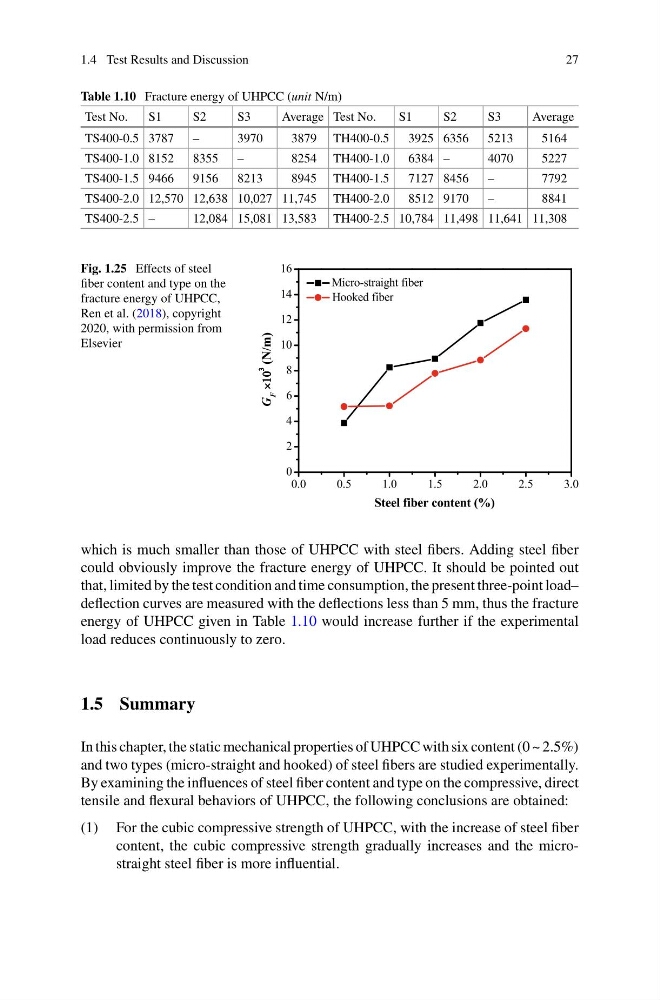
Fig. 1.25 Effects of steel
fiber content and type on the
fracture energy of UHPCC,
Ren et al. (2018), copyright
2020, with permission from
Elsevier
which is much smaller than those of UHPCC with steel fibers. Adding steel fiber
could obviously improve the fracture energy of UHPCC. It should be pointed out
that, limited by the test condition and time consumption, the present three-point load–
deflection curves are measured with the deflections less than 5 mm, thus the fracture
energy of UHPCC given in Table 1.10 would increase further if the experimental
load reduces continuously to zero.
1.5 Summary
In this chapter, the static mechanical properties of UHPCC with six content (0 ~ 2.5%)
and two types (micro-straight and hooked) of steel fibers are studied experimentally.
By examining the influences of steel fiber content and type on the compressive, direct
tensile and flexural behaviors of UHPCC, the following conclusions are obtained:
(1) For the cubic compressive strength of UHPCC, with the increase of steel fiber
content, the cubic compressive strength gradually increases and the microstraight steel fiber is more influential.
27
Table 1.10 Fracture energy of UHPCC (unit N/m)
Test No.
S1
S2
S3
Average Test No.
S1
S2
S3
Average
TS400-0.5 3787 –
3970
3879 TH400-0.5 3925 6356 5213
5164
TS400-1.0 8152 8355 –
8254 TH400-1.0 6384 –
4070
5227
TS400-1.5 9466 9156 8213
8945 TH400-1.5 7127 8456 –
7792
TS400-2.0 12,570 12,638 10,027 11,745 TH400-2.0 8512 9170 –
8841
TS400-2.5 –
12,084 15,081 13,583 TH400-2.5 10,784 11,498 11,641 11,308
Fig. 1.25 Effects of steel
fiber content and type on the
fracture energy of UHPCC,
Ren et al. (2018), copyright
2020, with permission from
Elsevier
which is much smaller than those of UHPCC with steel fibers. Adding steel fiber
could obviously improve the fracture energy of UHPCC. It should be pointed out
that, limited by the test condition and time consumption, the present three-point load–
deflection curves are measured with the deflections less than 5 mm, thus the fracture
energy of UHPCC given in Table 1.10 would increase further if the experimental
load reduces continuously to zero.
1.5 Summary
In this chapter, the static mechanical properties of UHPCC with six content (0 ~ 2.5%)
and two types (micro-straight and hooked) of steel fibers are studied experimentally.
By examining the influences of steel fiber content and type on the compressive, direct
tensile and flexural behaviors of UHPCC, the following conclusions are obtained:
(1) For the cubic compressive strength of UHPCC, with the increase of steel fiber
content, the cubic compressive strength gradually increases and the microstraight steel fiber is more influential.