

448
13 Experimental and Numerical Studies on Dynamic Behavior …
0
1
2
3
4
5
-120000
-100000
-80000
-60000
-40000
-20000
0
20000
40000
60000
80000
100000
Acceleration (m/s
2
)
Time (ms)
UHPCC-1-A 3
0
1
2
3
4
5
-60000
-40000
-20000
0
20000
40000
60000
80000
100000
120000
Acceleration (m/s
2
)
Time (ms)
UHPCC-2-A 1
(g)
(h)
(i)
(j)
0
1
2
3
4
5
-40000
-20000
0
20000
40000
60000
80000
100000
Acceleration (m/s
2
)
Time (ms)
UHPCC-2-A 2
0
1
2
3
4
5
-80000
-60000
-40000
-20000
0
20000
40000
60000
80000
100000
120000
Acceleration (m/s
2
)
Time (ms)
UHPCC-2-A 3
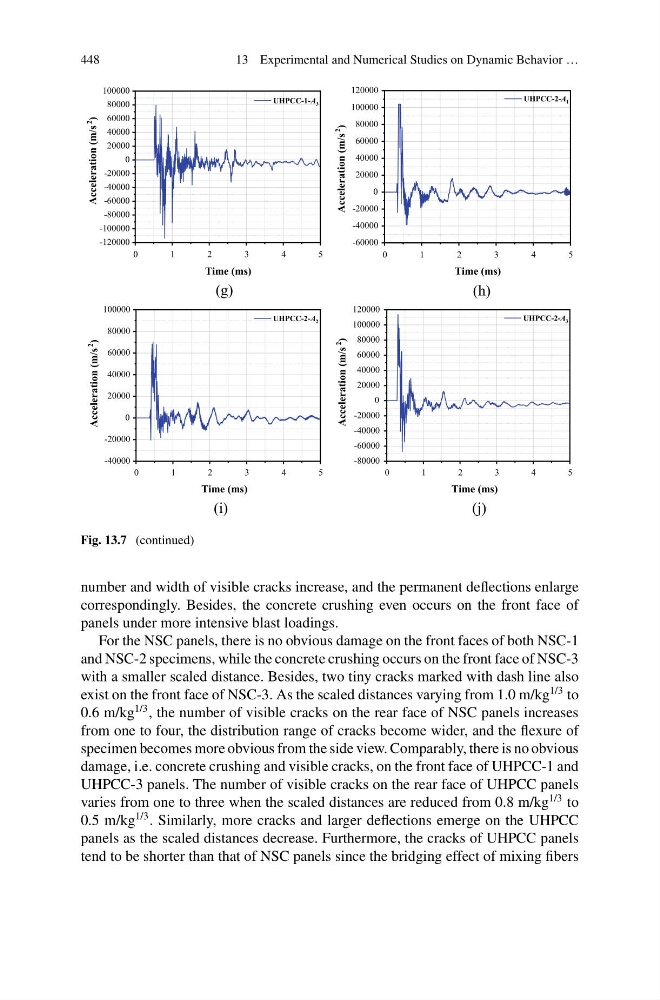
Fig. 13.7 (continued)
number and width of visible cracks increase, and the permanent deflections enlarge
correspondingly. Besides, the concrete crushing even occurs on the front face of
panels under more intensive blast loadings.
For the NSC panels, there is no obvious damage on the front faces of both NSC-1
and NSC-2 specimens, while the concrete crushing occurs on the front face of NSC-3
with a smaller scaled distance. Besides, two tiny cracks marked with dash line also
exist on the front face of NSC-3. As the scaled distances varying from 1.0 m/kg
1/3 to
0.6 m/kg
1/3 , the number of visible cracks on the rear face of NSC panels increases
from one to four, the distribution range of cracks become wider, and the flexure of
specimen becomes more obvious from the side view. Comparably, there is no obvious
damage, i.e. concrete crushing and visible cracks, on the front face of UHPCC-1 and
UHPCC-3 panels. The number of visible cracks on the rear face of UHPCC panels
varies from one to three when the scaled distances are reduced from 0.8 m/kg
1/3 to
0.5 m/kg
1/3 . Similarly, more cracks and larger deflections emerge on the UHPCC
panels as the scaled distances decrease. Furthermore, the cracks of UHPCC panels
tend to be shorter than that of NSC panels since the bridging effect of mixing fibers
13 Experimental and Numerical Studies on Dynamic Behavior …
0
1
2
3
4
5
-120000
-100000
-80000
-60000
-40000
-20000
0
20000
40000
60000
80000
100000
Acceleration (m/s
2
)
Time (ms)
UHPCC-1-A 3
0
1
2
3
4
5
-60000
-40000
-20000
0
20000
40000
60000
80000
100000
120000
Acceleration (m/s
2
)
Time (ms)
UHPCC-2-A 1
(g)
(h)
(i)
(j)
0
1
2
3
4
5
-40000
-20000
0
20000
40000
60000
80000
100000
Acceleration (m/s
2
)
Time (ms)
UHPCC-2-A 2
0
1
2
3
4
5
-80000
-60000
-40000
-20000
0
20000
40000
60000
80000
100000
120000
Acceleration (m/s
2
)
Time (ms)
UHPCC-2-A 3
Fig. 13.7 (continued)
number and width of visible cracks increase, and the permanent deflections enlarge
correspondingly. Besides, the concrete crushing even occurs on the front face of
panels under more intensive blast loadings.
For the NSC panels, there is no obvious damage on the front faces of both NSC-1
and NSC-2 specimens, while the concrete crushing occurs on the front face of NSC-3
with a smaller scaled distance. Besides, two tiny cracks marked with dash line also
exist on the front face of NSC-3. As the scaled distances varying from 1.0 m/kg
1/3 to
0.6 m/kg
1/3 , the number of visible cracks on the rear face of NSC panels increases
from one to four, the distribution range of cracks become wider, and the flexure of
specimen becomes more obvious from the side view. Comparably, there is no obvious
damage, i.e. concrete crushing and visible cracks, on the front face of UHPCC-1 and
UHPCC-3 panels. The number of visible cracks on the rear face of UHPCC panels
varies from one to three when the scaled distances are reduced from 0.8 m/kg
1/3 to
0.5 m/kg
1/3 . Similarly, more cracks and larger deflections emerge on the UHPCC
panels as the scaled distances decrease. Furthermore, the cracks of UHPCC panels
tend to be shorter than that of NSC panels since the bridging effect of mixing fibers