

11.3 Analytical Methods for Predicting the Dynamic Responses …
377
11.3 Analytical Methods for Predicting the Dynamic
Responses of UHPCC-FST Columns
There are commonly three main methods to analyze the dynamic responses of structural members subjected to the blast loadings. First is the numerical simulation
method based on ALE elements (ALE method), the second method is a simplified
numerical simulation method based on velocity loading proposed by Remennikov
and Uy (2014) (velocity method), and the third one is the equivalent single degree
of freedom method (SDOF method). In this section, the above three methods are
adopted to predict the global deformations of UHPCC-FST columns subjected to
close-range explosion presented in Sect. 11.2.
11.3.1 ALE Method
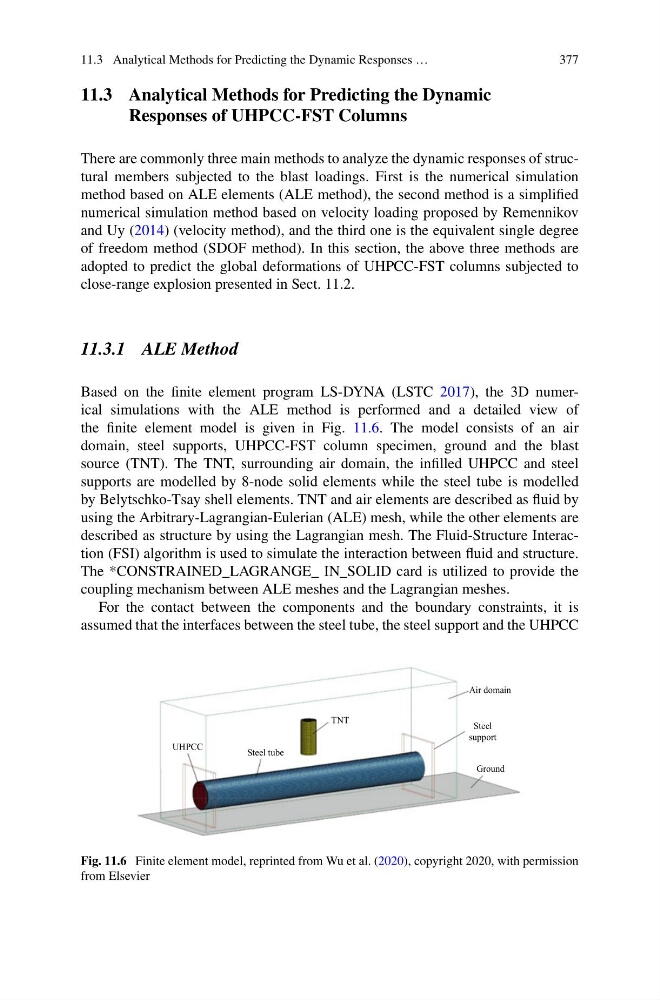
Based on the finite element program LS-DYNA (LSTC 2017), the 3D numerical simulations with the ALE method is performed and a detailed view of
the finite element model is given in Fig. 11.6. The model consists of an air
domain, steel supports, UHPCC-FST column specimen, ground and the blast
source (TNT). The TNT, surrounding air domain, the infilled UHPCC and steel
supports are modelled by 8-node solid elements while the steel tube is modelled
by Belytschko-Tsay shell elements. TNT and air elements are described as fluid by
using the Arbitrary-Lagrangian-Eulerian (ALE) mesh, while the other elements are
described as structure by using the Lagrangian mesh. The Fluid-Structure Interaction (FSI) algorithm is used to simulate the interaction between fluid and structure.
The *CONSTRAINED_LAGRANGE_ IN_SOLID card is utilized to provide the
coupling mechanism between ALE meshes and the Lagrangian meshes.
For the contact between the components and the boundary constraints, it is
assumed that the interfaces between the steel tube, the steel support and the UHPCC
TNT
Steel tube
UHPCC
Steel
support
Air domain
Ground
Fig. 11.6 Finite element model, reprinted from Wu et al. (2020), copyright 2020, with permission
from Elsevier
377
11.3 Analytical Methods for Predicting the Dynamic
Responses of UHPCC-FST Columns
There are commonly three main methods to analyze the dynamic responses of structural members subjected to the blast loadings. First is the numerical simulation
method based on ALE elements (ALE method), the second method is a simplified
numerical simulation method based on velocity loading proposed by Remennikov
and Uy (2014) (velocity method), and the third one is the equivalent single degree
of freedom method (SDOF method). In this section, the above three methods are
adopted to predict the global deformations of UHPCC-FST columns subjected to
close-range explosion presented in Sect. 11.2.
11.3.1 ALE Method
Based on the finite element program LS-DYNA (LSTC 2017), the 3D numerical simulations with the ALE method is performed and a detailed view of
the finite element model is given in Fig. 11.6. The model consists of an air
domain, steel supports, UHPCC-FST column specimen, ground and the blast
source (TNT). The TNT, surrounding air domain, the infilled UHPCC and steel
supports are modelled by 8-node solid elements while the steel tube is modelled
by Belytschko-Tsay shell elements. TNT and air elements are described as fluid by
using the Arbitrary-Lagrangian-Eulerian (ALE) mesh, while the other elements are
described as structure by using the Lagrangian mesh. The Fluid-Structure Interaction (FSI) algorithm is used to simulate the interaction between fluid and structure.
The *CONSTRAINED_LAGRANGE_ IN_SOLID card is utilized to provide the
coupling mechanism between ALE meshes and the Lagrangian meshes.
For the contact between the components and the boundary constraints, it is
assumed that the interfaces between the steel tube, the steel support and the UHPCC
TNT
Steel tube
UHPCC
Steel
support
Air domain
Ground
Fig. 11.6 Finite element model, reprinted from Wu et al. (2020), copyright 2020, with permission
from Elsevier