

362
10 Residual Axial Capacity of UHPCC-FST Column Under …
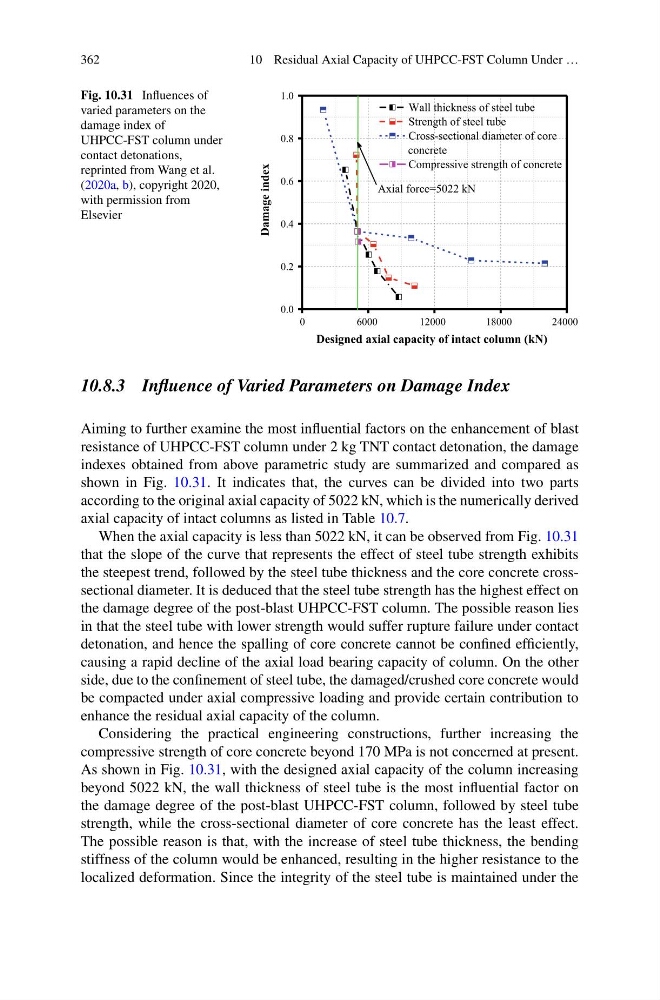
Fig. 10.31 Influences of
varied parameters on the
damage index of
UHPCC-FST column under
contact detonations,
reprinted from Wang et al.
(2020a, b), copyright 2020,
with permission from
Elsevier
0
6000
12000
18000
24000
0.0
0.2
0.4
0.6
0.8
1.0
Axial force=5022 kN
Wall thickness of steel tube
Strength of steel tube
Cross-sectional diameter of core
concrete
Compressive strength of concrete
Designed axial capacity of intact column (kN)
Damage index
10.8.3 Influence of Varied Parameters on Damage Index
Aiming to further examine the most influential factors on the enhancement of blast
resistance of UHPCC-FST column under 2 kg TNT contact detonation, the damage
indexes obtained from above parametric study are summarized and compared as
shown in Fig. 10.31. It indicates that, the curves can be divided into two parts
according to the original axial capacity of 5022 kN, which is the numerically derived
axial capacity of intact columns as listed in Table 10.7.
When the axial capacity is less than 5022 kN, it can be observed from Fig. 10.31
that the slope of the curve that represents the effect of steel tube strength exhibits
the steepest trend, followed by the steel tube thickness and the core concrete crosssectional diameter. It is deduced that the steel tube strength has the highest effect on
the damage degree of the post-blast UHPCC-FST column. The possible reason lies
in that the steel tube with lower strength would suffer rupture failure under contact
detonation, and hence the spalling of core concrete cannot be confined efficiently,
causing a rapid decline of the axial load bearing capacity of column. On the other
side, due to the confinement of steel tube, the damaged/crushed core concrete would
be compacted under axial compressive loading and provide certain contribution to
enhance the residual axial capacity of the column.
Considering the practical engineering constructions, further increasing the
compressive strength of core concrete beyond 170 MPa is not concerned at present.
As shown in Fig. 10.31, with the designed axial capacity of the column increasing
beyond 5022 kN, the wall thickness of steel tube is the most influential factor on
the damage degree of the post-blast UHPCC-FST column, followed by steel tube
strength, while the cross-sectional diameter of core concrete has the least effect.
The possible reason is that, with the increase of steel tube thickness, the bending
stiffness of the column would be enhanced, resulting in the higher resistance to the
localized deformation. Since the integrity of the steel tube is maintained under the
10 Residual Axial Capacity of UHPCC-FST Column Under …
Fig. 10.31 Influences of
varied parameters on the
damage index of
UHPCC-FST column under
contact detonations,
reprinted from Wang et al.
(2020a, b), copyright 2020,
with permission from
Elsevier
0
6000
12000
18000
24000
0.0
0.2
0.4
0.6
0.8
1.0
Axial force=5022 kN
Wall thickness of steel tube
Strength of steel tube
Cross-sectional diameter of core
concrete
Compressive strength of concrete
Designed axial capacity of intact column (kN)
Damage index
10.8.3 Influence of Varied Parameters on Damage Index
Aiming to further examine the most influential factors on the enhancement of blast
resistance of UHPCC-FST column under 2 kg TNT contact detonation, the damage
indexes obtained from above parametric study are summarized and compared as
shown in Fig. 10.31. It indicates that, the curves can be divided into two parts
according to the original axial capacity of 5022 kN, which is the numerically derived
axial capacity of intact columns as listed in Table 10.7.
When the axial capacity is less than 5022 kN, it can be observed from Fig. 10.31
that the slope of the curve that represents the effect of steel tube strength exhibits
the steepest trend, followed by the steel tube thickness and the core concrete crosssectional diameter. It is deduced that the steel tube strength has the highest effect on
the damage degree of the post-blast UHPCC-FST column. The possible reason lies
in that the steel tube with lower strength would suffer rupture failure under contact
detonation, and hence the spalling of core concrete cannot be confined efficiently,
causing a rapid decline of the axial load bearing capacity of column. On the other
side, due to the confinement of steel tube, the damaged/crushed core concrete would
be compacted under axial compressive loading and provide certain contribution to
enhance the residual axial capacity of the column.
Considering the practical engineering constructions, further increasing the
compressive strength of core concrete beyond 170 MPa is not concerned at present.
As shown in Fig. 10.31, with the designed axial capacity of the column increasing
beyond 5022 kN, the wall thickness of steel tube is the most influential factor on
the damage degree of the post-blast UHPCC-FST column, followed by steel tube
strength, while the cross-sectional diameter of core concrete has the least effect.
The possible reason is that, with the increase of steel tube thickness, the bending
stiffness of the column would be enhanced, resulting in the higher resistance to the
localized deformation. Since the integrity of the steel tube is maintained under the