

10.3 UHPCC-FST Columns
323
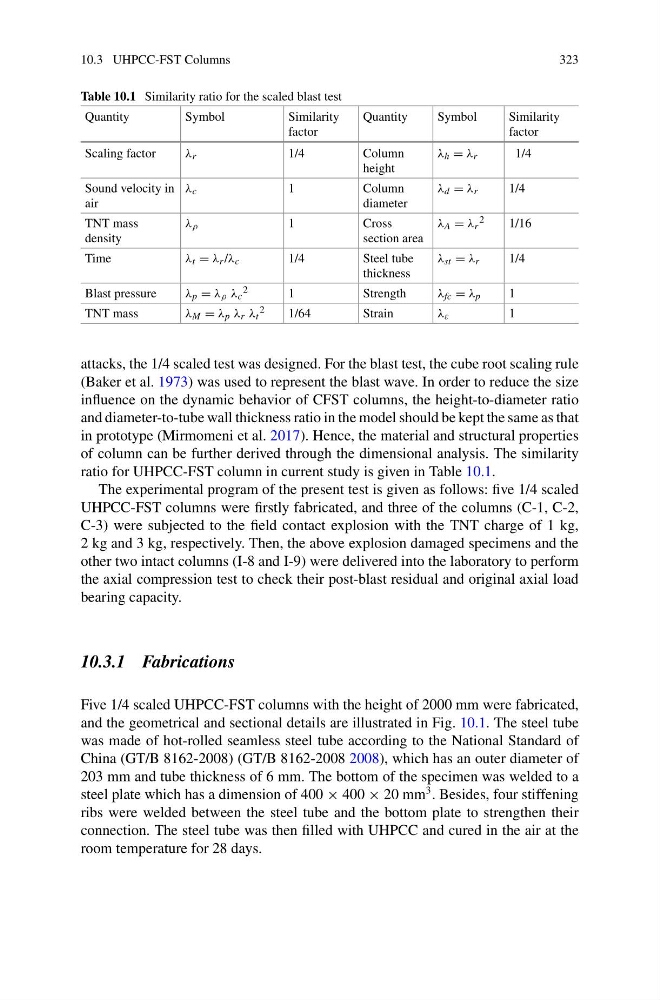
Table 10.1 Similarity ratio for the scaled blast test
Quantity
Symbol
Similarity
factor
Quantity
Symbol
Similarity
factor
Scaling factor
λ r
1/4
Column
height
λ h = λ r
1/4
Sound velocity in
air
λ c
1
Column
diameter
λ d = λ r
1/4
TNT mass
density
λ ρ
1
Cross
section area
λ A = λ r
2
1/16
Time
λ t = λ r /λ c
1/4
Steel tube
thickness
λ st = λ r
1/4
Blast pressure
λ p = λ ρ λ c
2
1
Strength
λ fc = λ p
1
TNT mass
λ M = λ p λ r λ t
2
1/64
Strain
λ ε
1
attacks, the 1/4 scaled test was designed. For the blast test, the cube root scaling rule
(Baker et al. 1973) was used to represent the blast wave. In order to reduce the size
influence on the dynamic behavior of CFST columns, the height-to-diameter ratio
and diameter-to-tube wall thickness ratio in the model should be kept the same as that
in prototype (Mirmomeni et al. 2017). Hence, the material and structural properties
of column can be further derived through the dimensional analysis. The similarity
ratio for UHPCC-FST column in current study is given in Table 10.1.
The experimental program of the present test is given as follows: five 1/4 scaled
UHPCC-FST columns were firstly fabricated, and three of the columns (C-1, C-2,
C-3) were subjected to the field contact explosion with the TNT charge of 1 kg,
2 kg and 3 kg, respectively. Then, the above explosion damaged specimens and the
other two intact columns (I-8 and I-9) were delivered into the laboratory to perform
the axial compression test to check their post-blast residual and original axial load
bearing capacity.
10.3.1 Fabrications
Five 1/4 scaled UHPCC-FST columns with the height of 2000 mm were fabricated,
and the geometrical and sectional details are illustrated in Fig. 10.1. The steel tube
was made of hot-rolled seamless steel tube according to the National Standard of
China (GT/B 8162-2008) (GT/B 8162-2008 2008), which has an outer diameter of
203 mm and tube thickness of 6 mm. The bottom of the specimen was welded to a
steel plate which has a dimension of 400 × 400 × 20 mm
3 . Besides, four stiffening
ribs were welded between the steel tube and the bottom plate to strengthen their
connection. The steel tube was then filled with UHPCC and cured in the air at the
room temperature for 28 days.
323
Table 10.1 Similarity ratio for the scaled blast test
Quantity
Symbol
Similarity
factor
Quantity
Symbol
Similarity
factor
Scaling factor
λ r
1/4
Column
height
λ h = λ r
1/4
Sound velocity in
air
λ c
1
Column
diameter
λ d = λ r
1/4
TNT mass
density
λ ρ
1
Cross
section area
λ A = λ r
2
1/16
Time
λ t = λ r /λ c
1/4
Steel tube
thickness
λ st = λ r
1/4
Blast pressure
λ p = λ ρ λ c
2
1
Strength
λ fc = λ p
1
TNT mass
λ M = λ p λ r λ t
2
1/64
Strain
λ ε
1
attacks, the 1/4 scaled test was designed. For the blast test, the cube root scaling rule
(Baker et al. 1973) was used to represent the blast wave. In order to reduce the size
influence on the dynamic behavior of CFST columns, the height-to-diameter ratio
and diameter-to-tube wall thickness ratio in the model should be kept the same as that
in prototype (Mirmomeni et al. 2017). Hence, the material and structural properties
of column can be further derived through the dimensional analysis. The similarity
ratio for UHPCC-FST column in current study is given in Table 10.1.
The experimental program of the present test is given as follows: five 1/4 scaled
UHPCC-FST columns were firstly fabricated, and three of the columns (C-1, C-2,
C-3) were subjected to the field contact explosion with the TNT charge of 1 kg,
2 kg and 3 kg, respectively. Then, the above explosion damaged specimens and the
other two intact columns (I-8 and I-9) were delivered into the laboratory to perform
the axial compression test to check their post-blast residual and original axial load
bearing capacity.
10.3.1 Fabrications
Five 1/4 scaled UHPCC-FST columns with the height of 2000 mm were fabricated,
and the geometrical and sectional details are illustrated in Fig. 10.1. The steel tube
was made of hot-rolled seamless steel tube according to the National Standard of
China (GT/B 8162-2008) (GT/B 8162-2008 2008), which has an outer diameter of
203 mm and tube thickness of 6 mm. The bottom of the specimen was welded to a
steel plate which has a dimension of 400 × 400 × 20 mm
3 . Besides, four stiffening
ribs were welded between the steel tube and the bottom plate to strengthen their
connection. The steel tube was then filled with UHPCC and cured in the air at the
room temperature for 28 days.