

282
9 Dynamic Responses of Reinforced UHPCC Members Under …
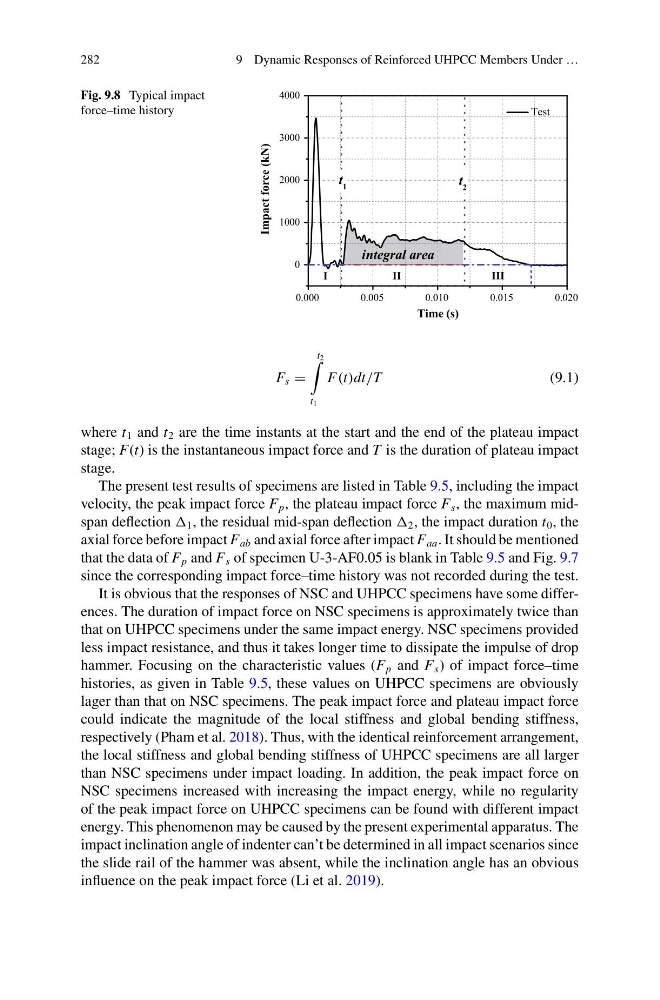
Fig. 9.8 Typical impact
force–time history
0.000
0.005
0.010
0.015
0.020
0
1000
2000
3000
4000
Test
integral area
t 2
t 1
Impact force (kN)
Time (s)
I
I I
III
F s =
t 2
t 1
F(t)dt/T
(9.1)
where t 1 and t 2 are the time instants at the start and the end of the plateau impact
stage; F(t) is the instantaneous impact force and T is the duration of plateau impact
stage.
The present test results of specimens are listed in Table 9.5, including the impact
velocity, the peak impact force F p , the plateau impact force F s , the maximum midspan deflection 1 , the residual mid-span deflection 2 , the impact duration t 0 , the
axial force before impact F ab and axial force after impact F aa . It should be mentioned
that the data of F p and F s of specimen U-3-AF0.05 is blank in Table 9.5 and Fig. 9.7
since the corresponding impact force–time history was not recorded during the test.
It is obvious that the responses of NSC and UHPCC specimens have some differences. The duration of impact force on NSC specimens is approximately twice than
that on UHPCC specimens under the same impact energy. NSC specimens provided
less impact resistance, and thus it takes longer time to dissipate the impulse of drop
hammer. Focusing on the characteristic values (F p and F s ) of impact force–time
histories, as given in Table 9.5, these values on UHPCC specimens are obviously
lager than that on NSC specimens. The peak impact force and plateau impact force
could indicate the magnitude of the local stiffness and global bending stiffness,
respectively (Pham et al. 2018). Thus, with the identical reinforcement arrangement,
the local stiffness and global bending stiffness of UHPCC specimens are all larger
than NSC specimens under impact loading. In addition, the peak impact force on
NSC specimens increased with increasing the impact energy, while no regularity
of the peak impact force on UHPCC specimens can be found with different impact
energy. This phenomenon may be caused by the present experimental apparatus. The
impact inclination angle of indenter can’t be determined in all impact scenarios since
the slide rail of the hammer was absent, while the inclination angle has an obvious
influence on the peak impact force (Li et al. 2019).
9 Dynamic Responses of Reinforced UHPCC Members Under …
Fig. 9.8 Typical impact
force–time history
0.000
0.005
0.010
0.015
0.020
0
1000
2000
3000
4000
Test
integral area
t 2
t 1
Impact force (kN)
Time (s)
I
I I
III
F s =
t 2
t 1
F(t)dt/T
(9.1)
where t 1 and t 2 are the time instants at the start and the end of the plateau impact
stage; F(t) is the instantaneous impact force and T is the duration of plateau impact
stage.
The present test results of specimens are listed in Table 9.5, including the impact
velocity, the peak impact force F p , the plateau impact force F s , the maximum midspan deflection 1 , the residual mid-span deflection 2 , the impact duration t 0 , the
axial force before impact F ab and axial force after impact F aa . It should be mentioned
that the data of F p and F s of specimen U-3-AF0.05 is blank in Table 9.5 and Fig. 9.7
since the corresponding impact force–time history was not recorded during the test.
It is obvious that the responses of NSC and UHPCC specimens have some differences. The duration of impact force on NSC specimens is approximately twice than
that on UHPCC specimens under the same impact energy. NSC specimens provided
less impact resistance, and thus it takes longer time to dissipate the impulse of drop
hammer. Focusing on the characteristic values (F p and F s ) of impact force–time
histories, as given in Table 9.5, these values on UHPCC specimens are obviously
lager than that on NSC specimens. The peak impact force and plateau impact force
could indicate the magnitude of the local stiffness and global bending stiffness,
respectively (Pham et al. 2018). Thus, with the identical reinforcement arrangement,
the local stiffness and global bending stiffness of UHPCC specimens are all larger
than NSC specimens under impact loading. In addition, the peak impact force on
NSC specimens increased with increasing the impact energy, while no regularity
of the peak impact force on UHPCC specimens can be found with different impact
energy. This phenomenon may be caused by the present experimental apparatus. The
impact inclination angle of indenter can’t be determined in all impact scenarios since
the slide rail of the hammer was absent, while the inclination angle has an obvious
influence on the peak impact force (Li et al. 2019).