

254
8 Response of UHPCC-FST Subjected to Low-Velocity Impact
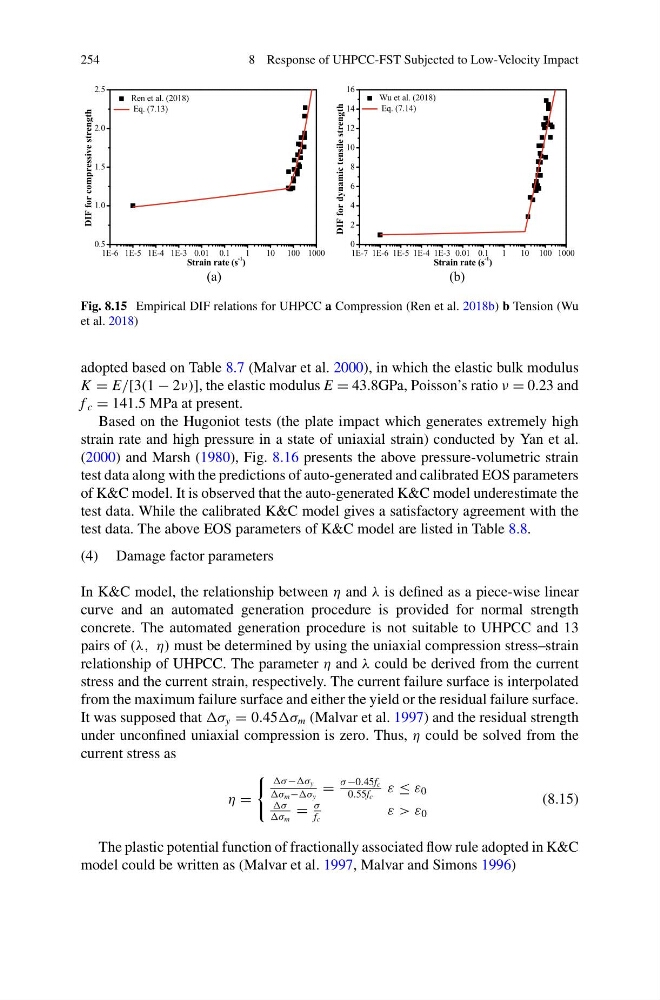
Fig. 8.15 Empirical DIF relations for UHPCC a Compression (Ren et al. 2018b) b Tension (Wu
et al. 2018)
adopted based on Table 8.7 (Malvar et al. 2000), in which the elastic bulk modulus
K = E/[3(1 − 2ν)], the elastic modulus E = 43.8GPa, Poisson’s ratio ν = 0.23 and
f c = 141.5 MPa at present.
Based on the Hugoniot tests (the plate impact which generates extremely high
strain rate and high pressure in a state of uniaxial strain) conducted by Yan et al.
(2000) and Marsh (1980), Fig. 8.16 presents the above pressure-volumetric strain
test data along with the predictions of auto-generated and calibrated EOS parameters
of K&C model. It is observed that the auto-generated K&C model underestimate the
test data. While the calibrated K&C model gives a satisfactory agreement with the
test data. The above EOS parameters of K&C model are listed in Table 8.8.
(4) Damage factor parameters
In K&C model, the relationship between η and λ is defined as a piece-wise linear
curve and an automated generation procedure is provided for normal strength
concrete. The automated generation procedure is not suitable to UHPCC and 13
pairs of (λ, η) must be determined by using the uniaxial compression stress–strain
relationship of UHPCC. The parameter η and λ could be derived from the current
stress and the current strain, respectively. The current failure surface is interpolated
from the maximum failure surface and either the yield or the residual failure surface.
It was supposed that y = 0.45 m (Malvar et al. 1997) and the residual strength
under unconfined uniaxial compression is zero. Thus, η could be solved from the
current stress as
η =
− y
σ m − y
=
σ −0.45f c
0.55f c
ε ≤ ε 0
σ m
=
σ
f c
ε > ε 0
(8.15)
The plastic potential function of fractionally associated flow rule adopted in K&C
model could be written as (Malvar et al. 1997, Malvar and Simons 1996)
8 Response of UHPCC-FST Subjected to Low-Velocity Impact
Fig. 8.15 Empirical DIF relations for UHPCC a Compression (Ren et al. 2018b) b Tension (Wu
et al. 2018)
adopted based on Table 8.7 (Malvar et al. 2000), in which the elastic bulk modulus
K = E/[3(1 − 2ν)], the elastic modulus E = 43.8GPa, Poisson’s ratio ν = 0.23 and
f c = 141.5 MPa at present.
Based on the Hugoniot tests (the plate impact which generates extremely high
strain rate and high pressure in a state of uniaxial strain) conducted by Yan et al.
(2000) and Marsh (1980), Fig. 8.16 presents the above pressure-volumetric strain
test data along with the predictions of auto-generated and calibrated EOS parameters
of K&C model. It is observed that the auto-generated K&C model underestimate the
test data. While the calibrated K&C model gives a satisfactory agreement with the
test data. The above EOS parameters of K&C model are listed in Table 8.8.
(4) Damage factor parameters
In K&C model, the relationship between η and λ is defined as a piece-wise linear
curve and an automated generation procedure is provided for normal strength
concrete. The automated generation procedure is not suitable to UHPCC and 13
pairs of (λ, η) must be determined by using the uniaxial compression stress–strain
relationship of UHPCC. The parameter η and λ could be derived from the current
stress and the current strain, respectively. The current failure surface is interpolated
from the maximum failure surface and either the yield or the residual failure surface.
It was supposed that y = 0.45 m (Malvar et al. 1997) and the residual strength
under unconfined uniaxial compression is zero. Thus, η could be solved from the
current stress as
η =
− y
σ m − y
=
σ −0.45f c
0.55f c
ε ≤ ε 0
σ m
=
σ
f c
ε > ε 0
(8.15)
The plastic potential function of fractionally associated flow rule adopted in K&C
model could be written as (Malvar et al. 1997, Malvar and Simons 1996)