

1.2 Test Program
5
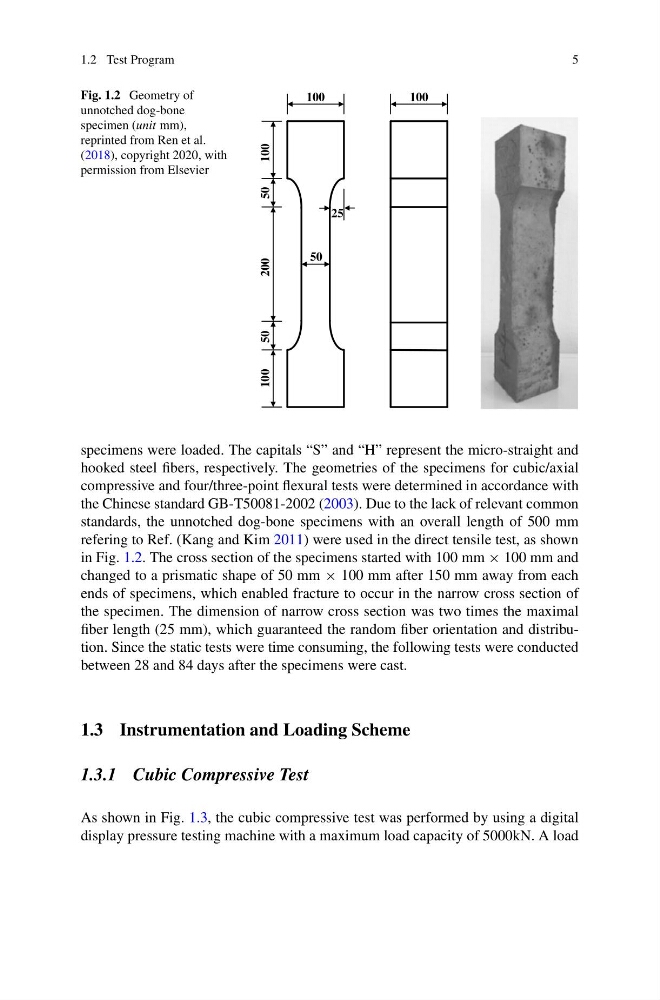
Fig. 1.2 Geometry of
unnotched dog-bone
specimen (unit mm),
reprinted from Ren et al.
(2018), copyright 2020, with
permission from Elsevier
100
100
0
5
0
0
1
200
50
50
25
100
specimens were loaded. The capitals “S” and “H” represent the micro-straight and
hooked steel fibers, respectively. The geometries of the specimens for cubic/axial
compressive and four/three-point flexural tests were determined in accordance with
the Chinese standard GB-T50081-2002 (2003). Due to the lack of relevant common
standards, the unnotched dog-bone specimens with an overall length of 500 mm
refering to Ref. (Kang and Kim 2011) were used in the direct tensile test, as shown
in Fig. 1.2. The cross section of the specimens started with 100 mm × 100 mm and
changed to a prismatic shape of 50 mm × 100 mm after 150 mm away from each
ends of specimens, which enabled fracture to occur in the narrow cross section of
the specimen. The dimension of narrow cross section was two times the maximal
fiber length (25 mm), which guaranteed the random fiber orientation and distribution. Since the static tests were time consuming, the following tests were conducted
between 28 and 84 days after the specimens were cast.
1.3 Instrumentation and Loading Scheme
1.3.1 Cubic Compressive Test
As shown in Fig. 1.3, the cubic compressive test was performed by using a digital
display pressure testing machine with a maximum load capacity of 5000kN. A load
5
Fig. 1.2 Geometry of
unnotched dog-bone
specimen (unit mm),
reprinted from Ren et al.
(2018), copyright 2020, with
permission from Elsevier
100
100
0
5
0
0
1
200
50
50
25
100
specimens were loaded. The capitals “S” and “H” represent the micro-straight and
hooked steel fibers, respectively. The geometries of the specimens for cubic/axial
compressive and four/three-point flexural tests were determined in accordance with
the Chinese standard GB-T50081-2002 (2003). Due to the lack of relevant common
standards, the unnotched dog-bone specimens with an overall length of 500 mm
refering to Ref. (Kang and Kim 2011) were used in the direct tensile test, as shown
in Fig. 1.2. The cross section of the specimens started with 100 mm × 100 mm and
changed to a prismatic shape of 50 mm × 100 mm after 150 mm away from each
ends of specimens, which enabled fracture to occur in the narrow cross section of
the specimen. The dimension of narrow cross section was two times the maximal
fiber length (25 mm), which guaranteed the random fiber orientation and distribution. Since the static tests were time consuming, the following tests were conducted
between 28 and 84 days after the specimens were cast.
1.3 Instrumentation and Loading Scheme
1.3.1 Cubic Compressive Test
As shown in Fig. 1.3, the cubic compressive test was performed by using a digital
display pressure testing machine with a maximum load capacity of 5000kN. A load