

8.1 Introduction
239
The existing works are mainly concentrated on the normal strength concrete (NSC)
and high-strength concrete (HSC) filled steel tubes (Bambach et al. 2008; Remennikov et al. 2011; Deng et al. 2012; Yousuff et al. 2012; Han et al. 2014; Wang
et al. 2013, 2015, 2016; Du et al. 2018), relatively limited experimental and numerical simulation works were conducted to investigate the structural performance and
impact resistance of UHPCC-FSTs subjected to transverse impact.
At present, a comprehensive study on the impact behavior of circular UHPCC-FST
under transverse impact load is conducted. Firstly, the axial compression test was
conducted to analyze the axial load capacities and obtain the constraining factor of
UHPCC-FSTs. Secondly, three UHPCC-FSTs are tested horizontally by using a drophammer impact device, and the dynamic response of the specimens under transverse
impact load, i.e., the impact force- and deflection-time histories, are recorded and
discussed. Thirdly, the plasticity concrete material model (K&C model) (Malvar et al.
1997) is adopted and the constitutive model parameters for UHPCC are calibrated
based on a series of test data. Finally, by using the calibrated K&C model, a FE
analysis model is established to predict the dynamic behavior of UHPCC-FSTs under
transverse impact load.
8.2 Test Program
8.2.1 UHPCC-FST Specimens
UHPCC is prepared in the State Key Laboratory of High Performance Civil Engineering Materials, Jiangsu Research Institute of Building Science in China, which
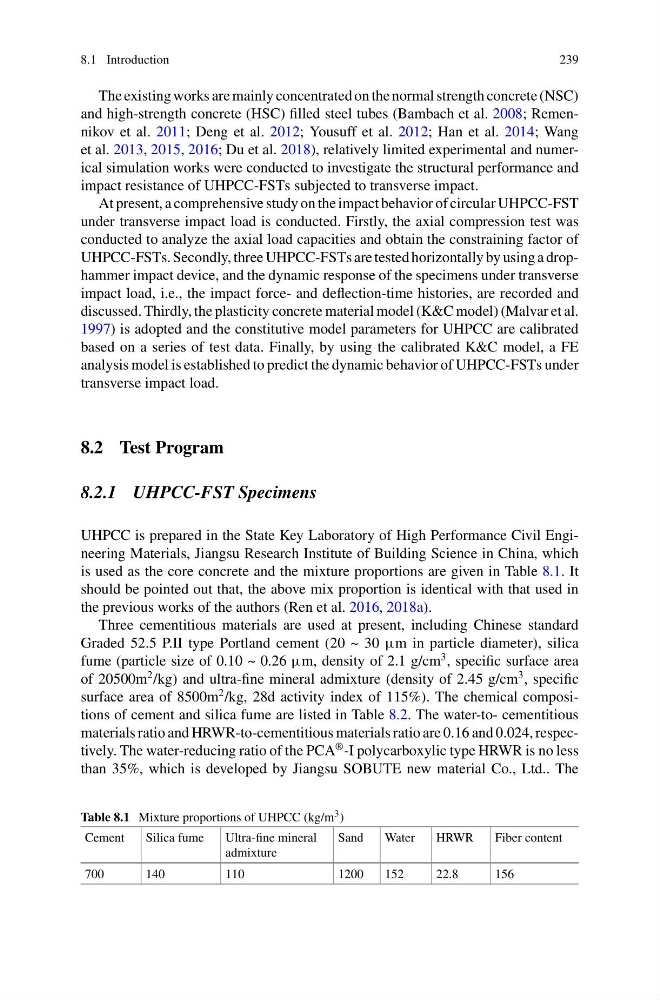
is used as the core concrete and the mixture proportions are given in Table 8.1. It
should be pointed out that, the above mix proportion is identical with that used in
the previous works of the authors (Ren et al. 2016, 2018a).
Three cementitious materials are used at present, including Chinese standard
Graded 52.5 P.II type Portland cement (20 ~ 30 µm in particle diameter), silica
fume (particle size of 0.10 ~ 0.26 µm, density of 2.1 g/cm
3 , specific surface area
of 20500m
2 /kg) and ultra-fine mineral admixture (density of 2.45 g/cm
3 , specific
surface area of 8500m
2 /kg, 28d activity index of 115%). The chemical compositions of cement and silica fume are listed in Table 8.2. The water-to- cementitious
materials ratio and HRWR-to-cementitious materials ratio are 0.16 and 0.024, respectively. The water-reducing ratio of the PCA
® -I polycarboxylic type HRWR is no less
than 35%, which is developed by Jiangsu SOBUTE new material Co., Ltd.. The
Table 8.1 Mixture proportions of UHPCC (kg/m 3 )
Cement
Silica fume
Ultra-fine mineral
admixture
Sand
Water
HRWR
Fiber content
700
140
110
1200
152
22.8
156
239
The existing works are mainly concentrated on the normal strength concrete (NSC)
and high-strength concrete (HSC) filled steel tubes (Bambach et al. 2008; Remennikov et al. 2011; Deng et al. 2012; Yousuff et al. 2012; Han et al. 2014; Wang
et al. 2013, 2015, 2016; Du et al. 2018), relatively limited experimental and numerical simulation works were conducted to investigate the structural performance and
impact resistance of UHPCC-FSTs subjected to transverse impact.
At present, a comprehensive study on the impact behavior of circular UHPCC-FST
under transverse impact load is conducted. Firstly, the axial compression test was
conducted to analyze the axial load capacities and obtain the constraining factor of
UHPCC-FSTs. Secondly, three UHPCC-FSTs are tested horizontally by using a drophammer impact device, and the dynamic response of the specimens under transverse
impact load, i.e., the impact force- and deflection-time histories, are recorded and
discussed. Thirdly, the plasticity concrete material model (K&C model) (Malvar et al.
1997) is adopted and the constitutive model parameters for UHPCC are calibrated
based on a series of test data. Finally, by using the calibrated K&C model, a FE
analysis model is established to predict the dynamic behavior of UHPCC-FSTs under
transverse impact load.
8.2 Test Program
8.2.1 UHPCC-FST Specimens
UHPCC is prepared in the State Key Laboratory of High Performance Civil Engineering Materials, Jiangsu Research Institute of Building Science in China, which
is used as the core concrete and the mixture proportions are given in Table 8.1. It
should be pointed out that, the above mix proportion is identical with that used in
the previous works of the authors (Ren et al. 2016, 2018a).
Three cementitious materials are used at present, including Chinese standard
Graded 52.5 P.II type Portland cement (20 ~ 30 µm in particle diameter), silica
fume (particle size of 0.10 ~ 0.26 µm, density of 2.1 g/cm
3 , specific surface area
of 20500m
2 /kg) and ultra-fine mineral admixture (density of 2.45 g/cm
3 , specific
surface area of 8500m
2 /kg, 28d activity index of 115%). The chemical compositions of cement and silica fume are listed in Table 8.2. The water-to- cementitious
materials ratio and HRWR-to-cementitious materials ratio are 0.16 and 0.024, respectively. The water-reducing ratio of the PCA
® -I polycarboxylic type HRWR is no less
than 35%, which is developed by Jiangsu SOBUTE new material Co., Ltd.. The
Table 8.1 Mixture proportions of UHPCC (kg/m 3 )
Cement
Silica fume
Ultra-fine mineral
admixture
Sand
Water
HRWR
Fiber content
700
140
110
1200
152
22.8
156