

200
7 Impact Resistance of Armor Steel/Ceramic/UHPCC Layered …
Projectile
Fractured
ceramic
(a)
(b)
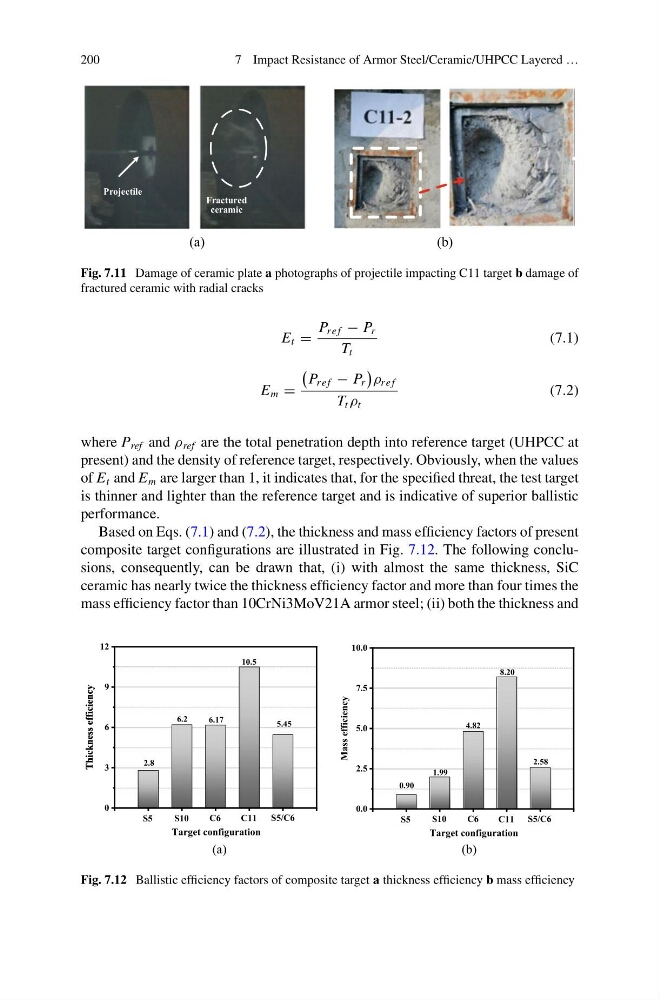
Fig. 7.11 Damage of ceramic plate a photographs of projectile impacting C11 target b damage of
fractured ceramic with radial cracks
E t =
P re f − P r
T t
(7.1)
E m =
P re f − P r
ρ re f
T t ρ t
(7.2)
where P ref and ρ ref are the total penetration depth into reference target (UHPCC at
present) and the density of reference target, respectively. Obviously, when the values
of E t and E m are larger than 1, it indicates that, for the specified threat, the test target
is thinner and lighter than the reference target and is indicative of superior ballistic
performance.
Based on Eqs. (7.1) and (7.2), the thickness and mass efficiency factors of present
composite target configurations are illustrated in Fig. 7.12. The following conclusions, consequently, can be drawn that, (i) with almost the same thickness, SiC
ceramic has nearly twice the thickness efficiency factor and more than four times the
mass efficiency factor than 10CrNi3MoV21A armor steel; (ii) both the thickness and
(a)
(b)
0
3
6
9
12
5.45
10.5
6.17
6.2
Thickness efficiency
S5/C6
C11
C6
S10
Thickness efficiency
S5
Target configuration
2.8
0.0
2.5
5.0
7.5
10.0
2.58
8.20
4.82
1.99
S5/C6
C11
C6
S10
Mass efficiency
S5
Target configuration
0.90
Fig. 7.12 Ballistic efficiency factors of composite target a thickness efficiency b mass efficiency
7 Impact Resistance of Armor Steel/Ceramic/UHPCC Layered …
Projectile
Fractured
ceramic
(a)
(b)
Fig. 7.11 Damage of ceramic plate a photographs of projectile impacting C11 target b damage of
fractured ceramic with radial cracks
E t =
P re f − P r
T t
(7.1)
E m =
P re f − P r
ρ re f
T t ρ t
(7.2)
where P ref and ρ ref are the total penetration depth into reference target (UHPCC at
present) and the density of reference target, respectively. Obviously, when the values
of E t and E m are larger than 1, it indicates that, for the specified threat, the test target
is thinner and lighter than the reference target and is indicative of superior ballistic
performance.
Based on Eqs. (7.1) and (7.2), the thickness and mass efficiency factors of present
composite target configurations are illustrated in Fig. 7.12. The following conclusions, consequently, can be drawn that, (i) with almost the same thickness, SiC
ceramic has nearly twice the thickness efficiency factor and more than four times the
mass efficiency factor than 10CrNi3MoV21A armor steel; (ii) both the thickness and
(a)
(b)
0
3
6
9
12
5.45
10.5
6.17
6.2
Thickness efficiency
S5/C6
C11
C6
S10
Thickness efficiency
S5
Target configuration
2.8
0.0
2.5
5.0
7.5
10.0
2.58
8.20
4.82
1.99
S5/C6
C11
C6
S10
Mass efficiency
S5
Target configuration
0.90
Fig. 7.12 Ballistic efficiency factors of composite target a thickness efficiency b mass efficiency