

6.4 Discussions
179
(a)
(b)
0
50
100
150
200
250
300
1-4 1-5 1-6 1-7 1-8
2-4 2-7
3-4 3-7
Bare panel
Panel with UHMWPE
Panel with CRFP
Dimensionless crater area
Shot no.
0
10
20
30
40
50
60
70
80
1-4 1-5 1-6 1-7 1-8
2-4 2-7
3-4 3-7
Bare panel
Panel with UHMWPE
Panel with CRFP
Crater volume (cm
3
)
Shot no.
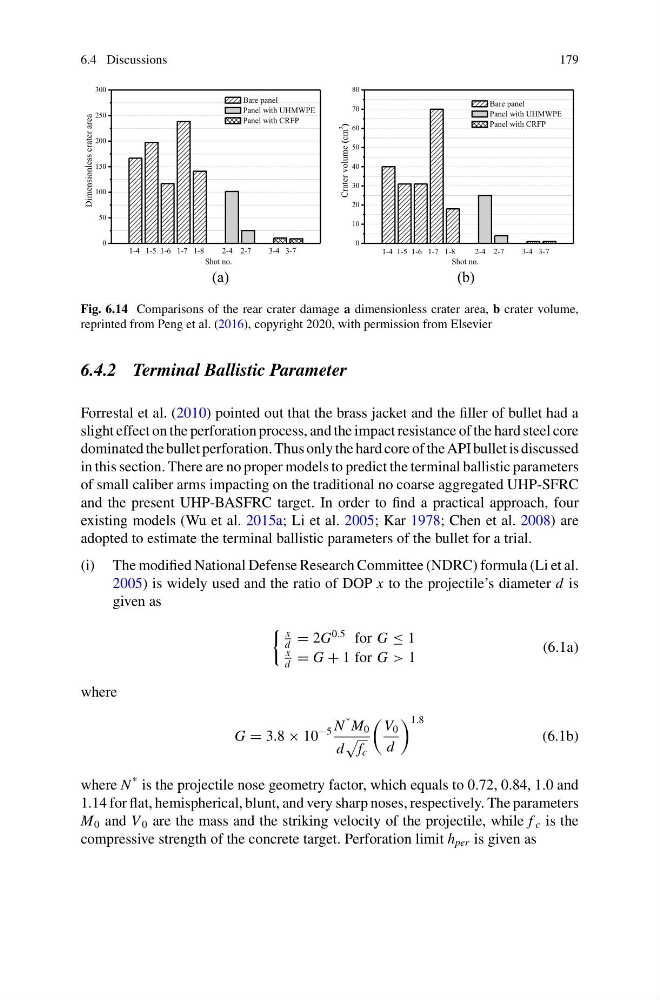
Fig. 6.14 Comparisons of the rear crater damage a dimensionless crater area, b crater volume,
reprinted from Peng et al. (2016), copyright 2020, with permission from Elsevier
6.4.2 Terminal Ballistic Parameter
Forrestal et al. (2010) pointed out that the brass jacket and the filler of bullet had a
slight effect on the perforation process, and the impact resistance of the hard steel core
dominated the bullet perforation. Thus only the hard core of the API bullet is discussed
in this section. There are no proper models to predict the terminal ballistic parameters
of small caliber arms impacting on the traditional no coarse aggregated UHP-SFRC
and the present UHP-BASFRC target. In order to find a practical approach, four
existing models (Wu et al. 2015a; Li et al. 2005; Kar 1978; Chen et al. 2008) are
adopted to estimate the terminal ballistic parameters of the bullet for a trial.
(i) The modified National Defense Research Committee (NDRC) formula (Li et al.
2005) is widely used and the ratio of DOP x to the projectile’s diameter d is
given as
x
d
= 2G
0.5 for G ≤ 1
x
d
= G + 1 for G > 1
(6.1a)
where
G = 3.8 × 10
−5 N
∗ M 0
d
f c
V 0
d
1.8
(6.1b)
where N
* is the projectile nose geometry factor, which equals to 0.72, 0.84, 1.0 and
1.14 for flat, hemispherical, blunt, and very sharp noses, respectively. The parameters
M 0 and V 0 are the mass and the striking velocity of the projectile, while f c is the
compressive strength of the concrete target. Perforation limit h per is given as
179
(a)
(b)
0
50
100
150
200
250
300
1-4 1-5 1-6 1-7 1-8
2-4 2-7
3-4 3-7
Bare panel
Panel with UHMWPE
Panel with CRFP
Dimensionless crater area
Shot no.
0
10
20
30
40
50
60
70
80
1-4 1-5 1-6 1-7 1-8
2-4 2-7
3-4 3-7
Bare panel
Panel with UHMWPE
Panel with CRFP
Crater volume (cm
3
)
Shot no.
Fig. 6.14 Comparisons of the rear crater damage a dimensionless crater area, b crater volume,
reprinted from Peng et al. (2016), copyright 2020, with permission from Elsevier
6.4.2 Terminal Ballistic Parameter
Forrestal et al. (2010) pointed out that the brass jacket and the filler of bullet had a
slight effect on the perforation process, and the impact resistance of the hard steel core
dominated the bullet perforation. Thus only the hard core of the API bullet is discussed
in this section. There are no proper models to predict the terminal ballistic parameters
of small caliber arms impacting on the traditional no coarse aggregated UHP-SFRC
and the present UHP-BASFRC target. In order to find a practical approach, four
existing models (Wu et al. 2015a; Li et al. 2005; Kar 1978; Chen et al. 2008) are
adopted to estimate the terminal ballistic parameters of the bullet for a trial.
(i) The modified National Defense Research Committee (NDRC) formula (Li et al.
2005) is widely used and the ratio of DOP x to the projectile’s diameter d is
given as
x
d
= 2G
0.5 for G ≤ 1
x
d
= G + 1 for G > 1
(6.1a)
where
G = 3.8 × 10
−5 N
∗ M 0
d
f c
V 0
d
1.8
(6.1b)
where N
* is the projectile nose geometry factor, which equals to 0.72, 0.84, 1.0 and
1.14 for flat, hemispherical, blunt, and very sharp noses, respectively. The parameters
M 0 and V 0 are the mass and the striking velocity of the projectile, while f c is the
compressive strength of the concrete target. Perforation limit h per is given as