

166
6 Impact Resistance of Basalt Aggregated UHP-SFRC/Fabric …
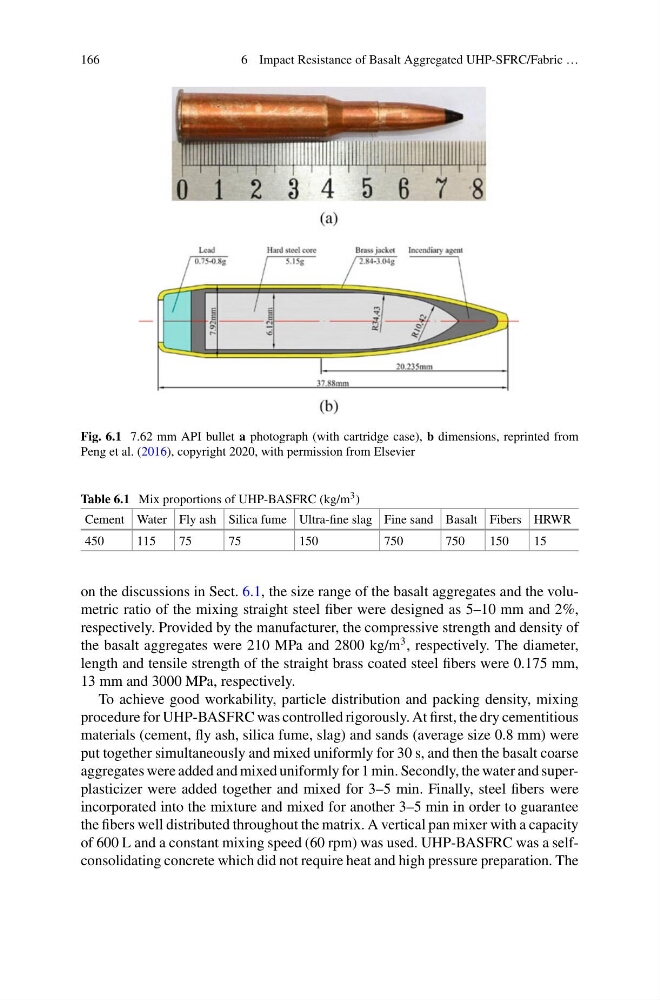
Fig. 6.1 7.62 mm API bullet a photograph (with cartridge case), b dimensions, reprinted from
Peng et al. (2016), copyright 2020, with permission from Elsevier
Table 6.1 Mix proportions of UHP-BASFRC (kg/m 3 )
Cement Water Fly ash Silica fume Ultra-fine slag Fine sand Basalt Fibers HRWR
450
115
75
75
150
750
750
150
15
on the discussions in Sect. 6.1, the size range of the basalt aggregates and the volumetric ratio of the mixing straight steel fiber were designed as 5–10 mm and 2%,
respectively. Provided by the manufacturer, the compressive strength and density of
the basalt aggregates were 210 MPa and 2800 kg/m
3 , respectively. The diameter,
length and tensile strength of the straight brass coated steel fibers were 0.175 mm,
13 mm and 3000 MPa, respectively.
To achieve good workability, particle distribution and packing density, mixing
procedure for UHP-BASFRC was controlled rigorously. At first, the dry cementitious
materials (cement, fly ash, silica fume, slag) and sands (average size 0.8 mm) were
put together simultaneously and mixed uniformly for 30 s, and then the basalt coarse
aggregates were added and mixed uniformly for 1 min. Secondly, the water and superplasticizer were added together and mixed for 3–5 min. Finally, steel fibers were
incorporated into the mixture and mixed for another 3–5 min in order to guarantee
the fibers well distributed throughout the matrix. A vertical pan mixer with a capacity
of 600 L and a constant mixing speed (60 rpm) was used. UHP-BASFRC was a selfconsolidating concrete which did not require heat and high pressure preparation. The
6 Impact Resistance of Basalt Aggregated UHP-SFRC/Fabric …
Fig. 6.1 7.62 mm API bullet a photograph (with cartridge case), b dimensions, reprinted from
Peng et al. (2016), copyright 2020, with permission from Elsevier
Table 6.1 Mix proportions of UHP-BASFRC (kg/m 3 )
Cement Water Fly ash Silica fume Ultra-fine slag Fine sand Basalt Fibers HRWR
450
115
75
75
150
750
750
150
15
on the discussions in Sect. 6.1, the size range of the basalt aggregates and the volumetric ratio of the mixing straight steel fiber were designed as 5–10 mm and 2%,
respectively. Provided by the manufacturer, the compressive strength and density of
the basalt aggregates were 210 MPa and 2800 kg/m
3 , respectively. The diameter,
length and tensile strength of the straight brass coated steel fibers were 0.175 mm,
13 mm and 3000 MPa, respectively.
To achieve good workability, particle distribution and packing density, mixing
procedure for UHP-BASFRC was controlled rigorously. At first, the dry cementitious
materials (cement, fly ash, silica fume, slag) and sands (average size 0.8 mm) were
put together simultaneously and mixed uniformly for 30 s, and then the basalt coarse
aggregates were added and mixed uniformly for 1 min. Secondly, the water and superplasticizer were added together and mixed for 3–5 min. Finally, steel fibers were
incorporated into the mixture and mixed for another 3–5 min in order to guarantee
the fibers well distributed throughout the matrix. A vertical pan mixer with a capacity
of 600 L and a constant mixing speed (60 rpm) was used. UHP-BASFRC was a selfconsolidating concrete which did not require heat and high pressure preparation. The