

5.3 Corundum Aggregated UHPCC Target
137
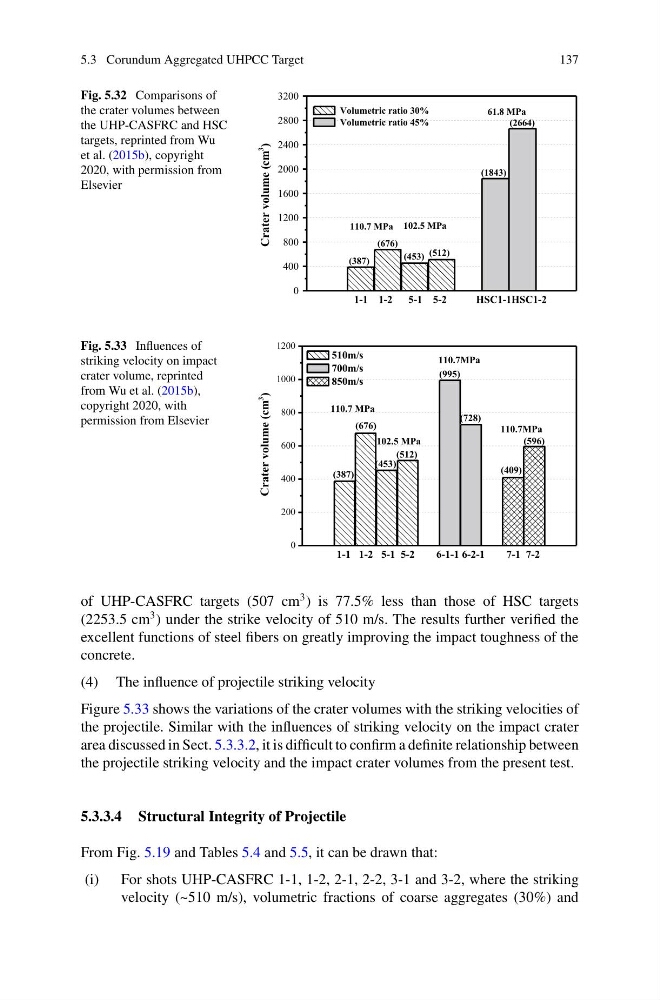
Fig. 5.32 Comparisons of
the crater volumes between
the UHP-CASFRC and HSC
targets, reprinted from Wu
et al. (2015b), copyright
2020, with permission from
Elsevier
0
400
800
1200
1600
2000
2400
2800
3200
(2664)
61.8 MPa
102.5 MPa
(512)
(453)
110.7 MPa
(387)
(1843)
(676)
Crater volume (cm
3
)
Volumetric ratio 30%
Volumetric ratio 45%
1-1 1-2
5-1 5-2
HSC1-1HSC1-2
Fig. 5.33 Influences of
striking velocity on impact
crater volume, reprinted
from Wu et al. (2015b),
copyright 2020, with
permission from Elsevier
0
200
400
600
800
1000
1200
102.5 MPa
(596)
(676)
110.7MPa
(728)
(995)
110.7 MPa
110.7MPa
(409)
(512)
1-1 1-2 5-1 5-2
6-1-1 6-2-1
7-1 7-2
(453)
(387)
Crater volume (cm
3
)
510m/s
700m/s
850m/s
of UHP-CASFRC targets (507 cm
3 ) is 77.5% less than those of HSC targets
(2253.5 cm
3 ) under the strike velocity of 510 m/s. The results further verified the
excellent functions of steel fibers on greatly improving the impact toughness of the
concrete.
(4) The influence of projectile striking velocity
Figure 5.33 shows the variations of the crater volumes with the striking velocities of
the projectile. Similar with the influences of striking velocity on the impact crater
area discussed in Sect. 5.3.3.2, it is difficult to confirm a definite relationship between
the projectile striking velocity and the impact crater volumes from the present test.
5.3.3.4 Structural Integrity of Projectile
From Fig. 5.19 and Tables 5.4 and 5.5, it can be drawn that:
(i) For shots UHP-CASFRC 1-1, 1-2, 2-1, 2-2, 3-1 and 3-2, where the striking
velocity (~510 m/s), volumetric fractions of coarse aggregates (30%) and
137
Fig. 5.32 Comparisons of
the crater volumes between
the UHP-CASFRC and HSC
targets, reprinted from Wu
et al. (2015b), copyright
2020, with permission from
Elsevier
0
400
800
1200
1600
2000
2400
2800
3200
(2664)
61.8 MPa
102.5 MPa
(512)
(453)
110.7 MPa
(387)
(1843)
(676)
Crater volume (cm
3
)
Volumetric ratio 30%
Volumetric ratio 45%
1-1 1-2
5-1 5-2
HSC1-1HSC1-2
Fig. 5.33 Influences of
striking velocity on impact
crater volume, reprinted
from Wu et al. (2015b),
copyright 2020, with
permission from Elsevier
0
200
400
600
800
1000
1200
102.5 MPa
(596)
(676)
110.7MPa
(728)
(995)
110.7 MPa
110.7MPa
(409)
(512)
1-1 1-2 5-1 5-2
6-1-1 6-2-1
7-1 7-2
(453)
(387)
Crater volume (cm
3
)
510m/s
700m/s
850m/s
of UHP-CASFRC targets (507 cm
3 ) is 77.5% less than those of HSC targets
(2253.5 cm
3 ) under the strike velocity of 510 m/s. The results further verified the
excellent functions of steel fibers on greatly improving the impact toughness of the
concrete.
(4) The influence of projectile striking velocity
Figure 5.33 shows the variations of the crater volumes with the striking velocities of
the projectile. Similar with the influences of striking velocity on the impact crater
area discussed in Sect. 5.3.3.2, it is difficult to confirm a definite relationship between
the projectile striking velocity and the impact crater volumes from the present test.
5.3.3.4 Structural Integrity of Projectile
From Fig. 5.19 and Tables 5.4 and 5.5, it can be drawn that:
(i) For shots UHP-CASFRC 1-1, 1-2, 2-1, 2-2, 3-1 and 3-2, where the striking
velocity (~510 m/s), volumetric fractions of coarse aggregates (30%) and