

92
4 Triaxial Compressive Behavior of UHPCC …
and the confining pressure have good effect on improving the toughness indices. The
same conclusion was obtained by Farnam et al. (2010).
4.5 Applications in the Numerical Analyses
In this section, based on the present and previous triaxial compression test data
on high-strength concrete (Lu and Hsu 2006; Xie et al. 1995; Sovják et al. 2013;
Farnam et al. 2010; Xiong 2009), the dominated strength parameters for HolmquistJohnson-Cook (HJC) constitutive model were calibrated. Then, by utilizing the large
commercial finite element program LS-DYNA, the HJC model and the corresponding
parameters were utilized to predict the terminal ballistic parameters of projectile
impacting high-strength concrete-like target.
4.5.1 Brief Introduction of HJC Constitutive Model
HJC model is an elastic-viscoplastic model and used to describe the dynamic
compressive behaviors of concrete subjected to large strain, high strain and hydrostatic pressure. It was embedded into the commercial finite element program LSDYNA (LS-DYNA 1997) as the *MAT_JOHNSON_HOLMQUIST_CONCRETE
(111
# ) model, and widely applied into the numerical simulations of the dynamic
responses of concrete-like material under projectile impact and explosive loadings.
It mainly includes three parts: equation of yield surface, equation of state and equation
of damage evolution, shown in Fig. 4.11.
Shown in Fig. 4.11a, the equation of yield surface of HJC model can be expressed
as
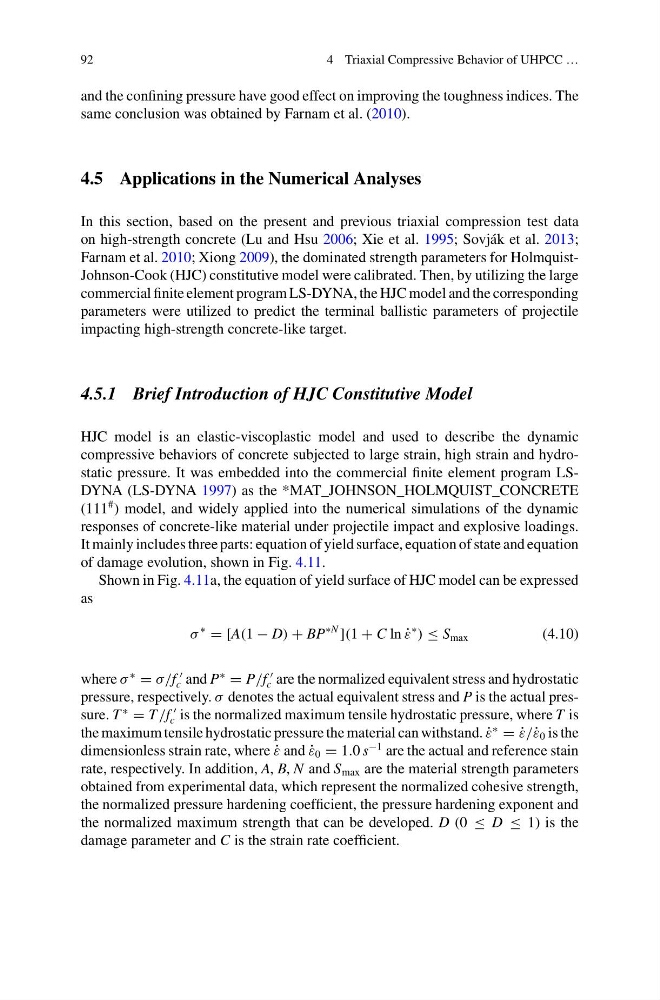
σ
∗
= [A(1 − D) + BP
∗N
](1 + C ln ˙
ε
∗
) ≤ S max
(4.10)
where σ
∗
= σ/f
c and P
∗
= P/f
c are the normalized equivalent stress and hydrostatic
pressure, respectively. σ denotes the actual equivalent stress and P is the actual pressure. T
∗
= T /f
c is the normalized maximum tensile hydrostatic pressure, where T is
the maximum tensile hydrostatic pressure the material can withstand. ˙
ε
∗
= ˙
ε/˙ ε 0 is the
dimensionless strain rate, where ˙
ε and ˙
ε 0 = 1.0 s
−1 are the actual and reference stain
rate, respectively. In addition, A, B, N and S max are the material strength parameters
obtained from experimental data, which represent the normalized cohesive strength,
the normalized pressure hardening coefficient, the pressure hardening exponent and
the normalized maximum strength that can be developed. D (0 ≤ D ≤ 1) is the
damage parameter and C is the strain rate coefficient.
4 Triaxial Compressive Behavior of UHPCC …
and the confining pressure have good effect on improving the toughness indices. The
same conclusion was obtained by Farnam et al. (2010).
4.5 Applications in the Numerical Analyses
In this section, based on the present and previous triaxial compression test data
on high-strength concrete (Lu and Hsu 2006; Xie et al. 1995; Sovják et al. 2013;
Farnam et al. 2010; Xiong 2009), the dominated strength parameters for HolmquistJohnson-Cook (HJC) constitutive model were calibrated. Then, by utilizing the large
commercial finite element program LS-DYNA, the HJC model and the corresponding
parameters were utilized to predict the terminal ballistic parameters of projectile
impacting high-strength concrete-like target.
4.5.1 Brief Introduction of HJC Constitutive Model
HJC model is an elastic-viscoplastic model and used to describe the dynamic
compressive behaviors of concrete subjected to large strain, high strain and hydrostatic pressure. It was embedded into the commercial finite element program LSDYNA (LS-DYNA 1997) as the *MAT_JOHNSON_HOLMQUIST_CONCRETE
(111
# ) model, and widely applied into the numerical simulations of the dynamic
responses of concrete-like material under projectile impact and explosive loadings.
It mainly includes three parts: equation of yield surface, equation of state and equation
of damage evolution, shown in Fig. 4.11.
Shown in Fig. 4.11a, the equation of yield surface of HJC model can be expressed
as
σ
∗
= [A(1 − D) + BP
∗N
](1 + C ln ˙
ε
∗
) ≤ S max
(4.10)
where σ
∗
= σ/f
c and P
∗
= P/f
c are the normalized equivalent stress and hydrostatic
pressure, respectively. σ denotes the actual equivalent stress and P is the actual pressure. T
∗
= T /f
c is the normalized maximum tensile hydrostatic pressure, where T is
the maximum tensile hydrostatic pressure the material can withstand. ˙
ε
∗
= ˙
ε/˙ ε 0 is the
dimensionless strain rate, where ˙
ε and ˙
ε 0 = 1.0 s
−1 are the actual and reference stain
rate, respectively. In addition, A, B, N and S max are the material strength parameters
obtained from experimental data, which represent the normalized cohesive strength,
the normalized pressure hardening coefficient, the pressure hardening exponent and
the normalized maximum strength that can be developed. D (0 ≤ D ≤ 1) is the
damage parameter and C is the strain rate coefficient.