

90
4 Triaxial Compressive Behavior of UHPCC …
Eq. (4.6) gives excellent predictions for high-strength concrete, and the influences
of strength, size, and compositions of specimens are not pronounced.
4.4.4 Toughness
The toughness of concrete (R) generally refers to the energy absorbing performance
of the material in compression and has been defined as the area under the stress–
strain curve calculated up to a specified strain value (Taerwe 1992; Nataraja et al.
1999). Most researchers (Nataraja et al. 1999; Fanella and Naaman 1985; Poon et al.
2004) have obtained the toughness of fiber reinforced concrete in compression as
the area under the stress–strain curve calculated up to a strain value of 0.015, while
the specimens still have significant resistance left. In this study, in order to calculate
the toughness of UHPCC under triaxial loading, a convenient method suggested by
Farnam et al. (2010) was adopted.
This method was used to determine a ratio named toughness index (TI) that
identify the toughness of material up to the selected strain criteria in compression
to the unconfined concrete specimen. To calculate toughness, energy of all three
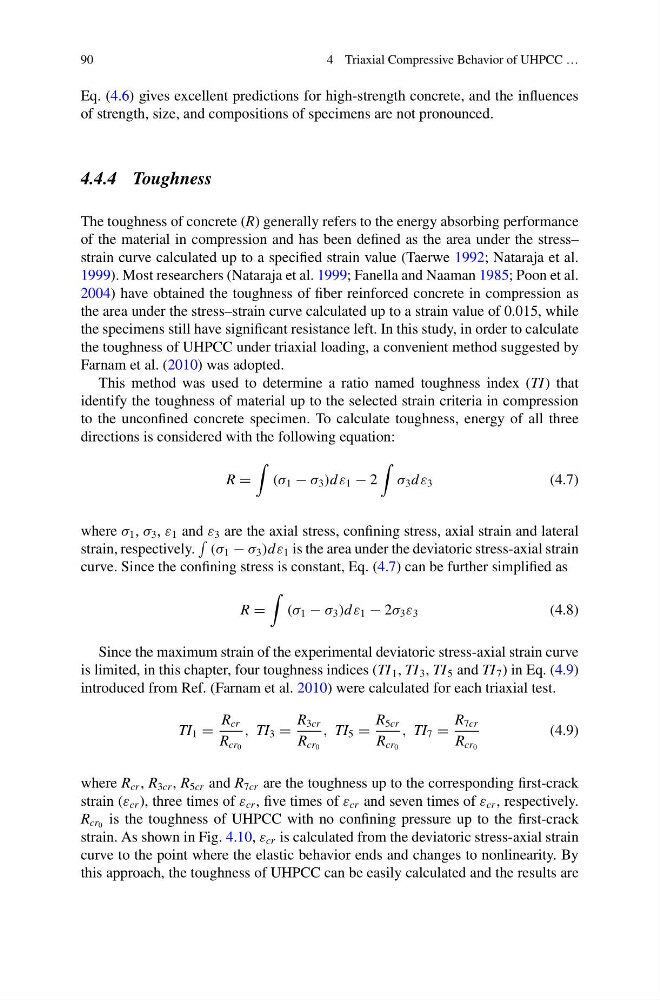
directions is considered with the following equation:
R =
(σ 1 − σ 3 )d ε 1 − 2
σ 3 d ε 3
(4.7)
where σ 1 , σ 3 , ε 1 and ε 3 are the axial stress, confining stress, axial strain and lateral
strain, respectively.
(σ 1 − σ 3 )d ε 1 is the area under the deviatoric stress-axial strain
curve. Since the confining stress is constant, Eq. (4.7) can be further simplified as
R =
(σ 1 − σ 3 )d ε 1 − 2σ 3 ε 3
(4.8)
Since the maximum strain of the experimental deviatoric stress-axial strain curve
is limited, in this chapter, four toughness indices (TI 1 , TI 3 , TI 5 and TI 7 ) in Eq. (4.9)
introduced from Ref. (Farnam et al. 2010) were calculated for each triaxial test.
TI 1 =
R cr
R cr 0
, TI 3 =
R 3cr
R cr 0
, TI 5 =
R 5cr
R cr 0
, TI 7 =
R 7cr
R cr 0
(4.9)
where R cr , R 3cr , R 5cr and R 7cr are the toughness up to the corresponding first-crack
strain (ε cr ), three times of ε cr , five times of ε cr and seven times of ε cr , respectively.
R cr 0 is the toughness of UHPCC with no confining pressure up to the first-crack
strain. As shown in Fig. 4.10, ε cr is calculated from the deviatoric stress-axial strain
curve to the point where the elastic behavior ends and changes to nonlinearity. By
this approach, the toughness of UHPCC can be easily calculated and the results are
4 Triaxial Compressive Behavior of UHPCC …
Eq. (4.6) gives excellent predictions for high-strength concrete, and the influences
of strength, size, and compositions of specimens are not pronounced.
4.4.4 Toughness
The toughness of concrete (R) generally refers to the energy absorbing performance
of the material in compression and has been defined as the area under the stress–
strain curve calculated up to a specified strain value (Taerwe 1992; Nataraja et al.
1999). Most researchers (Nataraja et al. 1999; Fanella and Naaman 1985; Poon et al.
2004) have obtained the toughness of fiber reinforced concrete in compression as
the area under the stress–strain curve calculated up to a strain value of 0.015, while
the specimens still have significant resistance left. In this study, in order to calculate
the toughness of UHPCC under triaxial loading, a convenient method suggested by
Farnam et al. (2010) was adopted.
This method was used to determine a ratio named toughness index (TI) that
identify the toughness of material up to the selected strain criteria in compression
to the unconfined concrete specimen. To calculate toughness, energy of all three
directions is considered with the following equation:
R =
(σ 1 − σ 3 )d ε 1 − 2
σ 3 d ε 3
(4.7)
where σ 1 , σ 3 , ε 1 and ε 3 are the axial stress, confining stress, axial strain and lateral
strain, respectively.
(σ 1 − σ 3 )d ε 1 is the area under the deviatoric stress-axial strain
curve. Since the confining stress is constant, Eq. (4.7) can be further simplified as
R =
(σ 1 − σ 3 )d ε 1 − 2σ 3 ε 3
(4.8)
Since the maximum strain of the experimental deviatoric stress-axial strain curve
is limited, in this chapter, four toughness indices (TI 1 , TI 3 , TI 5 and TI 7 ) in Eq. (4.9)
introduced from Ref. (Farnam et al. 2010) were calculated for each triaxial test.
TI 1 =
R cr
R cr 0
, TI 3 =
R 3cr
R cr 0
, TI 5 =
R 5cr
R cr 0
, TI 7 =
R 7cr
R cr 0
(4.9)
where R cr , R 3cr , R 5cr and R 7cr are the toughness up to the corresponding first-crack
strain (ε cr ), three times of ε cr , five times of ε cr and seven times of ε cr , respectively.
R cr 0 is the toughness of UHPCC with no confining pressure up to the first-crack
strain. As shown in Fig. 4.10, ε cr is calculated from the deviatoric stress-axial strain
curve to the point where the elastic behavior ends and changes to nonlinearity. By
this approach, the toughness of UHPCC can be easily calculated and the results are