

28
2 Size-Dependent Theories of Beams, Plates and Shells
theory (RBT) and theory of shear deformation of third order (TSDT) [71]. The full
review of the state of the art of theory of plates can be found in the work of Thai and
Kim [72].
The resolving equations yielded by the described size-dependent models can be
solved with the help either of analytical or numerical methods. However, application
of analytical approaches is available for rather simple geometry of nanostructures as
well as for simple loads and boundary conditions. In the case of practical problems
dealing with a general geometry, load and boundary conditions, a search for analytical
solutions is almost impossible due to complexity of the size-dependent models in
comparison with classical ones. Therefore, the most suitable methods are based on the
finite element method, differential-integral method, meshless method, Ritz method,
Galerkin method, etc. The key role in the numerical approaches is played by the
finite difference method being most suitable to analyse size-dependent structures.
In the recent dozen of years, there were carried out large investigations of
microbeams, microplates and microshells but without account of the size-dependent
effects. This is why, we briefly describe the state of the art of development of sizedependent models aimed at the forecast of dynamical behaviour of micro/nanobeam,
plate and shell structures. It includes mainly models of beams, plates and shells developed based on the nonlocal theory of elasticity [33], the surface theory of elasticity
[61], the modified couple stress theory [15] and the modified theory of deformation
gradient [18].
2.3 Non-classical (Size-Dependent) Models of Beams,
Plates and Shells
2.3.1 Nonlocal Theory
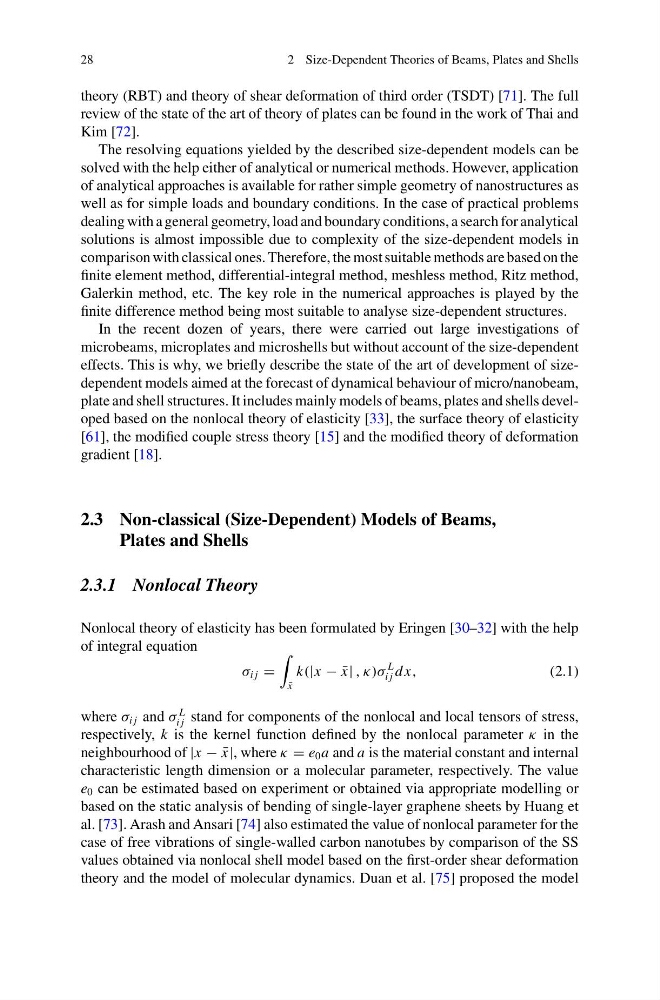
Nonlocal theory of elasticity has been formulated by Eringen [30–32] with the help
of integral equation
σ i j =
¯
x
k(|x − ¯
x| , κ)σ
L
i j dx,
(2.1)
where σ i j and σ
L
i j stand for components of the nonlocal and local tensors of stress,
respectively, k is the kernel function defined by the nonlocal parameter κ in the
neighbourhood of |x − ¯
x|, where κ = e 0 a and a is the material constant and internal
characteristic length dimension or a molecular parameter, respectively. The value
e 0 can be estimated based on experiment or obtained via appropriate modelling or
based on the static analysis of bending of single-layer graphene sheets by Huang et
al. [73]. Arash and Ansari [74] also estimated the value of nonlocal parameter for the
case of free vibrations of single-walled carbon nanotubes by comparison of the SS
values obtained via nonlocal shell model based on the first-order shear deformation
theory and the model of molecular dynamics. Duan et al. [75] proposed the model
2 Size-Dependent Theories of Beams, Plates and Shells
theory (RBT) and theory of shear deformation of third order (TSDT) [71]. The full
review of the state of the art of theory of plates can be found in the work of Thai and
Kim [72].
The resolving equations yielded by the described size-dependent models can be
solved with the help either of analytical or numerical methods. However, application
of analytical approaches is available for rather simple geometry of nanostructures as
well as for simple loads and boundary conditions. In the case of practical problems
dealing with a general geometry, load and boundary conditions, a search for analytical
solutions is almost impossible due to complexity of the size-dependent models in
comparison with classical ones. Therefore, the most suitable methods are based on the
finite element method, differential-integral method, meshless method, Ritz method,
Galerkin method, etc. The key role in the numerical approaches is played by the
finite difference method being most suitable to analyse size-dependent structures.
In the recent dozen of years, there were carried out large investigations of
microbeams, microplates and microshells but without account of the size-dependent
effects. This is why, we briefly describe the state of the art of development of sizedependent models aimed at the forecast of dynamical behaviour of micro/nanobeam,
plate and shell structures. It includes mainly models of beams, plates and shells developed based on the nonlocal theory of elasticity [33], the surface theory of elasticity
[61], the modified couple stress theory [15] and the modified theory of deformation
gradient [18].
2.3 Non-classical (Size-Dependent) Models of Beams,
Plates and Shells
2.3.1 Nonlocal Theory
Nonlocal theory of elasticity has been formulated by Eringen [30–32] with the help
of integral equation
σ i j =
¯
x
k(|x − ¯
x| , κ)σ
L
i j dx,
(2.1)
where σ i j and σ
L
i j stand for components of the nonlocal and local tensors of stress,
respectively, k is the kernel function defined by the nonlocal parameter κ in the
neighbourhood of |x − ¯
x|, where κ = e 0 a and a is the material constant and internal
characteristic length dimension or a molecular parameter, respectively. The value
e 0 can be estimated based on experiment or obtained via appropriate modelling or
based on the static analysis of bending of single-layer graphene sheets by Huang et
al. [73]. Arash and Ansari [74] also estimated the value of nonlocal parameter for the
case of free vibrations of single-walled carbon nanotubes by comparison of the SS
values obtained via nonlocal shell model based on the first-order shear deformation
theory and the model of molecular dynamics. Duan et al. [75] proposed the model