

350
9 Topologic Optimization of Vibrations of Size-Dependent Beams
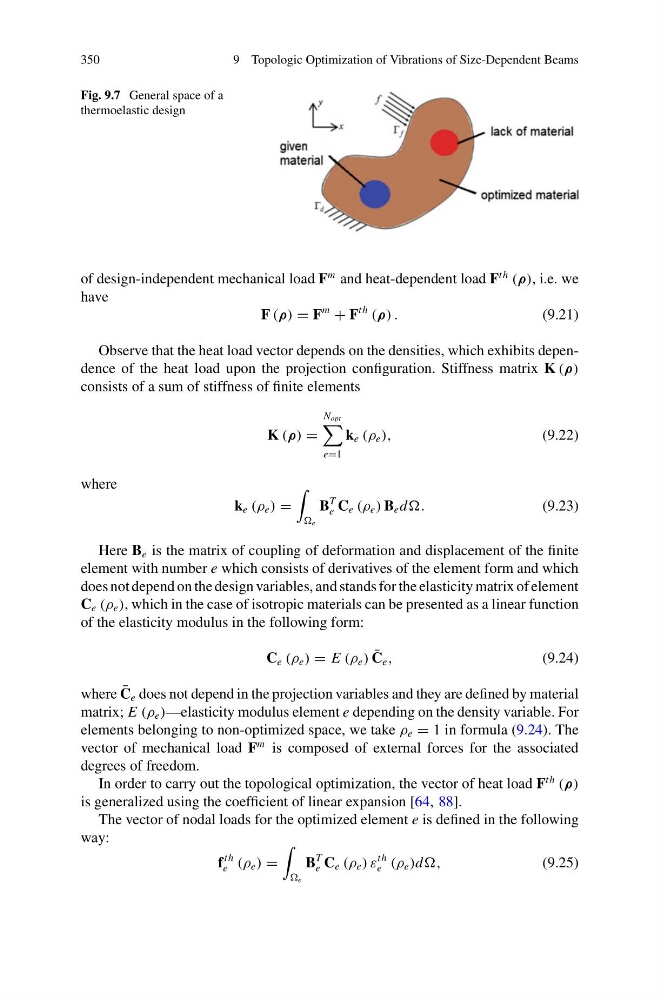
Fig. 9.7 General space of a
thermoelastic design
of design-independent mechanical load F
m and heat-dependent load F
th
(ρ), i.e. we
have
F (ρ) = F
m
+ F
th
(ρ) .
(9.21)
Observe that the heat load vector depends on the densities, which exhibits dependence of the heat load upon the projection configuration. Stiffness matrix K (ρ)
consists of a sum of stiffness of finite elements
K (ρ) =
N opt
e=1
k e (ρ e ),
(9.22)
where
k e (ρ e ) =
e
B
T
e C e (ρ e ) B e d.
(9.23)
Here B e is the matrix of coupling of deformation and displacement of the finite
element with number e which consists of derivatives of the element form and which
does not depend on the design variables, and stands for the elasticity matrix of element
C e (ρ e ), which in the case of isotropic materials can be presented as a linear function
of the elasticity modulus in the following form:
C e (ρ e ) = E (ρ e ) ¯
C e ,
(9.24)
where ¯
C e does not depend in the projection variables and they are defined by material
matrix; E (ρ e )—elasticity modulus element e depending on the density variable. For
elements belonging to non-optimized space, we take ρ e = 1 in formula (9.24). The
vector of mechanical load F
m is composed of external forces for the associated
degrees of freedom.
In order to carry out the topological optimization, the vector of heat load F
th
(ρ)
is generalized using the coefficient of linear expansion [64, 88].
The vector of nodal loads for the optimized element e is defined in the following
way:
f
th
e (ρ e ) =
e
B
T
e C e (ρ e ) ε
th
e (ρ e )d,
(9.25)
9 Topologic Optimization of Vibrations of Size-Dependent Beams
Fig. 9.7 General space of a
thermoelastic design
of design-independent mechanical load F
m and heat-dependent load F
th
(ρ), i.e. we
have
F (ρ) = F
m
+ F
th
(ρ) .
(9.21)
Observe that the heat load vector depends on the densities, which exhibits dependence of the heat load upon the projection configuration. Stiffness matrix K (ρ)
consists of a sum of stiffness of finite elements
K (ρ) =
N opt
e=1
k e (ρ e ),
(9.22)
where
k e (ρ e ) =
e
B
T
e C e (ρ e ) B e d.
(9.23)
Here B e is the matrix of coupling of deformation and displacement of the finite
element with number e which consists of derivatives of the element form and which
does not depend on the design variables, and stands for the elasticity matrix of element
C e (ρ e ), which in the case of isotropic materials can be presented as a linear function
of the elasticity modulus in the following form:
C e (ρ e ) = E (ρ e ) ¯
C e ,
(9.24)
where ¯
C e does not depend in the projection variables and they are defined by material
matrix; E (ρ e )—elasticity modulus element e depending on the density variable. For
elements belonging to non-optimized space, we take ρ e = 1 in formula (9.24). The
vector of mechanical load F
m is composed of external forces for the associated
degrees of freedom.
In order to carry out the topological optimization, the vector of heat load F
th
(ρ)
is generalized using the coefficient of linear expansion [64, 88].
The vector of nodal loads for the optimized element e is defined in the following
way:
f
th
e (ρ e ) =
e
B
T
e C e (ρ e ) ε
th
e (ρ e )d,
(9.25)