

348
9 Topologic Optimization of Vibrations of Size-Dependent Beams
σ P N =
N e
e=1
F(σ e )
¯
σ
p 1/p
.
(9.18)
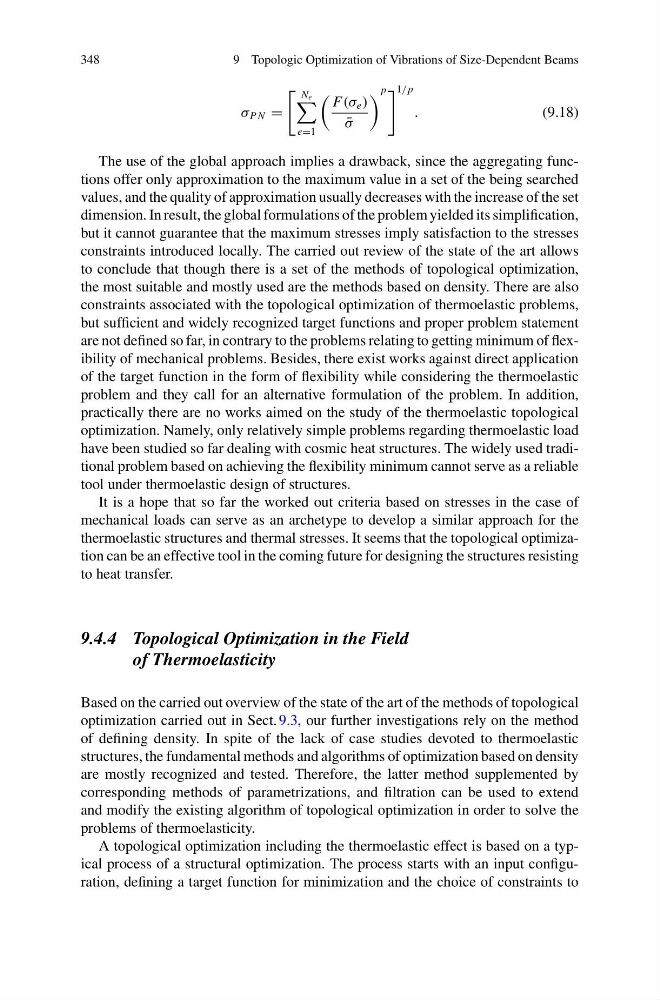
The use of the global approach implies a drawback, since the aggregating functions offer only approximation to the maximum value in a set of the being searched
values, and the quality of approximation usually decreases with the increase of the set
dimension. In result, the global formulations of the problem yielded its simplification,
but it cannot guarantee that the maximum stresses imply satisfaction to the stresses
constraints introduced locally. The carried out review of the state of the art allows
to conclude that though there is a set of the methods of topological optimization,
the most suitable and mostly used are the methods based on density. There are also
constraints associated with the topological optimization of thermoelastic problems,
but sufficient and widely recognized target functions and proper problem statement
are not defined so far, in contrary to the problems relating to getting minimum of flexibility of mechanical problems. Besides, there exist works against direct application
of the target function in the form of flexibility while considering the thermoelastic
problem and they call for an alternative formulation of the problem. In addition,
practically there are no works aimed on the study of the thermoelastic topological
optimization. Namely, only relatively simple problems regarding thermoelastic load
have been studied so far dealing with cosmic heat structures. The widely used traditional problem based on achieving the flexibility minimum cannot serve as a reliable
tool under thermoelastic design of structures.
It is a hope that so far the worked out criteria based on stresses in the case of
mechanical loads can serve as an archetype to develop a similar approach for the
thermoelastic structures and thermal stresses. It seems that the topological optimization can be an effective tool in the coming future for designing the structures resisting
to heat transfer.
9.4.4 Topological Optimization in the Field
of Thermoelasticity
Based on the carried out overview of the state of the art of the methods of topological
optimization carried out in Sect. 9.3, our further investigations rely on the method
of defining density. In spite of the lack of case studies devoted to thermoelastic
structures, the fundamental methods and algorithms of optimization based on density
are mostly recognized and tested. Therefore, the latter method supplemented by
corresponding methods of parametrizations, and filtration can be used to extend
and modify the existing algorithm of topological optimization in order to solve the
problems of thermoelasticity.
A topological optimization including the thermoelastic effect is based on a typical process of a structural optimization. The process starts with an input configuration, defining a target function for minimization and the choice of constraints to
9 Topologic Optimization of Vibrations of Size-Dependent Beams
σ P N =
N e
e=1
F(σ e )
¯
σ
p 1/p
.
(9.18)
The use of the global approach implies a drawback, since the aggregating functions offer only approximation to the maximum value in a set of the being searched
values, and the quality of approximation usually decreases with the increase of the set
dimension. In result, the global formulations of the problem yielded its simplification,
but it cannot guarantee that the maximum stresses imply satisfaction to the stresses
constraints introduced locally. The carried out review of the state of the art allows
to conclude that though there is a set of the methods of topological optimization,
the most suitable and mostly used are the methods based on density. There are also
constraints associated with the topological optimization of thermoelastic problems,
but sufficient and widely recognized target functions and proper problem statement
are not defined so far, in contrary to the problems relating to getting minimum of flexibility of mechanical problems. Besides, there exist works against direct application
of the target function in the form of flexibility while considering the thermoelastic
problem and they call for an alternative formulation of the problem. In addition,
practically there are no works aimed on the study of the thermoelastic topological
optimization. Namely, only relatively simple problems regarding thermoelastic load
have been studied so far dealing with cosmic heat structures. The widely used traditional problem based on achieving the flexibility minimum cannot serve as a reliable
tool under thermoelastic design of structures.
It is a hope that so far the worked out criteria based on stresses in the case of
mechanical loads can serve as an archetype to develop a similar approach for the
thermoelastic structures and thermal stresses. It seems that the topological optimization can be an effective tool in the coming future for designing the structures resisting
to heat transfer.
9.4.4 Topological Optimization in the Field
of Thermoelasticity
Based on the carried out overview of the state of the art of the methods of topological
optimization carried out in Sect. 9.3, our further investigations rely on the method
of defining density. In spite of the lack of case studies devoted to thermoelastic
structures, the fundamental methods and algorithms of optimization based on density
are mostly recognized and tested. Therefore, the latter method supplemented by
corresponding methods of parametrizations, and filtration can be used to extend
and modify the existing algorithm of topological optimization in order to solve the
problems of thermoelasticity.
A topological optimization including the thermoelastic effect is based on a typical process of a structural optimization. The process starts with an input configuration, defining a target function for minimization and the choice of constraints to