

8.3 Formulation of the Problem
305
where
k 1 = E A, k 2 = E I, k 3 = k s G A, k 4 =
1
4
l
2 G A,
I =
h/2
−h/2
bz
2 dz =
bh
3
12
, N
T
=
h/2
−h/2
Ebα θ dz,
M
T
=
h/2
−h/2
Ebα θ z dz .
(8.15)
It should be emphasized that in order to get a plane deformable state, it is sufficient
to substitute E by ˜
E = E/
1 − ν
2
and α by ˜
α = α (1 + ν)] in formula (8.15).
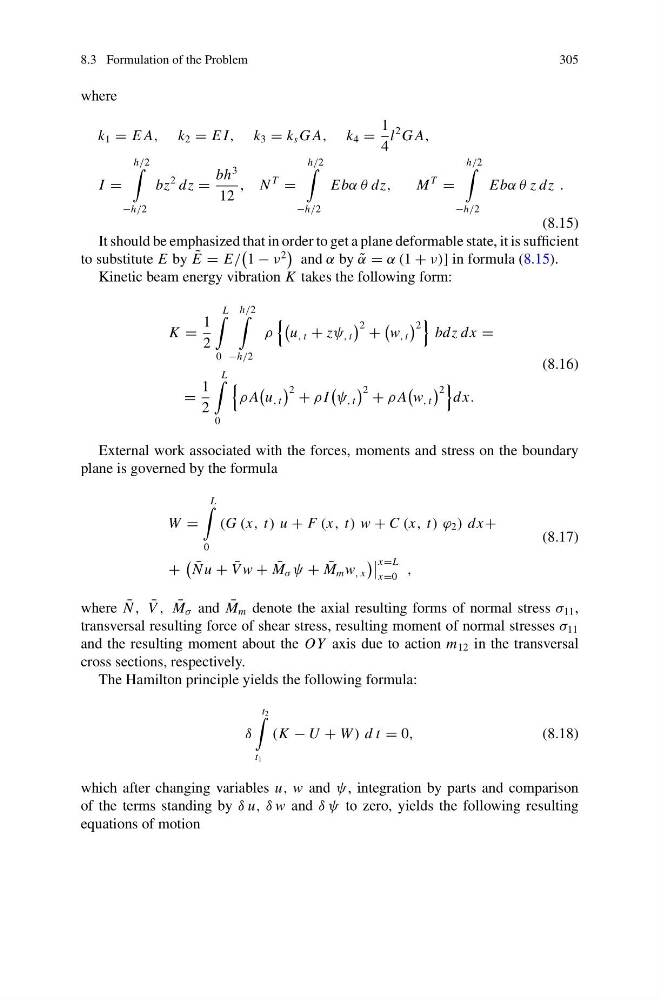
Kinetic beam energy vibration K takes the following form:
K =
1
2
L
0
h/2
−h/2
ρ
u , t + zψ , t
2 +
w , t
2
bdz dx =
=
1
2
L
0
ρ A
u , t
2 + ρ I
ψ , t
2 + ρ A
w , t
2
dx.
(8.16)
External work associated with the forces, moments and stress on the boundary
plane is governed by the formula
W =
L
0
(G (x, t) u + F (x, t) w + C (x, t) ϕ 2 ) dx+
+
¯
N u + ¯
V w + ¯
M σ ψ + ¯
M m w , x
x=L
x=0
,
(8.17)
where ¯
N , ¯
V , ¯
M σ and ¯
M m denote the axial resulting forms of normal stress σ 11 ,
transversal resulting force of shear stress, resulting moment of normal stresses σ 11
and the resulting moment about the OY axis due to action m 12 in the transversal
cross sections, respectively.
The Hamilton principle yields the following formula:
δ
t 2
t 1
(K − U + W ) d t = 0,
(8.18)
which after changing variables u, w and ψ, integration by parts and comparison
of the terms standing by δ u, δ w and δ ψ to zero, yields the following resulting
equations of motion
305
where
k 1 = E A, k 2 = E I, k 3 = k s G A, k 4 =
1
4
l
2 G A,
I =
h/2
−h/2
bz
2 dz =
bh
3
12
, N
T
=
h/2
−h/2
Ebα θ dz,
M
T
=
h/2
−h/2
Ebα θ z dz .
(8.15)
It should be emphasized that in order to get a plane deformable state, it is sufficient
to substitute E by ˜
E = E/
1 − ν
2
and α by ˜
α = α (1 + ν)] in formula (8.15).
Kinetic beam energy vibration K takes the following form:
K =
1
2
L
0
h/2
−h/2
ρ
u , t + zψ , t
2 +
w , t
2
bdz dx =
=
1
2
L
0
ρ A
u , t
2 + ρ I
ψ , t
2 + ρ A
w , t
2
dx.
(8.16)
External work associated with the forces, moments and stress on the boundary
plane is governed by the formula
W =
L
0
(G (x, t) u + F (x, t) w + C (x, t) ϕ 2 ) dx+
+
¯
N u + ¯
V w + ¯
M σ ψ + ¯
M m w , x
x=L
x=0
,
(8.17)
where ¯
N , ¯
V , ¯
M σ and ¯
M m denote the axial resulting forms of normal stress σ 11 ,
transversal resulting force of shear stress, resulting moment of normal stresses σ 11
and the resulting moment about the OY axis due to action m 12 in the transversal
cross sections, respectively.
The Hamilton principle yields the following formula:
δ
t 2
t 1
(K − U + W ) d t = 0,
(8.18)
which after changing variables u, w and ψ, integration by parts and comparison
of the terms standing by δ u, δ w and δ ψ to zero, yields the following resulting
equations of motion