

8.3 Formulation of the Problem
303
where u (x, t) , w (x, t) and ψ (x, t) are the axial displacement of the beam middle
line, transversal beam deflection and the angle of rotation of the transversal load with
respect to the vertical direction, respectively.
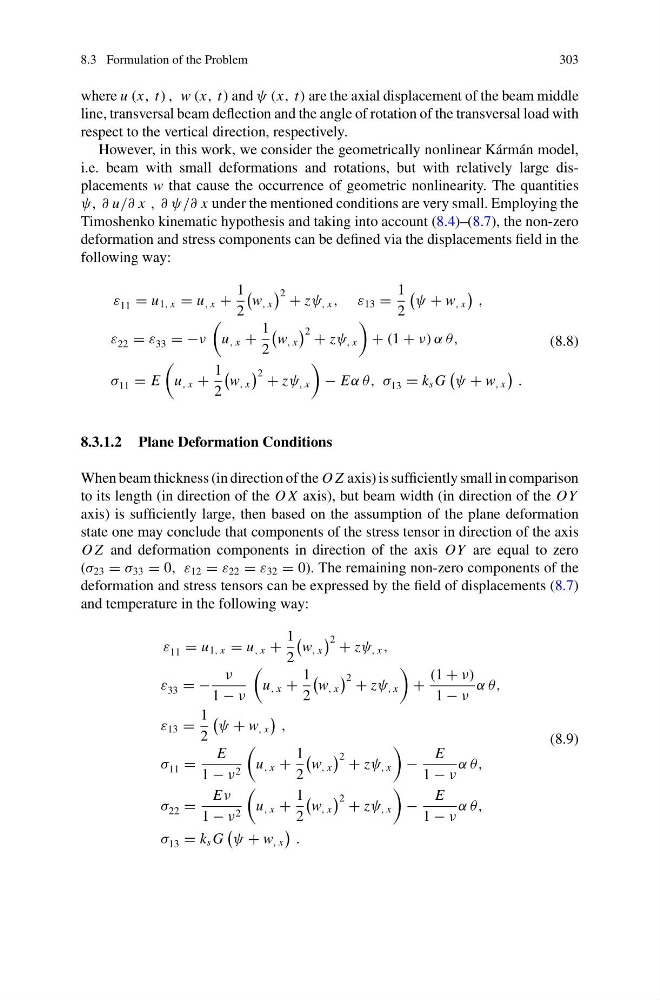
However, in this work, we consider the geometrically nonlinear Kármán model,
i.e. beam with small deformations and rotations, but with relatively large displacements w that cause the occurrence of geometric nonlinearity. The quantities
ψ, ∂ u/∂ x , ∂ ψ/∂ x under the mentioned conditions are very small. Employing the
Timoshenko kinematic hypothesis and taking into account (8.4)–(8.7), the non-zero
deformation and stress components can be defined via the displacements field in the
following way:
ε 11 = u 1, x = u , x +
1
2
w , x
2 + zψ , x , ε 13 =
1
2
ψ + w , x
,
ε 22 = ε 33 = −ν
u , x +
1
2
w , x
2 + zψ , x
+ (1 + ν) α θ,
σ 11 = E
u , x +
1
2
w , x
2 + zψ , x
− Eα θ, σ 13 = k s G
ψ + w , x
.
(8.8)
8.3.1.2 Plane Deformation Conditions
When beam thickness (in direction of the O Z axis) is sufficiently small in comparison
to its length (in direction of the O X axis), but beam width (in direction of the OY
axis) is sufficiently large, then based on the assumption of the plane deformation
state one may conclude that components of the stress tensor in direction of the axis
O Z and deformation components in direction of the axis OY are equal to zero
(σ 23 = σ 33 = 0, ε 12 = ε 22 = ε 32 = 0). The remaining non-zero components of the
deformation and stress tensors can be expressed by the field of displacements (8.7)
and temperature in the following way:
ε 11 = u 1, x = u , x +
1
2
w , x
2 + zψ , x ,
ε 33 = −
ν
1 − ν
u , x +
1
2
w , x
2 + zψ , x
+
(1 + ν)
1 − ν
α θ,
ε 13 =
1
2
ψ + w , x
,
σ 11 =
E
1 − ν 2
u , x +
1
2
w , x
2 + zψ , x
−
E
1 − ν
α θ,
σ 22 =
Eν
1 − ν 2
u , x +
1
2
w , x
2 + zψ , x
−
E
1 − ν
α θ,
σ 13 = k s G
ψ + w , x
.
(8.9)
303
where u (x, t) , w (x, t) and ψ (x, t) are the axial displacement of the beam middle
line, transversal beam deflection and the angle of rotation of the transversal load with
respect to the vertical direction, respectively.
However, in this work, we consider the geometrically nonlinear Kármán model,
i.e. beam with small deformations and rotations, but with relatively large displacements w that cause the occurrence of geometric nonlinearity. The quantities
ψ, ∂ u/∂ x , ∂ ψ/∂ x under the mentioned conditions are very small. Employing the
Timoshenko kinematic hypothesis and taking into account (8.4)–(8.7), the non-zero
deformation and stress components can be defined via the displacements field in the
following way:
ε 11 = u 1, x = u , x +
1
2
w , x
2 + zψ , x , ε 13 =
1
2
ψ + w , x
,
ε 22 = ε 33 = −ν
u , x +
1
2
w , x
2 + zψ , x
+ (1 + ν) α θ,
σ 11 = E
u , x +
1
2
w , x
2 + zψ , x
− Eα θ, σ 13 = k s G
ψ + w , x
.
(8.8)
8.3.1.2 Plane Deformation Conditions
When beam thickness (in direction of the O Z axis) is sufficiently small in comparison
to its length (in direction of the O X axis), but beam width (in direction of the OY
axis) is sufficiently large, then based on the assumption of the plane deformation
state one may conclude that components of the stress tensor in direction of the axis
O Z and deformation components in direction of the axis OY are equal to zero
(σ 23 = σ 33 = 0, ε 12 = ε 22 = ε 32 = 0). The remaining non-zero components of the
deformation and stress tensors can be expressed by the field of displacements (8.7)
and temperature in the following way:
ε 11 = u 1, x = u , x +
1
2
w , x
2 + zψ , x ,
ε 33 = −
ν
1 − ν
u , x +
1
2
w , x
2 + zψ , x
+
(1 + ν)
1 − ν
α θ,
ε 13 =
1
2
ψ + w , x
,
σ 11 =
E
1 − ν 2
u , x +
1
2
w , x
2 + zψ , x
−
E
1 − ν
α θ,
σ 22 =
Eν
1 − ν 2
u , x +
1
2
w , x
2 + zψ , x
−
E
1 − ν
α θ,
σ 13 = k s G
ψ + w , x
.
(8.9)