

7.7 Mathematical Model of Three-Layer Micro- and Nano-Beams
271
M 3 = M
0
3 + M
h
3 = b
c
−c
σ xx z + m
3
xy
dz =
= Dγ 3 t
2
3
−1
1 +
3
1 + ν 3
l 3
h 3
2
∂α
∂ x
−
1 +
6
1 + ν 3
l 3
h 3
2
∂
2 w
∂ x 2
,
(7.120)
Q 3 = b
c
−c
G 3 αdz = G 3 hbt 3 α.
(7.121)
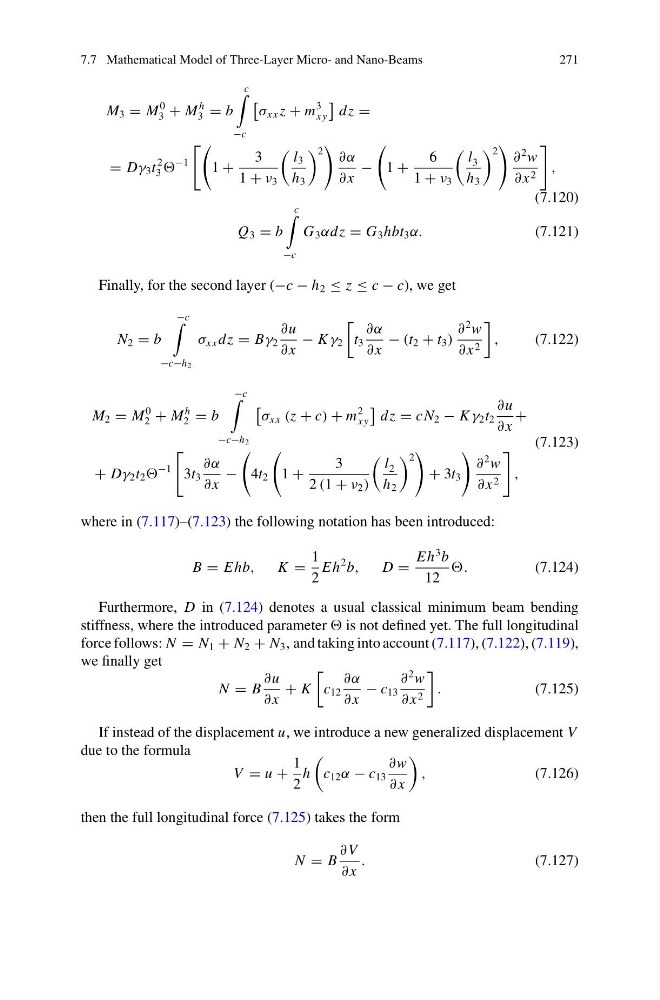
Finally, for the second layer (−c − h 2 ≤ z ≤ c − c), we get
N 2 = b
−c
−c−h 2
σ xx dz = Bγ 2
∂u
∂ x
− K γ 2
t 3
∂α
∂ x
− (t 2 + t 3 )
∂
2 w
∂ x 2
,
(7.122)
M 2 = M
0
2 + M
h
2 = b
−c
−c−h 2
σ xx (z + c) + m
2
xy
dz = cN 2 − K γ 2 t 2
∂u
∂ x
+
+ Dγ 2 t 2
−1
3t 3
∂α
∂ x
−
4t 2
1 +
3
2 (1 + ν 2 )
l 2
h 2
2
+ 3t 3
∂
2 w
∂ x 2
,
(7.123)
where in (7.117)–(7.123) the following notation has been introduced:
B = Ehb,
K =
1
2
Eh
2 b,
D =
Eh
3 b
12
.
(7.124)
Furthermore, D in (7.124) denotes a usual classical minimum beam bending
stiffness, where the introduced parameter is not defined yet. The full longitudinal
force follows: N = N 1 + N 2 + N 3 , and taking into account (7.117), (7.122), (7.119),
we finally get
N = B
∂u
∂ x
+ K
c 12
∂α
∂ x
− c 13
∂
2 w
∂ x 2
.
(7.125)
If instead of the displacement u, we introduce a new generalized displacement V
due to the formula
V = u +
1
2
h
c 12 α − c 13
∂w
∂ x
,
(7.126)
then the full longitudinal force (7.125) takes the form
N = B
∂ V
∂ x
.
(7.127)
271
M 3 = M
0
3 + M
h
3 = b
c
−c
σ xx z + m
3
xy
dz =
= Dγ 3 t
2
3
−1
1 +
3
1 + ν 3
l 3
h 3
2
∂α
∂ x
−
1 +
6
1 + ν 3
l 3
h 3
2
∂
2 w
∂ x 2
,
(7.120)
Q 3 = b
c
−c
G 3 αdz = G 3 hbt 3 α.
(7.121)
Finally, for the second layer (−c − h 2 ≤ z ≤ c − c), we get
N 2 = b
−c
−c−h 2
σ xx dz = Bγ 2
∂u
∂ x
− K γ 2
t 3
∂α
∂ x
− (t 2 + t 3 )
∂
2 w
∂ x 2
,
(7.122)
M 2 = M
0
2 + M
h
2 = b
−c
−c−h 2
σ xx (z + c) + m
2
xy
dz = cN 2 − K γ 2 t 2
∂u
∂ x
+
+ Dγ 2 t 2
−1
3t 3
∂α
∂ x
−
4t 2
1 +
3
2 (1 + ν 2 )
l 2
h 2
2
+ 3t 3
∂
2 w
∂ x 2
,
(7.123)
where in (7.117)–(7.123) the following notation has been introduced:
B = Ehb,
K =
1
2
Eh
2 b,
D =
Eh
3 b
12
.
(7.124)
Furthermore, D in (7.124) denotes a usual classical minimum beam bending
stiffness, where the introduced parameter is not defined yet. The full longitudinal
force follows: N = N 1 + N 2 + N 3 , and taking into account (7.117), (7.122), (7.119),
we finally get
N = B
∂u
∂ x
+ K
c 12
∂α
∂ x
− c 13
∂
2 w
∂ x 2
.
(7.125)
If instead of the displacement u, we introduce a new generalized displacement V
due to the formula
V = u +
1
2
h
c 12 α − c 13
∂w
∂ x
,
(7.126)
then the full longitudinal force (7.125) takes the form
N = B
∂ V
∂ x
.
(7.127)