

7.6 Stability of Curvilinear Euler-Bernoulli Beams in Temperature Fields
257
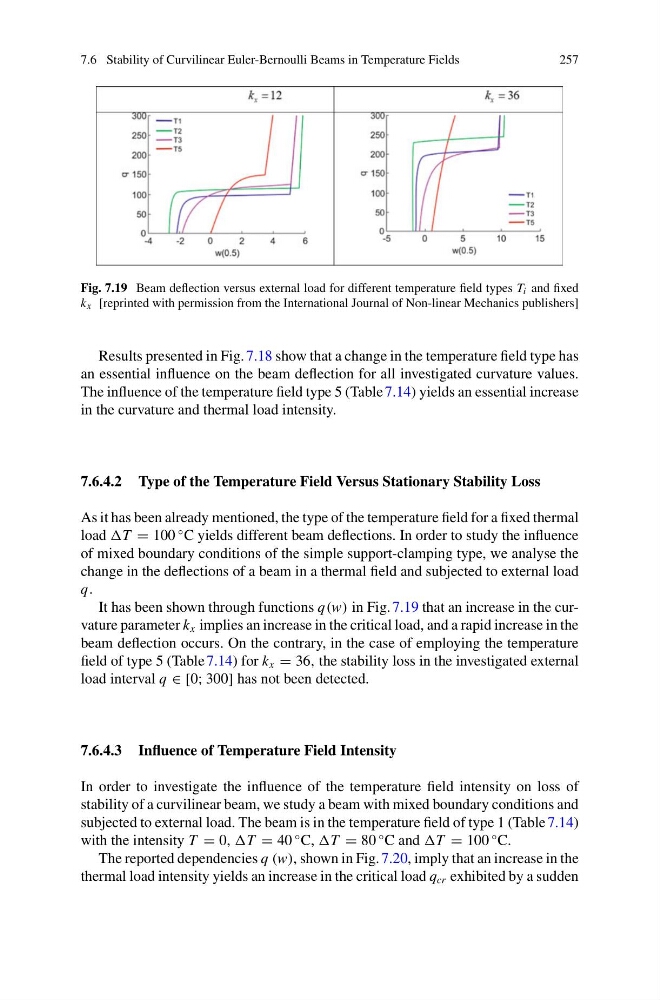
Fig. 7.19 Beam deflection versus external load for different temperature field types T i and fixed
k x [reprinted with permission from the International Journal of Non-linear Mechanics publishers]
Results presented in Fig. 7.18 show that a change in the temperature field type has
an essential influence on the beam deflection for all investigated curvature values.
The influence of the temperature field type 5 (Table 7.14) yields an essential increase
in the curvature and thermal load intensity.
7.6.4.2 Type of the Temperature Field Versus Stationary Stability Loss
As it has been already mentioned, the type of the temperature field for a fixed thermal
load T = 100
◦ C yields different beam deflections. In order to study the influence
of mixed boundary conditions of the simple support-clamping type, we analyse the
change in the deflections of a beam in a thermal field and subjected to external load
q.
It has been shown through functions q(w) in Fig. 7.19 that an increase in the curvature parameter k x implies an increase in the critical load, and a rapid increase in the
beam deflection occurs. On the contrary, in the case of employing the temperature
field of type 5 (Table 7.14) for k x = 36, the stability loss in the investigated external
load interval q ∈ [0; 300] has not been detected.
7.6.4.3 Influence of Temperature Field Intensity
In order to investigate the influence of the temperature field intensity on loss of
stability of a curvilinear beam, we study a beam with mixed boundary conditions and
subjected to external load. The beam is in the temperature field of type 1 (Table 7.14)
with the intensity T = 0, T = 40
◦ C, T = 80
◦ C and T = 100
◦ C.
The reported dependencies q (w), shown in Fig. 7.20, imply that an increase in the
thermal load intensity yields an increase in the critical load q cr exhibited by a sudden
257
Fig. 7.19 Beam deflection versus external load for different temperature field types T i and fixed
k x [reprinted with permission from the International Journal of Non-linear Mechanics publishers]
Results presented in Fig. 7.18 show that a change in the temperature field type has
an essential influence on the beam deflection for all investigated curvature values.
The influence of the temperature field type 5 (Table 7.14) yields an essential increase
in the curvature and thermal load intensity.
7.6.4.2 Type of the Temperature Field Versus Stationary Stability Loss
As it has been already mentioned, the type of the temperature field for a fixed thermal
load T = 100
◦ C yields different beam deflections. In order to study the influence
of mixed boundary conditions of the simple support-clamping type, we analyse the
change in the deflections of a beam in a thermal field and subjected to external load
q.
It has been shown through functions q(w) in Fig. 7.19 that an increase in the curvature parameter k x implies an increase in the critical load, and a rapid increase in the
beam deflection occurs. On the contrary, in the case of employing the temperature
field of type 5 (Table 7.14) for k x = 36, the stability loss in the investigated external
load interval q ∈ [0; 300] has not been detected.
7.6.4.3 Influence of Temperature Field Intensity
In order to investigate the influence of the temperature field intensity on loss of
stability of a curvilinear beam, we study a beam with mixed boundary conditions and
subjected to external load. The beam is in the temperature field of type 1 (Table 7.14)
with the intensity T = 0, T = 40
◦ C, T = 80
◦ C and T = 100
◦ C.
The reported dependencies q (w), shown in Fig. 7.20, imply that an increase in the
thermal load intensity yields an increase in the critical load q cr exhibited by a sudden