

7.6 Stability of Curvilinear Euler-Bernoulli Beams in Temperature Fields
253
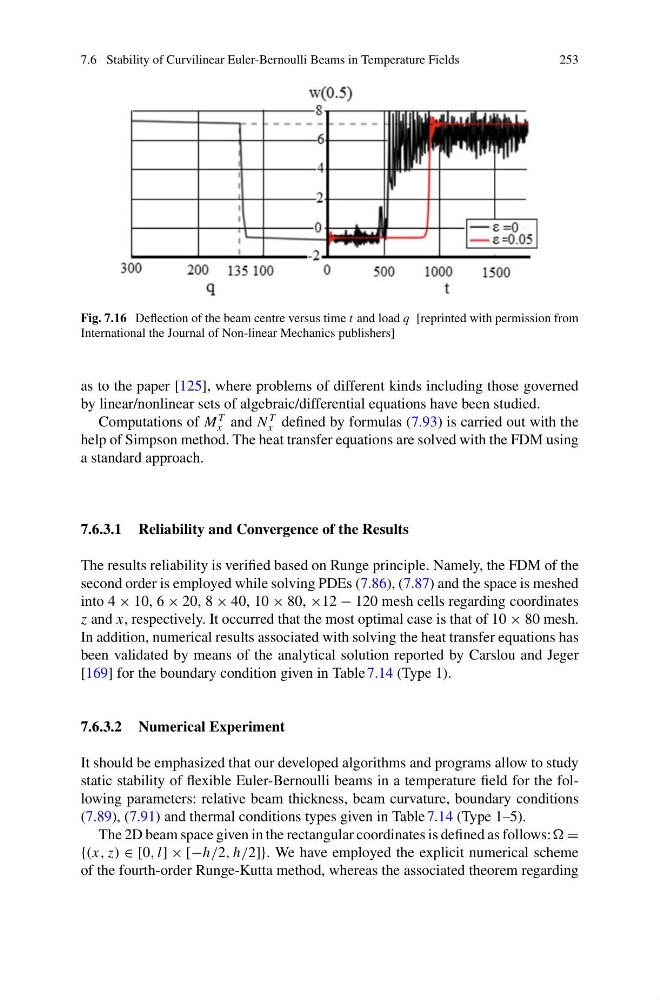
Fig. 7.16 Deflection of the beam centre versus time t and load q [reprinted with permission from
International the Journal of Non-linear Mechanics publishers]
as to the paper [125], where problems of different kinds including those governed
by linear/nonlinear sets of algebraic/differential equations have been studied.
Computations of M
T
x and N
T
x defined by formulas (7.93) is carried out with the
help of Simpson method. The heat transfer equations are solved with the FDM using
a standard approach.
7.6.3.1 Reliability and Convergence of the Results
The results reliability is verified based on Runge principle. Namely, the FDM of the
second order is employed while solving PDEs (7.86), (7.87) and the space is meshed
into 4 × 10, 6 × 20, 8 × 40, 10 × 80, ×12 − 120 mesh cells regarding coordinates
z and x, respectively. It occurred that the most optimal case is that of 10 × 80 mesh.
In addition, numerical results associated with solving the heat transfer equations has
been validated by means of the analytical solution reported by Carslou and Jeger
[169] for the boundary condition given in Table 7.14 (Type 1).
7.6.3.2 Numerical Experiment
It should be emphasized that our developed algorithms and programs allow to study
static stability of flexible Euler-Bernoulli beams in a temperature field for the following parameters: relative beam thickness, beam curvature, boundary conditions
(7.89), (7.91) and thermal conditions types given in Table 7.14 (Type 1–5).
The 2D beam space given in the rectangular coordinates is defined as follows: =
{(x, z) ∈ [0, l] × [−h/2, h/2]}. We have employed the explicit numerical scheme
of the fourth-order Runge-Kutta method, whereas the associated theorem regarding
253
Fig. 7.16 Deflection of the beam centre versus time t and load q [reprinted with permission from
International the Journal of Non-linear Mechanics publishers]
as to the paper [125], where problems of different kinds including those governed
by linear/nonlinear sets of algebraic/differential equations have been studied.
Computations of M
T
x and N
T
x defined by formulas (7.93) is carried out with the
help of Simpson method. The heat transfer equations are solved with the FDM using
a standard approach.
7.6.3.1 Reliability and Convergence of the Results
The results reliability is verified based on Runge principle. Namely, the FDM of the
second order is employed while solving PDEs (7.86), (7.87) and the space is meshed
into 4 × 10, 6 × 20, 8 × 40, 10 × 80, ×12 − 120 mesh cells regarding coordinates
z and x, respectively. It occurred that the most optimal case is that of 10 × 80 mesh.
In addition, numerical results associated with solving the heat transfer equations has
been validated by means of the analytical solution reported by Carslou and Jeger
[169] for the boundary condition given in Table 7.14 (Type 1).
7.6.3.2 Numerical Experiment
It should be emphasized that our developed algorithms and programs allow to study
static stability of flexible Euler-Bernoulli beams in a temperature field for the following parameters: relative beam thickness, beam curvature, boundary conditions
(7.89), (7.91) and thermal conditions types given in Table 7.14 (Type 1–5).
The 2D beam space given in the rectangular coordinates is defined as follows: =
{(x, z) ∈ [0, l] × [−h/2, h/2]}. We have employed the explicit numerical scheme
of the fourth-order Runge-Kutta method, whereas the associated theorem regarding