

230
7 Mathematical Models of Functionally Graded Beams in Temperature Field
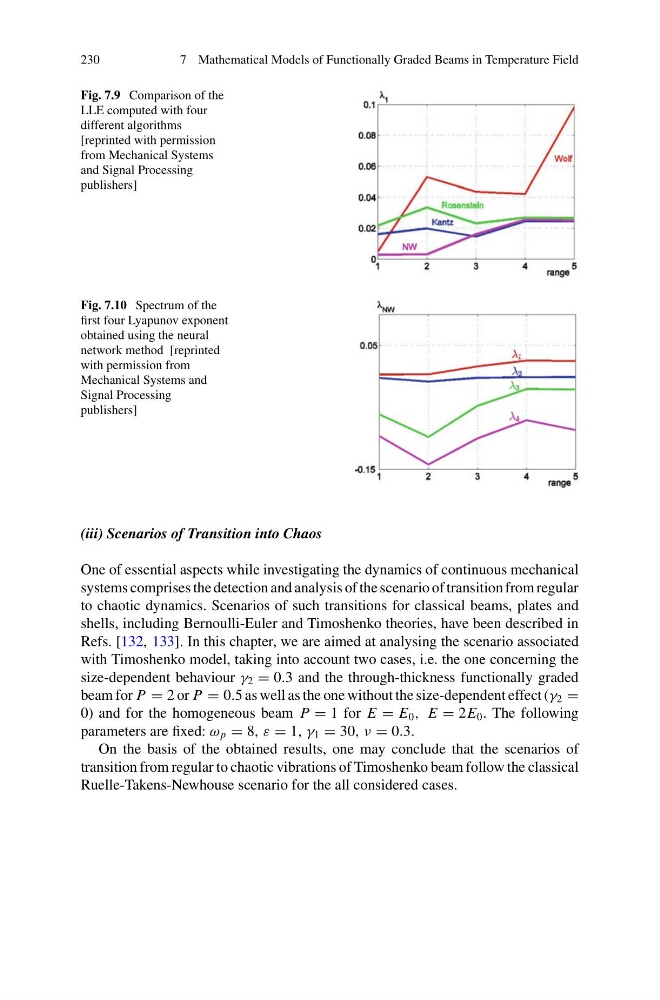
Fig. 7.9 Comparison of the
LLE computed with four
different algorithms
[reprinted with permission
from Mechanical Systems
and Signal Processing
publishers]
Fig. 7.10 Spectrum of the
first four Lyapunov exponent
obtained using the neural
network method [reprinted
with permission from
Mechanical Systems and
Signal Processing
publishers]
(iii) Scenarios of Transition into Chaos
One of essential aspects while investigating the dynamics of continuous mechanical
systems comprises the detection and analysis of the scenario of transition from regular
to chaotic dynamics. Scenarios of such transitions for classical beams, plates and
shells, including Bernoulli-Euler and Timoshenko theories, have been described in
Refs. [132, 133]. In this chapter, we are aimed at analysing the scenario associated
with Timoshenko model, taking into account two cases, i.e. the one concerning the
size-dependent behaviour γ 2 = 0.3 and the through-thickness functionally graded
beam for P = 2 or P = 0.5 as well as the one without the size-dependent effect (γ 2 =
0) and for the homogeneous beam P = 1 for E = E 0 , E = 2E 0 . The following
parameters are fixed: ω p = 8, ε = 1, γ 1 = 30, ν = 0.3.
On the basis of the obtained results, one may conclude that the scenarios of
transition from regular to chaotic vibrations of Timoshenko beam follow the classical
Ruelle-Takens-Newhouse scenario for the all considered cases.
7 Mathematical Models of Functionally Graded Beams in Temperature Field
Fig. 7.9 Comparison of the
LLE computed with four
different algorithms
[reprinted with permission
from Mechanical Systems
and Signal Processing
publishers]
Fig. 7.10 Spectrum of the
first four Lyapunov exponent
obtained using the neural
network method [reprinted
with permission from
Mechanical Systems and
Signal Processing
publishers]
(iii) Scenarios of Transition into Chaos
One of essential aspects while investigating the dynamics of continuous mechanical
systems comprises the detection and analysis of the scenario of transition from regular
to chaotic dynamics. Scenarios of such transitions for classical beams, plates and
shells, including Bernoulli-Euler and Timoshenko theories, have been described in
Refs. [132, 133]. In this chapter, we are aimed at analysing the scenario associated
with Timoshenko model, taking into account two cases, i.e. the one concerning the
size-dependent behaviour γ 2 = 0.3 and the through-thickness functionally graded
beam for P = 2 or P = 0.5 as well as the one without the size-dependent effect (γ 2 =
0) and for the homogeneous beam P = 1 for E = E 0 , E = 2E 0 . The following
parameters are fixed: ω p = 8, ε = 1, γ 1 = 30, ν = 0.3.
On the basis of the obtained results, one may conclude that the scenarios of
transition from regular to chaotic vibrations of Timoshenko beam follow the classical
Ruelle-Takens-Newhouse scenario for the all considered cases.