

6.5 Static Solutions
169
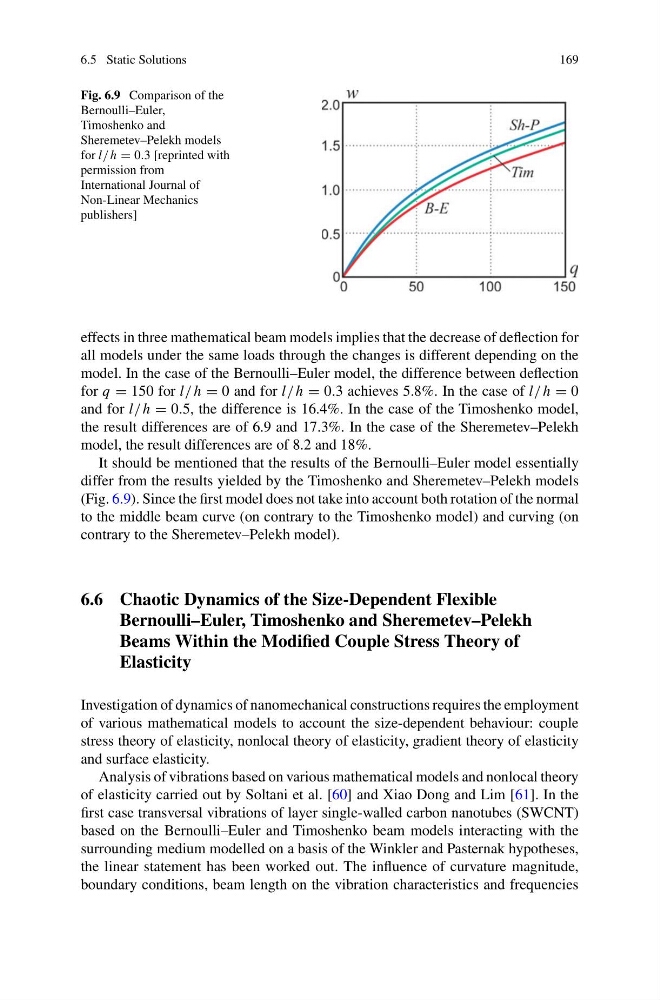
Fig. 6.9 Comparison of the
Bernoulli–Euler,
Timoshenko and
Sheremetev–Pelekh models
for l/ h = 0.3 [reprinted with
permission from
International Journal of
Non-Linear Mechanics
publishers]
effects in three mathematical beam models implies that the decrease of deflection for
all models under the same loads through the changes is different depending on the
model. In the case of the Bernoulli–Euler model, the difference between deflection
for q = 150 for l/ h = 0 and for l/ h = 0.3 achieves 5.8%. In the case of l/ h = 0
and for l/ h = 0.5, the difference is 16.4%. In the case of the Timoshenko model,
the result differences are of 6.9 and 17.3%. In the case of the Sheremetev–Pelekh
model, the result differences are of 8.2 and 18%.
It should be mentioned that the results of the Bernoulli–Euler model essentially
differ from the results yielded by the Timoshenko and Sheremetev–Pelekh models
(Fig. 6.9). Since the first model does not take into account both rotation of the normal
to the middle beam curve (on contrary to the Timoshenko model) and curving (on
contrary to the Sheremetev–Pelekh model).
6.6 Chaotic Dynamics of the Size-Dependent Flexible
Bernoulli–Euler, Timoshenko and Sheremetev–Pelekh
Beams Within the Modified Couple Stress Theory of
Elasticity
Investigation of dynamics of nanomechanical constructions requires the employment
of various mathematical models to account the size-dependent behaviour: couple
stress theory of elasticity, nonlocal theory of elasticity, gradient theory of elasticity
and surface elasticity.
Analysis of vibrations based on various mathematical models and nonlocal theory
of elasticity carried out by Soltani et al. [60] and Xiao Dong and Lim [61]. In the
first case transversal vibrations of layer single-walled carbon nanotubes (SWCNT)
based on the Bernoulli–Euler and Timoshenko beam models interacting with the
surrounding medium modelled on a basis of the Winkler and Pasternak hypotheses,
the linear statement has been worked out. The influence of curvature magnitude,
boundary conditions, beam length on the vibration characteristics and frequencies
169
Fig. 6.9 Comparison of the
Bernoulli–Euler,
Timoshenko and
Sheremetev–Pelekh models
for l/ h = 0.3 [reprinted with
permission from
International Journal of
Non-Linear Mechanics
publishers]
effects in three mathematical beam models implies that the decrease of deflection for
all models under the same loads through the changes is different depending on the
model. In the case of the Bernoulli–Euler model, the difference between deflection
for q = 150 for l/ h = 0 and for l/ h = 0.3 achieves 5.8%. In the case of l/ h = 0
and for l/ h = 0.5, the difference is 16.4%. In the case of the Timoshenko model,
the result differences are of 6.9 and 17.3%. In the case of the Sheremetev–Pelekh
model, the result differences are of 8.2 and 18%.
It should be mentioned that the results of the Bernoulli–Euler model essentially
differ from the results yielded by the Timoshenko and Sheremetev–Pelekh models
(Fig. 6.9). Since the first model does not take into account both rotation of the normal
to the middle beam curve (on contrary to the Timoshenko model) and curving (on
contrary to the Sheremetev–Pelekh model).
6.6 Chaotic Dynamics of the Size-Dependent Flexible
Bernoulli–Euler, Timoshenko and Sheremetev–Pelekh
Beams Within the Modified Couple Stress Theory of
Elasticity
Investigation of dynamics of nanomechanical constructions requires the employment
of various mathematical models to account the size-dependent behaviour: couple
stress theory of elasticity, nonlocal theory of elasticity, gradient theory of elasticity
and surface elasticity.
Analysis of vibrations based on various mathematical models and nonlocal theory
of elasticity carried out by Soltani et al. [60] and Xiao Dong and Lim [61]. In the
first case transversal vibrations of layer single-walled carbon nanotubes (SWCNT)
based on the Bernoulli–Euler and Timoshenko beam models interacting with the
surrounding medium modelled on a basis of the Winkler and Pasternak hypotheses,
the linear statement has been worked out. The influence of curvature magnitude,
boundary conditions, beam length on the vibration characteristics and frequencies