

6.4 Technical Theory for the Different Models
153
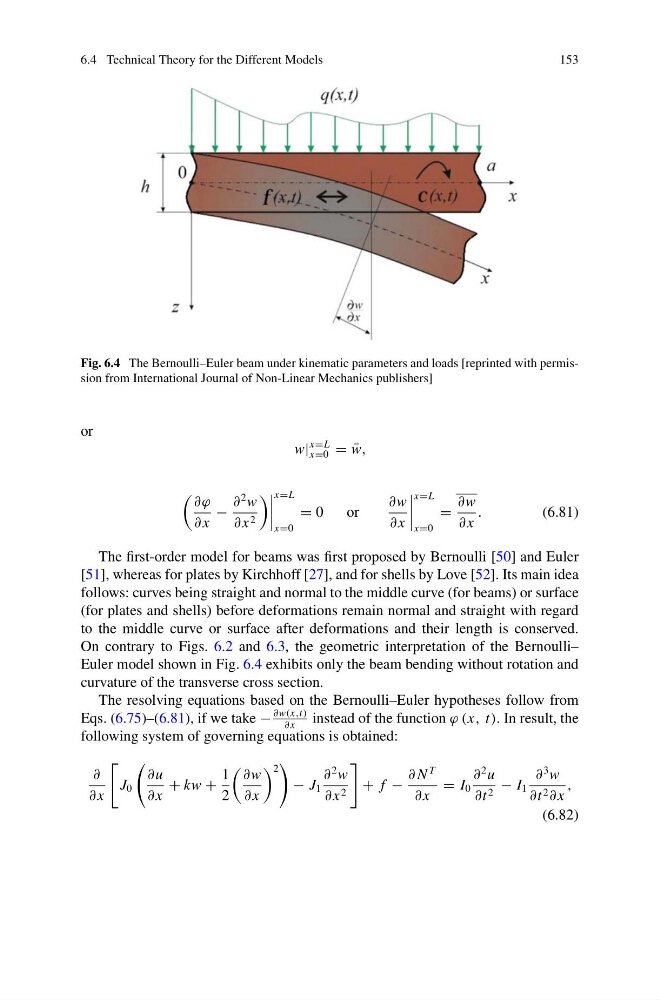
Fig. 6.4 The Bernoulli–Euler beam under kinematic parameters and loads [reprinted with permission from International Journal of Non-Linear Mechanics publishers]
or
w|
x=L
x=0 = ¯
w,
∂ϕ
∂ x
−
∂
2 w
∂ x 2
x=L
x=0
= 0
or
∂w
∂ x
x=L
x=0
=
____
∂w
∂ x
.
(6.81)
The first-order model for beams was first proposed by Bernoulli [50] and Euler
[51], whereas for plates by Kirchhoff [27], and for shells by Love [52]. Its main idea
follows: curves being straight and normal to the middle curve (for beams) or surface
(for plates and shells) before deformations remain normal and straight with regard
to the middle curve or surface after deformations and their length is conserved.
On contrary to Figs. 6.2 and 6.3, the geometric interpretation of the Bernoulli–
Euler model shown in Fig. 6.4 exhibits only the beam bending without rotation and
curvature of the transverse cross section.
The resolving equations based on the Bernoulli–Euler hypotheses follow from
Eqs. (6.75)–(6.81), if we take −
∂w(x,t)
∂ x
instead of the function ϕ (x, t). In result, the
following system of governing equations is obtained:
∂
∂ x
J 0
∂u
∂ x
+ kw +
1
2
∂w
∂ x
2
− J 1
∂
2 w
∂ x 2
+ f −
∂ N
T
∂ x
= I 0
∂
2 u
∂t 2 − I 1
∂
3 w
∂t 2 ∂ x
,
(6.82)
153
Fig. 6.4 The Bernoulli–Euler beam under kinematic parameters and loads [reprinted with permission from International Journal of Non-Linear Mechanics publishers]
or
w|
x=L
x=0 = ¯
w,
∂ϕ
∂ x
−
∂
2 w
∂ x 2
x=L
x=0
= 0
or
∂w
∂ x
x=L
x=0
=
____
∂w
∂ x
.
(6.81)
The first-order model for beams was first proposed by Bernoulli [50] and Euler
[51], whereas for plates by Kirchhoff [27], and for shells by Love [52]. Its main idea
follows: curves being straight and normal to the middle curve (for beams) or surface
(for plates and shells) before deformations remain normal and straight with regard
to the middle curve or surface after deformations and their length is conserved.
On contrary to Figs. 6.2 and 6.3, the geometric interpretation of the Bernoulli–
Euler model shown in Fig. 6.4 exhibits only the beam bending without rotation and
curvature of the transverse cross section.
The resolving equations based on the Bernoulli–Euler hypotheses follow from
Eqs. (6.75)–(6.81), if we take −
∂w(x,t)
∂ x
instead of the function ϕ (x, t). In result, the
following system of governing equations is obtained:
∂
∂ x
J 0
∂u
∂ x
+ kw +
1
2
∂w
∂ x
2
− J 1
∂
2 w
∂ x 2
+ f −
∂ N
T
∂ x
= I 0
∂
2 u
∂t 2 − I 1
∂
3 w
∂t 2 ∂ x
,
(6.82)