

4.5 Numerical Experiment
107
0.06
0.04
0.02
0 50
100
150
n
LLE
Wolf
Rosenstein
Kantz
0.06
0.04
0.02
0 50
100
150
n
LLE
Wolf
Rosenstein
Kantz
0.08
a) Beam 1
b) Beam 2
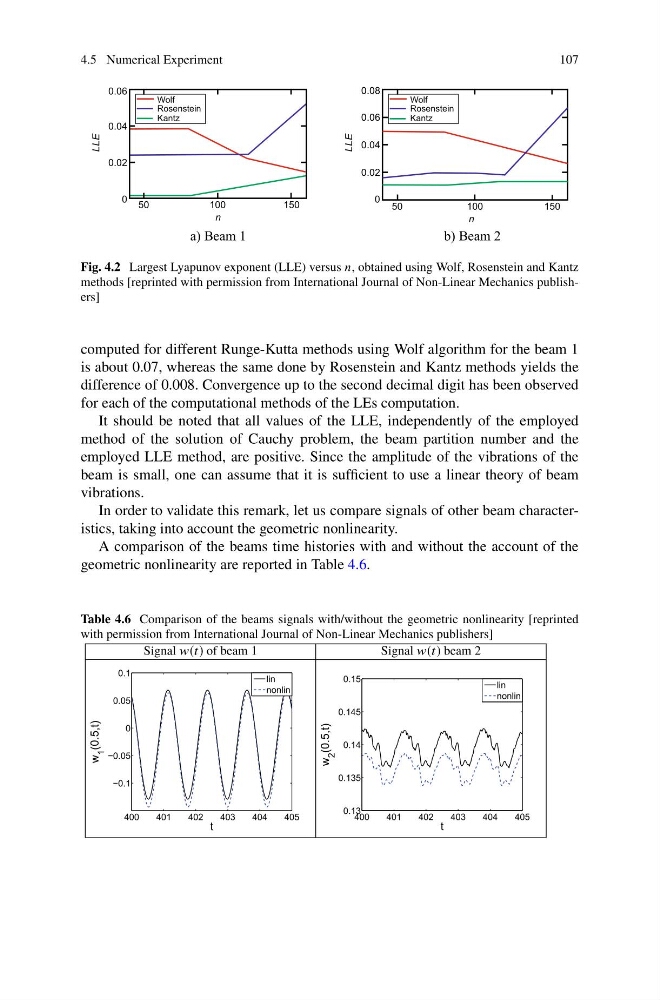
Fig. 4.2 Largest Lyapunov exponent (LLE) versus n, obtained using Wolf, Rosenstein and Kantz
methods [reprinted with permission from International Journal of Non-Linear Mechanics publishers]
computed for different Runge-Kutta methods using Wolf algorithm for the beam 1
is about 0.07, whereas the same done by Rosenstein and Kantz methods yields the
difference of 0.008. Convergence up to the second decimal digit has been observed
for each of the computational methods of the LEs computation.
It should be noted that all values of the LLE, independently of the employed
method of the solution of Cauchy problem, the beam partition number and the
employed LLE method, are positive. Since the amplitude of the vibrations of the
beam is small, one can assume that it is sufficient to use a linear theory of beam
vibrations.
In order to validate this remark, let us compare signals of other beam characteristics, taking into account the geometric nonlinearity.
A comparison of the beams time histories with and without the account of the
geometric nonlinearity are reported in Table 4.6.
Table 4.6 Comparison of the beams signals with/without the geometric nonlinearity [reprinted
with permission from International Journal of Non-Linear Mechanics publishers]
107
0.06
0.04
0.02
0 50
100
150
n
LLE
Wolf
Rosenstein
Kantz
0.06
0.04
0.02
0 50
100
150
n
LLE
Wolf
Rosenstein
Kantz
0.08
a) Beam 1
b) Beam 2
Fig. 4.2 Largest Lyapunov exponent (LLE) versus n, obtained using Wolf, Rosenstein and Kantz
methods [reprinted with permission from International Journal of Non-Linear Mechanics publishers]
computed for different Runge-Kutta methods using Wolf algorithm for the beam 1
is about 0.07, whereas the same done by Rosenstein and Kantz methods yields the
difference of 0.008. Convergence up to the second decimal digit has been observed
for each of the computational methods of the LEs computation.
It should be noted that all values of the LLE, independently of the employed
method of the solution of Cauchy problem, the beam partition number and the
employed LLE method, are positive. Since the amplitude of the vibrations of the
beam is small, one can assume that it is sufficient to use a linear theory of beam
vibrations.
In order to validate this remark, let us compare signals of other beam characteristics, taking into account the geometric nonlinearity.
A comparison of the beams time histories with and without the account of the
geometric nonlinearity are reported in Table 4.6.
Table 4.6 Comparison of the beams signals with/without the geometric nonlinearity [reprinted
with permission from International Journal of Non-Linear Mechanics publishers]