

Feasibility of Joining Aluminum to Nylon Using Friction …
53
a
b
c
d
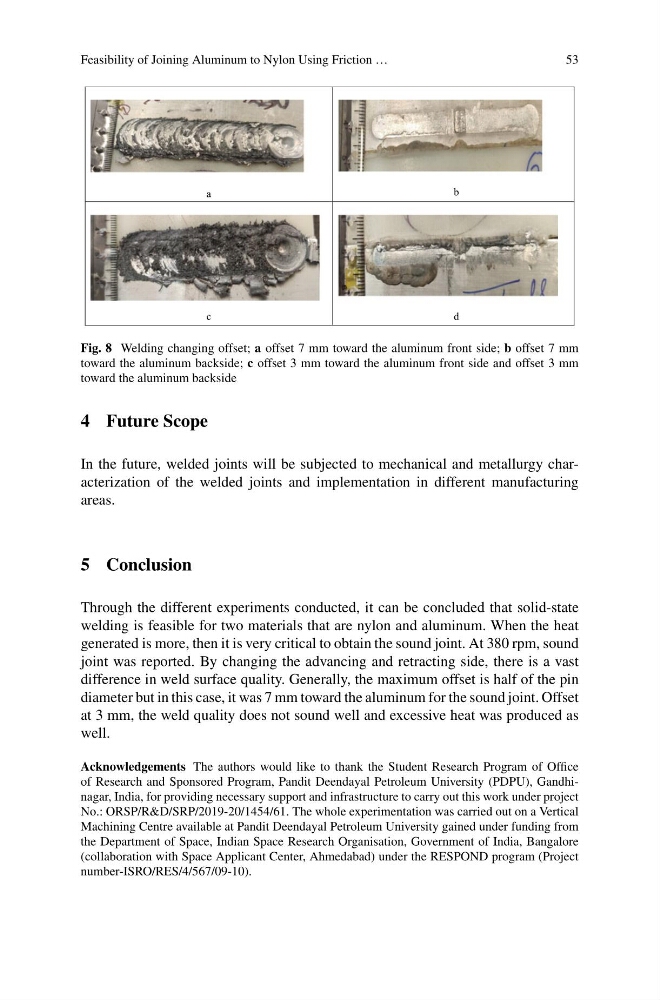
Fig. 8 Welding changing offset; a offset 7 mm toward the aluminum front side; b offset 7 mm
toward the aluminum backside; c offset 3 mm toward the aluminum front side and offset 3 mm
toward the aluminum backside
4 Future Scope
In the future, welded joints will be subjected to mechanical and metallurgy characterization of the welded joints and implementation in different manufacturing
areas.
5 Conclusion
Through the different experiments conducted, it can be concluded that solid-state
welding is feasible for two materials that are nylon and aluminum. When the heat
generated is more, then it is very critical to obtain the sound joint. At 380 rpm, sound
joint was reported. By changing the advancing and retracting side, there is a vast
difference in weld surface quality. Generally, the maximum offset is half of the pin
diameter but in this case, it was 7 mm toward the aluminum for the sound joint. Offset
at 3 mm, the weld quality does not sound well and excessive heat was produced as
well.
Acknowledgements The authors would like to thank the Student Research Program of Office
of Research and Sponsored Program, Pandit Deendayal Petroleum University (PDPU), Gandhinagar, India, for providing necessary support and infrastructure to carry out this work under project
No.: ORSP/R&D/SRP/2019-20/1454/61. The whole experimentation was carried out on a Vertical
Machining Centre available at Pandit Deendayal Petroleum University gained under funding from
the Department of Space, Indian Space Research Organisation, Government of India, Bangalore
(collaboration with Space Applicant Center, Ahmedabad) under the RESPOND program (Project
number-ISRO/RES/4/567/09-10).
53
a
b
c
d
Fig. 8 Welding changing offset; a offset 7 mm toward the aluminum front side; b offset 7 mm
toward the aluminum backside; c offset 3 mm toward the aluminum front side and offset 3 mm
toward the aluminum backside
4 Future Scope
In the future, welded joints will be subjected to mechanical and metallurgy characterization of the welded joints and implementation in different manufacturing
areas.
5 Conclusion
Through the different experiments conducted, it can be concluded that solid-state
welding is feasible for two materials that are nylon and aluminum. When the heat
generated is more, then it is very critical to obtain the sound joint. At 380 rpm, sound
joint was reported. By changing the advancing and retracting side, there is a vast
difference in weld surface quality. Generally, the maximum offset is half of the pin
diameter but in this case, it was 7 mm toward the aluminum for the sound joint. Offset
at 3 mm, the weld quality does not sound well and excessive heat was produced as
well.
Acknowledgements The authors would like to thank the Student Research Program of Office
of Research and Sponsored Program, Pandit Deendayal Petroleum University (PDPU), Gandhinagar, India, for providing necessary support and infrastructure to carry out this work under project
No.: ORSP/R&D/SRP/2019-20/1454/61. The whole experimentation was carried out on a Vertical
Machining Centre available at Pandit Deendayal Petroleum University gained under funding from
the Department of Space, Indian Space Research Organisation, Government of India, Bangalore
(collaboration with Space Applicant Center, Ahmedabad) under the RESPOND program (Project
number-ISRO/RES/4/567/09-10).