

Design and Analysis of Circular and Square Arm …
463
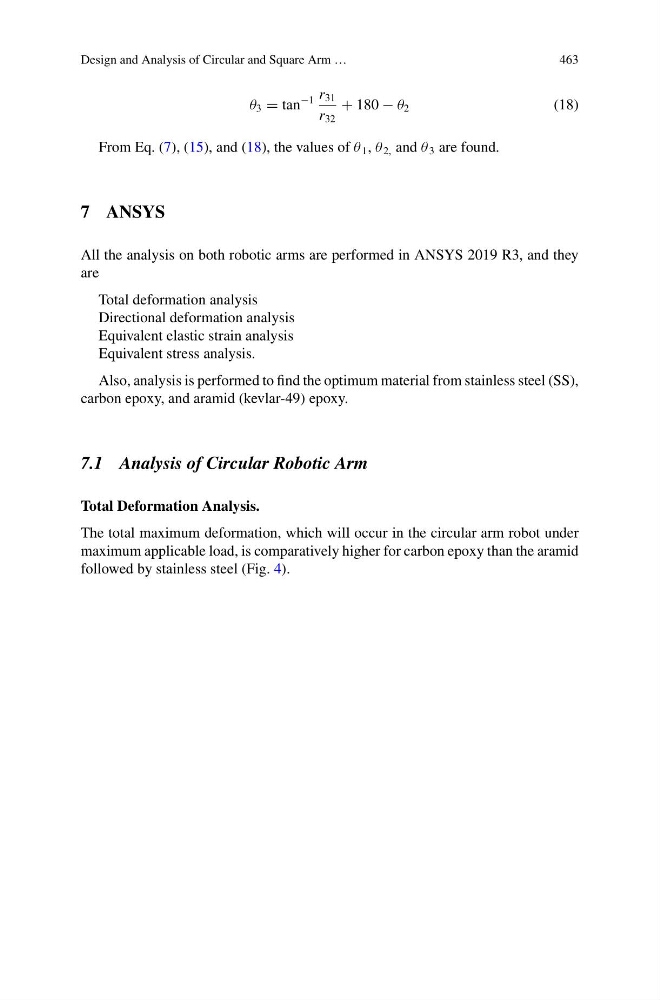
θ 3 = tan
−1 r 31
r 32
+ 180 − θ 2
(18)
From Eq. (7), (15), and (18), the values of θ 1 , θ 2, and θ 3 are found.
7 ANSYS
All the analysis on both robotic arms are performed in ANSYS 2019 R3, and they
are
Total deformation analysis
Directional deformation analysis
Equivalent elastic strain analysis
Equivalent stress analysis.
Also, analysis is performed to find the optimum material from stainless steel (SS),
carbon epoxy, and aramid (kevlar-49) epoxy.
7.1 Analysis of Circular Robotic Arm
Total Deformation Analysis.
The total maximum deformation, which will occur in the circular arm robot under
maximum applicable load, is comparatively higher for carbon epoxy than the aramid
followed by stainless steel (Fig. 4).
463
θ 3 = tan
−1 r 31
r 32
+ 180 − θ 2
(18)
From Eq. (7), (15), and (18), the values of θ 1 , θ 2, and θ 3 are found.
7 ANSYS
All the analysis on both robotic arms are performed in ANSYS 2019 R3, and they
are
Total deformation analysis
Directional deformation analysis
Equivalent elastic strain analysis
Equivalent stress analysis.
Also, analysis is performed to find the optimum material from stainless steel (SS),
carbon epoxy, and aramid (kevlar-49) epoxy.
7.1 Analysis of Circular Robotic Arm
Total Deformation Analysis.
The total maximum deformation, which will occur in the circular arm robot under
maximum applicable load, is comparatively higher for carbon epoxy than the aramid
followed by stainless steel (Fig. 4).