

Effect of Optimized Slip and Texture Zone …
441
(a) Dimensionless lubricant pressure
(b) Dimensionless load carrying capacity
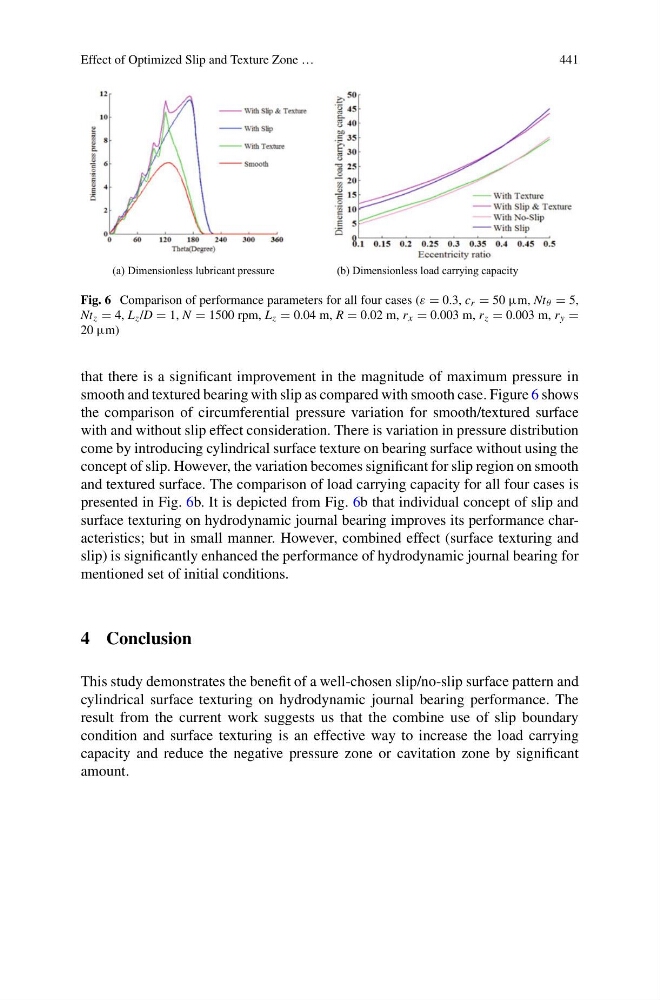
Fig. 6 Comparison of performance parameters for all four cases (ε = 0.3, c r = 50 µm, Nt θ = 5,
Nt z = 4, L z /D = 1, N = 1500 rpm, L z = 0.04 m, R = 0.02 m, r x = 0.003 m, r z = 0.003 m, r y =
20 µm)
that there is a significant improvement in the magnitude of maximum pressure in
smooth and textured bearing with slip as compared with smooth case. Figure 6 shows
the comparison of circumferential pressure variation for smooth/textured surface
with and without slip effect consideration. There is variation in pressure distribution
come by introducing cylindrical surface texture on bearing surface without using the
concept of slip. However, the variation becomes significant for slip region on smooth
and textured surface. The comparison of load carrying capacity for all four cases is
presented in Fig. 6b. It is depicted from Fig. 6b that individual concept of slip and
surface texturing on hydrodynamic journal bearing improves its performance characteristics; but in small manner. However, combined effect (surface texturing and
slip) is significantly enhanced the performance of hydrodynamic journal bearing for
mentioned set of initial conditions.
4 Conclusion
This study demonstrates the benefit of a well-chosen slip/no-slip surface pattern and
cylindrical surface texturing on hydrodynamic journal bearing performance. The
result from the current work suggests us that the combine use of slip boundary
condition and surface texturing is an effective way to increase the load carrying
capacity and reduce the negative pressure zone or cavitation zone by significant
amount.
441
(a) Dimensionless lubricant pressure
(b) Dimensionless load carrying capacity
Fig. 6 Comparison of performance parameters for all four cases (ε = 0.3, c r = 50 µm, Nt θ = 5,
Nt z = 4, L z /D = 1, N = 1500 rpm, L z = 0.04 m, R = 0.02 m, r x = 0.003 m, r z = 0.003 m, r y =
20 µm)
that there is a significant improvement in the magnitude of maximum pressure in
smooth and textured bearing with slip as compared with smooth case. Figure 6 shows
the comparison of circumferential pressure variation for smooth/textured surface
with and without slip effect consideration. There is variation in pressure distribution
come by introducing cylindrical surface texture on bearing surface without using the
concept of slip. However, the variation becomes significant for slip region on smooth
and textured surface. The comparison of load carrying capacity for all four cases is
presented in Fig. 6b. It is depicted from Fig. 6b that individual concept of slip and
surface texturing on hydrodynamic journal bearing improves its performance characteristics; but in small manner. However, combined effect (surface texturing and
slip) is significantly enhanced the performance of hydrodynamic journal bearing for
mentioned set of initial conditions.
4 Conclusion
This study demonstrates the benefit of a well-chosen slip/no-slip surface pattern and
cylindrical surface texturing on hydrodynamic journal bearing performance. The
result from the current work suggests us that the combine use of slip boundary
condition and surface texturing is an effective way to increase the load carrying
capacity and reduce the negative pressure zone or cavitation zone by significant
amount.