

30
D. Shah and V. J. Badheka
Table 1
(continued)
S. No. Type
Process
Description
7
FSAM Type 2
Theoretical review
In this article, the potential for FSAM in fabricating
high-performance lightweight alloys. The microstructure and
strength analysis of Mg-4Y-3Nd and AA5083 are illustrated
here. The hardness of the structure built through FSAM of
Mg-based alloy was 120 HV, significantly higher than 97 HV of
the base metal, and the same for Al-based alloy having base
hardness of 88 HV was found out to be 104 HV. This review
bolsters the fact that structurally stronger components can be
fabricated through FSAM. The possible future trends in this
technique are also predicted in this paper [77]
8
FSAM Type 1 and 2
Experimental paper on repairing of Al 7075 through
FSAM
This article explores the possibility of FSAM for repairing of
materials. Repairing of damaged structures is of great interest to
the aerospace and defence sectors. Holes and grooves were
made in 7075 Al alloy. The holes were filled through Type 2
FSAM, and the grooves were filled with Type 1 FSAM with a
similar filler material. There was sufficient mixing between the
deposited material and the sidewalls, but the repair quality at the
lower portions was not at par in both the cases. Although this
technique shows promising results, much work has to be done
such as finding optimized parameters to avoid defects and lack
of mixing at the lower portions. A more mature technique like
Refill Friction Stir Spot Welding, friction taper plug welding and
filling friction stir welding should be used as they produce a
much higher weld quality [92–94]. This article also bolsters the
possibility of Friction deposition techniques having a vast effect
on repair applications on a large scale due to its good scalability
[95]
(continued)
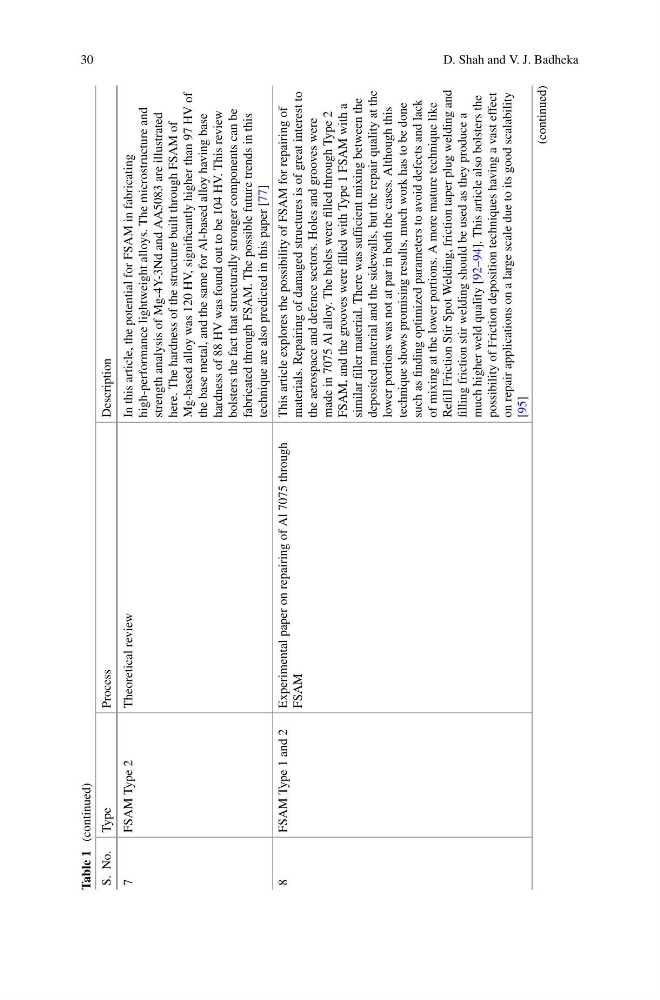
D. Shah and V. J. Badheka
Table 1
(continued)
S. No. Type
Process
Description
7
FSAM Type 2
Theoretical review
In this article, the potential for FSAM in fabricating
high-performance lightweight alloys. The microstructure and
strength analysis of Mg-4Y-3Nd and AA5083 are illustrated
here. The hardness of the structure built through FSAM of
Mg-based alloy was 120 HV, significantly higher than 97 HV of
the base metal, and the same for Al-based alloy having base
hardness of 88 HV was found out to be 104 HV. This review
bolsters the fact that structurally stronger components can be
fabricated through FSAM. The possible future trends in this
technique are also predicted in this paper [77]
8
FSAM Type 1 and 2
Experimental paper on repairing of Al 7075 through
FSAM
This article explores the possibility of FSAM for repairing of
materials. Repairing of damaged structures is of great interest to
the aerospace and defence sectors. Holes and grooves were
made in 7075 Al alloy. The holes were filled through Type 2
FSAM, and the grooves were filled with Type 1 FSAM with a
similar filler material. There was sufficient mixing between the
deposited material and the sidewalls, but the repair quality at the
lower portions was not at par in both the cases. Although this
technique shows promising results, much work has to be done
such as finding optimized parameters to avoid defects and lack
of mixing at the lower portions. A more mature technique like
Refill Friction Stir Spot Welding, friction taper plug welding and
filling friction stir welding should be used as they produce a
much higher weld quality [92–94]. This article also bolsters the
possibility of Friction deposition techniques having a vast effect
on repair applications on a large scale due to its good scalability
[95]
(continued)