

404
K. Gawhade et al.
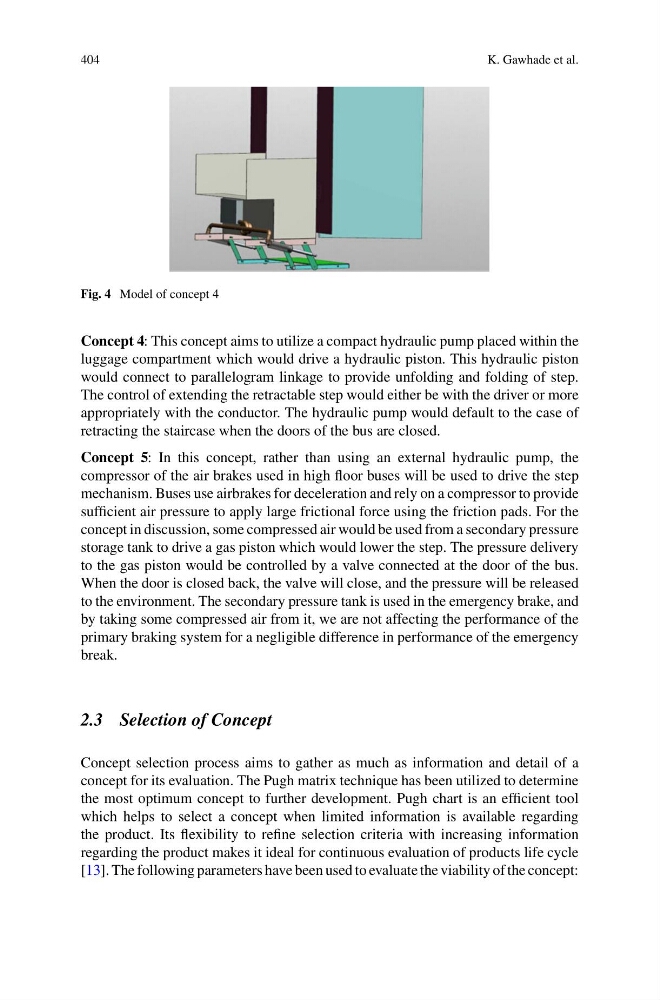
Fig. 4 Model of concept 4
Concept 4: This concept aims to utilize a compact hydraulic pump placed within the
luggage compartment which would drive a hydraulic piston. This hydraulic piston
would connect to parallelogram linkage to provide unfolding and folding of step.
The control of extending the retractable step would either be with the driver or more
appropriately with the conductor. The hydraulic pump would default to the case of
retracting the staircase when the doors of the bus are closed.
Concept 5: In this concept, rather than using an external hydraulic pump, the
compressor of the air brakes used in high floor buses will be used to drive the step
mechanism. Buses use airbrakes for deceleration and rely on a compressor to provide
sufficient air pressure to apply large frictional force using the friction pads. For the
concept in discussion, some compressed air would be used from a secondary pressure
storage tank to drive a gas piston which would lower the step. The pressure delivery
to the gas piston would be controlled by a valve connected at the door of the bus.
When the door is closed back, the valve will close, and the pressure will be released
to the environment. The secondary pressure tank is used in the emergency brake, and
by taking some compressed air from it, we are not affecting the performance of the
primary braking system for a negligible difference in performance of the emergency
break.
2.3 Selection of Concept
Concept selection process aims to gather as much as information and detail of a
concept for its evaluation. The Pugh matrix technique has been utilized to determine
the most optimum concept to further development. Pugh chart is an efficient tool
which helps to select a concept when limited information is available regarding
the product. Its flexibility to refine selection criteria with increasing information
regarding the product makes it ideal for continuous evaluation of products life cycle
[13]. The following parameters have been used to evaluate the viability of the concept:
K. Gawhade et al.
Fig. 4 Model of concept 4
Concept 4: This concept aims to utilize a compact hydraulic pump placed within the
luggage compartment which would drive a hydraulic piston. This hydraulic piston
would connect to parallelogram linkage to provide unfolding and folding of step.
The control of extending the retractable step would either be with the driver or more
appropriately with the conductor. The hydraulic pump would default to the case of
retracting the staircase when the doors of the bus are closed.
Concept 5: In this concept, rather than using an external hydraulic pump, the
compressor of the air brakes used in high floor buses will be used to drive the step
mechanism. Buses use airbrakes for deceleration and rely on a compressor to provide
sufficient air pressure to apply large frictional force using the friction pads. For the
concept in discussion, some compressed air would be used from a secondary pressure
storage tank to drive a gas piston which would lower the step. The pressure delivery
to the gas piston would be controlled by a valve connected at the door of the bus.
When the door is closed back, the valve will close, and the pressure will be released
to the environment. The secondary pressure tank is used in the emergency brake, and
by taking some compressed air from it, we are not affecting the performance of the
primary braking system for a negligible difference in performance of the emergency
break.
2.3 Selection of Concept
Concept selection process aims to gather as much as information and detail of a
concept for its evaluation. The Pugh matrix technique has been utilized to determine
the most optimum concept to further development. Pugh chart is an efficient tool
which helps to select a concept when limited information is available regarding
the product. Its flexibility to refine selection criteria with increasing information
regarding the product makes it ideal for continuous evaluation of products life cycle
[13]. The following parameters have been used to evaluate the viability of the concept: