

402
K. Gawhade et al.
2.1 Identification of Opportunity
Accessibility to high floor bus in a country like India seem no to get any better any
time soon. This type of market demands a low-cost solution to resolve this problem.
Any system developed will be required to be compatible with current running fleet
of buses with minimal changes to the vehicle, and its operation should not require
any professional training.
Available products in the market satisfy all conditions except the cost factor. A
product consisting fully mechanical component must be able to provide accessibility
within the budget. With this insight, we have realized that if our product is to be profitable and disruptive, it must be cheap while also being able to seamlessly integrate
as a retrofit in existing buses while following standard norms.
2.2 Concept Generation
By studying journals, government norms, and customer needs, concepts were generated through brainstorming the problem which resulted in five possible solution of
the problem. The concepts were modeled using Unigraphics NX 12, a PLM software. Designs are based on the standard high floor bus dimension defined by Indian
government.
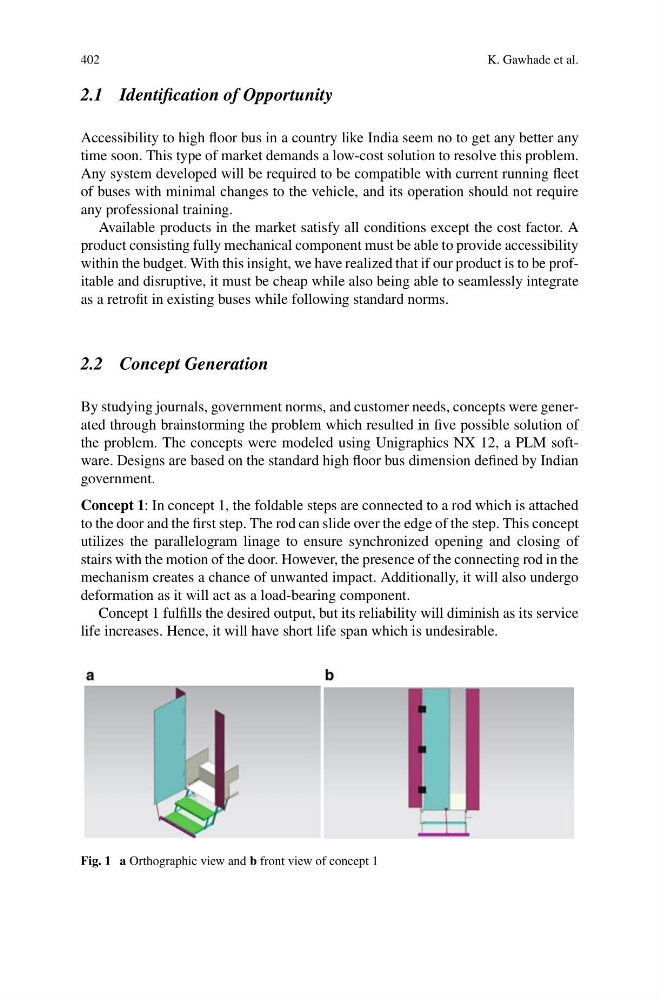
Concept 1: In concept 1, the foldable steps are connected to a rod which is attached
to the door and the first step. The rod can slide over the edge of the step. This concept
utilizes the parallelogram linage to ensure synchronized opening and closing of
stairs with the motion of the door. However, the presence of the connecting rod in the
mechanism creates a chance of unwanted impact. Additionally, it will also undergo
deformation as it will act as a load-bearing component.
Concept 1 fulfills the desired output, but its reliability will diminish as its service
life increases. Hence, it will have short life span which is undesirable.
Fig. 1 a Orthographic view and b front view of concept 1
K. Gawhade et al.
2.1 Identification of Opportunity
Accessibility to high floor bus in a country like India seem no to get any better any
time soon. This type of market demands a low-cost solution to resolve this problem.
Any system developed will be required to be compatible with current running fleet
of buses with minimal changes to the vehicle, and its operation should not require
any professional training.
Available products in the market satisfy all conditions except the cost factor. A
product consisting fully mechanical component must be able to provide accessibility
within the budget. With this insight, we have realized that if our product is to be profitable and disruptive, it must be cheap while also being able to seamlessly integrate
as a retrofit in existing buses while following standard norms.
2.2 Concept Generation
By studying journals, government norms, and customer needs, concepts were generated through brainstorming the problem which resulted in five possible solution of
the problem. The concepts were modeled using Unigraphics NX 12, a PLM software. Designs are based on the standard high floor bus dimension defined by Indian
government.
Concept 1: In concept 1, the foldable steps are connected to a rod which is attached
to the door and the first step. The rod can slide over the edge of the step. This concept
utilizes the parallelogram linage to ensure synchronized opening and closing of
stairs with the motion of the door. However, the presence of the connecting rod in the
mechanism creates a chance of unwanted impact. Additionally, it will also undergo
deformation as it will act as a load-bearing component.
Concept 1 fulfills the desired output, but its reliability will diminish as its service
life increases. Hence, it will have short life span which is undesirable.
Fig. 1 a Orthographic view and b front view of concept 1